

Modular Chiller Market Analysis (2019–2027)
Modular Chiller Market Overview
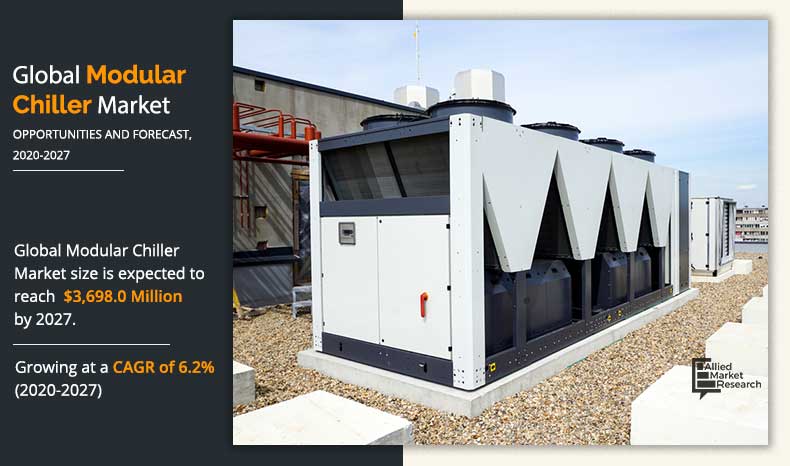
The global modular chiller market is set to grow from $2,667.1 million in 2019 to $3,698.0 million by 2027, with a CAGR of 6.2%. Modular chillers, key components of HVAC systems, provide efficient cooling and heating for residential, commercial, and industrial settings. Their robust design, energy efficiency, and capacity control make them ideal for diverse applications. The market is propelled by global construction growth, government infrastructure spending, and rising disposable incomes, particularly in emerging economies. Despite challenges like high costs and raw material price volatility, opportunities in energy-efficient solutions and urbanization drive market expansion.
𝐃𝐨𝐰𝐧𝐥𝐨𝐚𝐝 𝐏𝐃𝐅 𝐒𝐚𝐦𝐩𝐥𝐞 𝐂𝐨𝐩𝐲@ https://www.alliedmarketresearch.com/request-sample/A09422
Modular Chiller Market Dynamics
Drivers
- Rising Construction and Infrastructure Investments: Increased global construction activities, particularly in infrastructure, significantly boost the modular chiller market. Governments are investing heavily in transport and public infrastructure, requiring efficient HVAC systems. For example, the Australian government allocated $110 billion for transport infrastructure by 2030, necessitating modular chillers for climate control in buildings and facilities. Similarly, Germany’s $603.4 million investment in October 2020 to upgrade HVAC systems in public buildings highlights the demand for energy-efficient chillers.
- Urbanization and Disposable Income Growth: Rapid industrialization and urbanization in countries like China, India, Vietnam, and Indonesia fuel demand for modular chillers. The rise in disposable income, such as a 7% increase in the U.S. from 2017 to 2019, enables greater investment in commercial and residential infrastructure, boosting chiller adoption. India’s National Smart Cities Mission, aiming to develop 100 smart cities by 2025, further drives demand for advanced HVAC solutions.
- End-User Industry Demand: Modular chillers are critical in industries like food and beverage, medical, and mining, where precise temperature control is essential. China’s aviation sector, for instance, saw significant growth with 27 new airports built between 2014 and 2017, increasing the need for chillers to maintain comfortable environments in terminals and facilities.
Challenges
- High Installation and Maintenance Costs: The setup, installation, and maintenance of modular chillers are expensive, limiting adoption in cost-sensitive markets. These costs include specialized equipment and ongoing servicing, which can deter smaller-scale projects.
- Raw Material Price Volatility: Fluctuations in the prices of raw materials used in chiller manufacturing, such as metals and refrigerants, pose a challenge to market growth, affecting production costs and pricing strategies.
- Regulatory Compliance: Modular chillers must adhere to stringent environmental standards, such as ISO regulations, which increase design and production complexity, potentially hindering market expansion.
Opportunities
- Energy Efficiency Initiatives: Government policies promoting energy efficiency in industries like power, mining, and automotive create opportunities for modular chillers. These systems are designed to reduce energy consumption, aligning with global sustainability goals.
- Strategic Acquisitions and Product Launches: Major players are enhancing their portfolios through acquisitions and innovations. For example, Ingersoll Rand’s acquisition of ICS Cool Energy Ltd in January 2018 expanded its rental equipment business for energy-efficient chillers in Europe, driving market growth.
- Emerging Markets: Rapid urbanization in Asia-Pacific and LAMEA regions, particularly in India and China, offers significant growth potential. Large-scale infrastructure projects, such as China’s airport expansions, underscore the need for modular chillers.
𝐄𝐧𝐪𝐮𝐢𝐫𝐞 𝐁𝐞𝐟𝐨𝐫𝐞 𝐁𝐮𝐲𝐢𝐧𝐠@ https://www.alliedmarketresearch.com/purchase-enquiry/A09422
Impact of COVID-19
The COVID-19 pandemic disrupted the modular chiller market in 2020, with lockdowns halting construction and industrial activities in major markets like China, the U.S., Germany, Italy, and the UK. This led to a decline in demand for chillers, as end-user industries like hospitality and retail faced closures. However, recovery began by late 2021 as vaccination efforts enabled construction and manufacturing to resume at full capacity. Continued recovery is expected, though temporary setbacks from rising COVID-19 cases in China in early 2023 may impact short-term growth.
Modular Chiller Market Segmental Overview
By Product Type
The market is divided into air-cooled and water-cooled modular chillers:
- Water-Cooled Modular Chillers: Generated the highest revenue in 2019 due to their efficiency in large-scale applications, such as commercial buildings and industrial facilities.
- Air-Cooled Modular Chillers: Expected to grow at a significant CAGR, driven by their suitability for smaller installations and regions with limited water availability.
By Capacity
The market is segmented into below 300 tons and more than 300 tons:
- More than 300 Tons: Led in revenue in 2019, catering to large commercial and industrial projects requiring high cooling capacities.
- Below 300 Tons: Anticipated to grow steadily, serving smaller residential and commercial applications.
By Application
The market is categorized into residential, commercial, and industrial:
- Commercial: Dominated in 2019, driven by demand in offices, retail spaces, and public buildings requiring efficient climate control.
- Industrial: Expected to grow significantly, fueled by applications in food and beverage, medical, and mining sectors.
- Residential: Benefits from rising disposable incomes and urban housing developments.
By Region
The market is analyzed across North America, Europe, Asia-Pacific, and LAMEA:
- Asia-Pacific: Held the highest revenue share in 2019 and is expected to maintain significant growth, driven by urbanization and infrastructure projects in China, India, and Australia.
- LAMEA: Projected to grow at a notable CAGR, supported by increasing construction in Latin America, the Middle East, and Africa.
- North America: Benefits from steady demand in the U.S. and Canada, particularly in commercial and industrial sectors.
- Europe: Driven by government investments in energy-efficient HVAC systems, such as Germany’s public building upgrades.
Competitive Landscape
Key players include:
- Johnson Controls International Inc.
- Raytheon Technologies (Carrier Corporation)
- Ingersoll-Rand Plc (Trane Technologies Plc)
- Daikin Industries Ltd (McQuay Air-Conditioning Ltd)
- Mitsubishi Electric Corporation
- LG Electronics
- Midea Group Co. Ltd
- Gree Electric Appliances Inc. of Zhuhai
- Frigel Firenze S.p.A.
- Multistack LLC
These companies focus on acquisitions and product launches to enhance their offerings. For instance, Ingersoll Rand’s acquisition of ICS Cool Energy Ltd strengthened its position in Europe’s energy-efficient chiller market.
𝐔𝐩𝐝𝐚𝐭𝐞 𝐎𝐧 𝐃𝐞𝐦𝐚𝐧𝐝@ https://www.alliedmarketresearch.com/request-for-customization/A09422
Regional Analysis
- Asia-Pacific: Leads due to rapid urbanization and projects like India’s Smart Cities Mission and China’s airport expansions.
- LAMEA: Emerging markets show growth potential as infrastructure investments increase.
- North America: Steady growth driven by commercial and industrial applications.
- Europe: Benefits from energy efficiency initiatives and government funding for HVAC upgrades.
Future Outlook
The modular chiller market is set to reach $3,698.0 million by 2027, driven by urbanization, infrastructure investments, and energy efficiency demands. Emerging markets and technological advancements will sustain growth, despite challenges like high costs and regulatory complexities.
Key Benefits for Stakeholders
- Market Insights: Detailed analysis of trends, segments, and forecasts from 2019 to 2027.
- Growth Opportunities: Identifies potential in emerging markets and energy-efficient solutions.
- Competitive Analysis: Profiles of key players and their strategies aid strategic planning.
- Regional Insights: Highlights high-growth regions like Asia-Pacific and LAMEA.
The global modular chiller market is poised for steady growth, reaching $3,698.0 million by 2027. Urbanization, government investments, and demand for energy-efficient HVAC systems drive the market, with opportunities in emerging economies and innovative technologies shaping its future.




