

** The Return of Gold as Currency: What It Means for the Art Market and Theriault’s Vision
In a surprising and significant turn of events, gold has officially returned as a medium of exchange in modern-day trade. Last week, Russia reportedly delivered several tons of gold to Iran in exchange for $1.75 billion worth of military drones. This transaction has sent ripples through both financial and geopolitical landscapes, marking the first time in decades that gold has been used for such a high-stakes trade. This is an unprecedented event for most people, but for Canadian contemporary artist Theriault, this development is intriguing and revealing.
Historically seen as a store of value for millennia, gold is now back in the limelight as a transactional asset. This recent development underscores the deep-rooted significance of gold as money—a concept that has remained constant for centuries. Theriault, who closely watches these global shifts, sees parallels between the resurgence of gold and the evolving landscape of art, where value and provenance are also undergoing dramatic transformations.
**Gold’s Long-Standing “Monetary Premium”**
The idea of gold being used as money has existed for a while. In fact, gold’s utility as a medium of exchange has stood the test of time for thousands of years. In 1912, JP Morgan famously told Congress, “Gold is money. Everything else is credit.” His statement reflects a sentiment that has existed for much of human history. For most of the recorded time, gold didn’t need to be explained—it was inherently understood as the universal currency, holding a “monetary premium” that far outweighed its value as a mere metal.
This monetary premium is the portion of gold’s valuation that stems from its use as currency, as opposed to its utility in manufacturing or jewelry. Historically, about 80% of gold’s value is derived from its role as a medium of exchange and store of wealth. Yet, until recently, there wasn’t a specific term to define this concept—simply because people rarely questioned gold’s status as money.
The term “monetary premium” was coined by Bitcoin. ,” enthusiasts in recent years to describe the value of Bitcoin as a currency. Interestingly, this term now circles back to gold, as recent geopolitical events illustrate that gold’s relevance as money is far from over. Theriault observes this resurgence of interest in gold as a parallel to shifts in the art world, where intrinsic value and provenance are being reevaluated in the digital age, particularly with the rise of NFTs.
**Theriault’s Perspective on the Shifting Foundations of Asset Class Value**
As an artist rooted in exploring the intersection of traditional and digital mediums, Claude Edwin Theriault of MBF-Lifestyle East Coast has long been interested in the evolving nature of value, both in art and in global markets. He has witnessed firsthand how the rise of NFTs (non-fungible tokens) has transformed the concept of provenance in art. Similar to how gold is now once again being used as a means of exchange, digital art and blockchain technology are creating new ways of assigning and preserving value.
Theriault believes that the return of gold as a medium of exchange signals a broader rethinking of value and currency. Just as the “monetary premium” of gold underscores its utility as money, the valuation of NFTs and digital art questions traditional notions of authenticity, ownership, and provenance. In a world where both art and money are becoming increasingly digital, Theriault finds it essential to question the foundations of these systems.
For Theriault, gold’s re-emergence as a transactional asset is a metaphor for the return to foundational principles—whether in art or finance. The use of gold in such a high-level trade highlights how physical assets with intrinsic value still hold sway even in a world dominated by digital currencies and electronic transactions. This is much like how physical art continues to command respect in the marketplace despite the rise of digital art forms.
**The Art World’s “Monetary Premium” and What It Means for Artists**
Theriault’s observations go deeper into how these developments affect the art world. Much like the gold trade, the art world is also undergoing a shift in how value is perceived and exchanged. Traditionally, provenance—the documentation of an artwork’s history and authenticity—has played a crucial role in determining an artwork’s value. However, with the advent of digital art and NFTs, provenance is now being encoded directly onto the blockchain, fundamentally changing how art is bought, sold, and valued.
In the past, galleries, auction houses, and art dealers acted as gatekeepers of value in the art world. Much like how physical gold was stored in vaults and exchanged through financial institutions, art was traded through established entities that held the keys to determining its worth. Today, platforms like blockchain allow artists to sell their work directly to collectors, bypassing traditional channels. This democratization of art sales mirrors the rise of cryptocurrencies and gold’s renewed role as currency.
**The Return of Gold as Money: A Historical Shift**
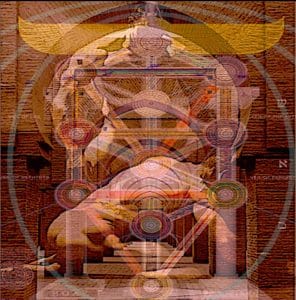
Theriault sees the “monetary premium” of art shifting, just as recent events have highlighted gold’s monetary premium. As artists increasingly embrace digital platforms to sell their work, the need for physical galleries and auction houses is diminishing, just as physical gold vaults are becoming less central in the digital age of finance. This shift allows artists like Theriault to take control of their art’s provenance and value, much like how decentralized finance gives people more autonomy over their wealth.
**A Foundation Shifting Beneath Our Feet**
While mainstream media may not yet be discussing the significance of gold’s return as a transactional asset, it’s clear that a fundamental shift is taking place—not only in finance but also in art. The use of gold to settle a modern-day trade deal harks back to centuries-old practices while simultaneously opening the door to new conversations about value in a digital age.
Theriault believes that just as gold is regaining its status as a medium of exchange, the art world is experiencing its own revolution. Technological advancements and shifting global dynamics are reshaping the concept of value, whether in the form of gold bars or digital artworks. With these changes, artists now have the opportunity to redefine how their work is valued and sold, much like gold’s valuation is being recontextualized in today’s world.
In conclusion, as gold finds its way back into the realm of currency, Theriault invites us to reconsider the very foundations of both money and art. As these shifts continue to unfold, it’s clear that the future holds exciting possibilities for artists and collectors alike, with the potential for both markets to evolve in ways we’ve never seen before.