
Ziegler-Natta Catalyst Market Size and Trends Analysis
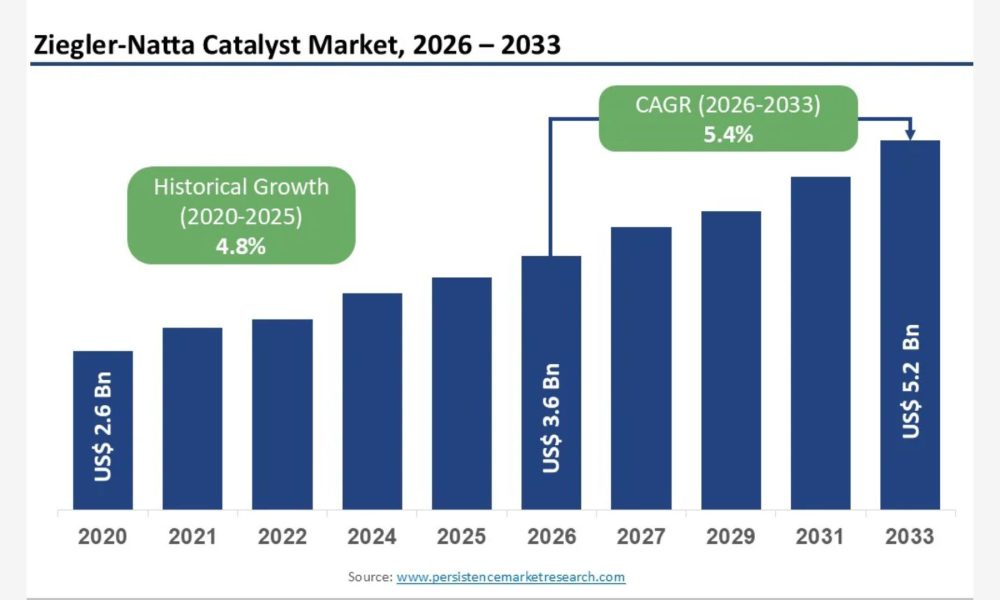
The global Ziegler-Natta catalyst market is projected to witness steady expansion over the forecast period, reflecting sustained growth in polyolefin production worldwide. The market is expected to be valued at US$ 3.6 billion in 2026 and is estimated to reach approximately US$ 5.2 billion by 2033, growing at a CAGR of 5.4% between 2026 and 2033. This growth trajectory is closely aligned with rising demand for polyethylene (PE) and polypropylene (PP), which remain essential materials across packaging, automotive, construction, and consumer goods industries.
Ziegler-Natta catalysts play a critical role in polymerization processes, enabling the efficient production of polyolefins with controlled molecular structures and tailored performance characteristics. Their ability to produce high-yield polymers with consistent properties makes them indispensable in large-scale industrial operations.
Get Your FREE Sample Report Instantly – Click Now: https://www.persistencemarketresearch.com/samples/32498
Market Overview
Ziegler-Natta catalysts are coordination catalysts used primarily in the polymerization of olefins such as ethylene and propylene. Since their commercial introduction, they have revolutionized polymer chemistry by enabling the mass production of plastics with high structural precision.
Today, these catalysts remain foundational to the polyolefin industry. Despite the emergence of metallocene and other single-site catalysts, Ziegler-Natta systems continue to dominate due to their cost-effectiveness, operational reliability, and suitability for large-volume applications. Their adaptability in producing various grades of polypropylene and polyethylene ensures continued relevance in a competitive market landscape.
Key Growth Drivers
- Rising Polyolefin Demand Across End-Use Industries
The primary driver of the Ziegler-Natta catalyst market is the expanding production of polyolefins. Packaging remains the largest consumer segment, accounting for a substantial share of polyethylene and polypropylene demand. Flexible films, rigid containers, caps, closures, and industrial packaging all rely heavily on polyolefin materials.
In the automotive sector, manufacturers increasingly prioritize lightweight plastics to improve fuel efficiency and reduce emissions. Polypropylene components are widely used in dashboards, bumpers, interior trims, and under-the-hood applications. Similarly, the construction industry depends on polyolefins for pipes, insulation materials, membranes, and fittings.
As these sectors continue to grow, so does the need for catalysts that ensure consistent polymer quality and optimized production efficiency.
- Capacity Expansions in Asia and the Middle East
Significant capacity additions across Asia-Pacific and the Middle East are reinforcing global supply availability. Countries such as China, India, Saudi Arabia, and the UAE are investing heavily in petrochemical infrastructure to meet domestic and export demand for polyolefins.
Abundant feedstock availability, particularly in the Middle East, supports competitive production economics. These expansions translate directly into increased demand for catalyst systems capable of operating efficiently in high-capacity polymerization plants.
Asia-Pacific remains a dominant region due to its strong manufacturing base, rising consumer demand, and expanding packaging and automotive industries. The Middle East, on the other hand, continues to strengthen its position as a major exporter of polyolefins, supported by integrated refining and petrochemical complexes.
- Focus on Lightweight and Durable Plastics
End-users are increasingly emphasizing lightweight yet durable plastic materials to meet regulatory and performance standards. Automotive OEMs, packaging manufacturers, and construction companies require polymers with specific mechanical properties such as improved stiffness, impact resistance, and thermal stability.
Advanced Ziegler-Natta catalyst systems enable precise control over polymer architecture, allowing manufacturers to tailor properties according to application requirements. This customization enhances product differentiation while maintaining cost efficiency, making these catalysts highly attractive for large-scale operations.
- Cost-Efficiency and High-Yield Production
Production economics remain central to the competitiveness of polyolefin manufacturers. Ziegler-Natta catalysts are valued for their high activity levels, which allow greater polymer output per unit of catalyst. Improved catalyst efficiency reduces operational costs, minimizes waste, and enhances overall plant productivity.
Manufacturers are continuously investing in next-generation catalyst formulations that deliver superior yields while maintaining polymer quality. These advancements help producers remain competitive in a market characterized by fluctuating raw material prices and tightening margins.
Get a Customized Market View in One Click: https://www.persistencemarketresearch.com/request-customization/32498
Regulatory and Sustainability Trends
Regulatory pressure for improved resource efficiency and lower emissions is significantly shaping the Ziegler-Natta catalyst market. Governments and international bodies are introducing stricter environmental standards aimed at reducing carbon footprints and improving energy efficiency in industrial processes.
This regulatory landscape compels catalyst manufacturers to develop formulations that reduce energy consumption during polymerization while minimizing by-product formation. High-activity catalysts that operate effectively under optimized process conditions contribute to lower energy usage and improved environmental performance.
Additionally, sustainability goals within the plastics industry are driving innovation in recyclable and circular polymer systems. While the broader plastics debate continues, the focus on creating durable, recyclable materials has strengthened the demand for catalyst technologies that support consistent, high-quality polymer production suitable for recycling streams.
Technological Advancements
Continuous R&D efforts are enhancing the performance of Ziegler-Natta catalysts. Innovations focus on improving activity levels, controlling stereospecificity, and enhancing polymer molecular weight distribution. These improvements allow manufacturers to produce specialty grades that meet evolving application demands.
Although metallocene catalysts offer precise molecular control, Ziegler-Natta systems maintain a competitive advantage in large-scale polypropylene production due to their proven reliability and lower cost structure. Hybrid approaches and improved support materials are also emerging, bridging performance gaps while maintaining economic viability.
The integration of digital process monitoring and advanced plant automation further enhances catalyst performance optimization. Real-time monitoring of polymerization conditions enables producers to maximize catalyst efficiency and minimize operational disruptions.
Market Challenges
Despite steady growth prospects, the market faces certain challenges. Volatility in raw material prices, particularly titanium and other catalyst components, can affect manufacturing costs. Additionally, environmental scrutiny of plastic waste continues to influence public perception and regulatory action.
Competition from alternative catalyst technologies, including metallocenes and post-metallocene systems, presents another competitive dynamic. However, the cost-performance balance of Ziegler-Natta catalysts continues to secure their dominant position in mainstream polyolefin production.
For In-Depth Competitive Analysis, Buy Now: https://www.persistencemarketresearch.com/checkout/32498
Future Outlook
The outlook for the Ziegler-Natta catalyst market remains positive through 2033. Rising global demand for polyolefins, ongoing industrial expansion, and increasing focus on production efficiency will sustain market momentum.
The shift toward higher-activity, more sustainable catalyst formulations is expected to define the next phase of market development. Suppliers that successfully combine environmental compliance with cost-effective performance enhancements will gain competitive advantage.
As global industries continue to rely on durable, lightweight, and versatile plastic materials, Ziegler-Natta catalysts will remain central to polymer manufacturing processes. With projected growth from US$ 3.6 billion in 2026 to US$ 5.2 billion by 2033, the market reflects stable expansion supported by technological innovation, capacity growth, and sustained demand across key end-use sectors.
In an evolving regulatory and economic landscape, next-generation Ziegler-Natta systems are set to play a crucial role in balancing efficiency, sustainability, and high-performance polymer production.
About Persistence Market Research:
Persistence Market Research delivers strategic research solutions that drive business growth. Founded in 2012 and registered in England and Wales in 2023 as Persistence Research & Consultancy Services Ltd., we have completed 3,600+ custom and syndicated studies and supported 2,700+ projects for leading research firms. Combining traditional methodologies with modern tools, we provide actionable insights to multinational corporations, consultants, investors, and government bodies, earning strong trust through long-term client relationships.
Contact Us:
Persistence Market Research
Second Floor, 150 Fleet Street,
London, EC4A 2DQ, United Kingdom
USA Phone: +1 646-878-6329
UK Phone: +44 203-837-5656
Email: [email protected]
Web: https://www.persistencemarketresearch.com




