
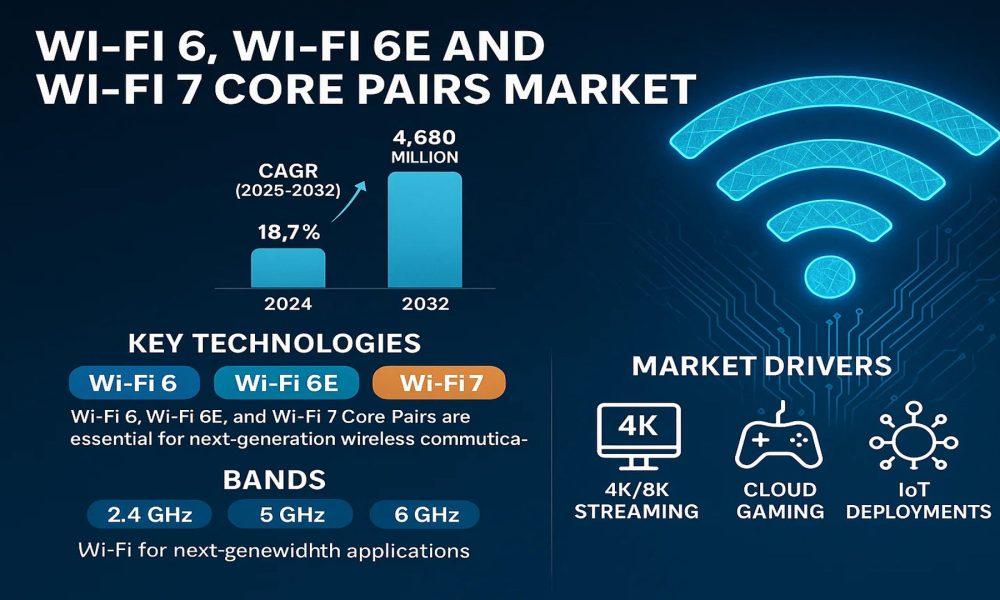
Wi-Fi 6, Wi-Fi 6E and Wi-Fi 7 Core Pairs Market size was valued at US$ 1,420 million in 2024 and is projected to reach US$ 4,680 million by 2032, at a CAGR of 18.7% during the forecast period 2025-2032. While the semiconductor industry faced a slowdown in 2022, the demand for high-speed wireless connectivity solutions continues to surge, driven by enterprise and consumer applications.
Wi-Fi 6, Wi-Fi 6E, and Wi-Fi 7 Core Pairs are critical components enabling next-generation wireless communication. These advanced technologies provide higher throughput, lower latency, and improved efficiency compared to legacy Wi-Fi standards. Wi-Fi 6 operates on the 2.4 GHz and 5 GHz bands, while Wi-Fi 6E extends into the 6 GHz spectrum for reduced interference. Wi-Fi 7, the latest standard, further enhances performance with features like 320 MHz channels and multi-link operation.
The market growth is fueled by rising demand for high-bandwidth applications such as 4K/8K streaming, cloud gaming, and IoT deployments. Enterprises are rapidly adopting these technologies to support hybrid work environments, while smart home devices increasingly integrate Wi-Fi 6/6E capabilities. Key players like Broadcom, Qualcomm, and Intel dominate the market, with Broadcom holding an estimated 32% revenue share in 2024. Recent developments include Qualcomm’s launch of its Wi-Fi 7 networking platforms in 2023, targeting automotive and enterprise segments.
Download Your Complimentary Sample Report-https://semiconductorinsight.com/download-sample-report/?product_id=107240
MARKET DYNAMICS
MARKET DRIVERS
Rapid Adoption of High-Speed Internet Technologies to Accelerate Demand for Wi-Fi 6/6E/7 Core Pairs
The global transition to faster and more reliable internet connectivity is driving substantial growth in the Wi-Fi 6, 6E and 7 core pairs market. With internet traffic projected to grow at a compound annual growth rate of over 25% in coming years, the demand for advanced wireless solutions that support higher bandwidth and lower latency continues to escalate. Wi-Fi 6 and its successors provide significantly improved speeds, supporting up to 9.6 Gbps compared to 3.5 Gbps for Wi-Fi 5, while reducing network congestion in high-density environments. These benefits are particularly crucial as enterprises and consumers increasingly rely on bandwidth-intensive applications like video conferencing, cloud gaming and 4K/8K streaming.
Proliferation of IoT and Smart Devices Creates Massive Deployment Opportunities
The exponential growth of IoT devices, expected to surpass 29 billion globally by 2027, is creating unprecedented demand for robust wireless infrastructure. Wi-Fi 6/6E/7 core pairs enable more efficient connectivity for smart home ecosystems, industrial automation systems and enterprise IoT deployments by supporting a significantly higher number of simultaneous connections without performance degradation. The technology’s advanced features like OFDMA and Target Wake Time (TWT) are particularly valuable for power-constrained IoT devices, extending battery life while maintaining reliable connections.
Moreover, the increasing integration of AI and machine learning in network management is driving smarter Wi-Fi deployments. Features such as automated frequency coordination and enhanced beamforming are making next-generation Wi-Fi solutions more attractive for both commercial and residential applications.
Evolution of Enterprise Networking Requirements Fuels Market Expansion
Enterprise digital transformation initiatives are accelerating adoption of Wi-Fi 6/6E/7 solutions as businesses upgrade their networks to support hybrid work models and cloud-based applications. The enterprise segment accounted for over 45% of the market revenue in 2024, with projections indicating continued double-digit growth. Features like Multi-User MIMO and 160 MHz channels provide the performance required for modern office environments, while enhanced security protocols address growing cybersecurity concerns.
Recent Developments:
- Market Growth: The Wi-Fi 6, 6E, and 7 core pairs market has been witnessing robust growth due to increasing demand for high-speed, low-latency wireless connectivity in smart homes, enterprise networks, and IoT applications. The market is projected to continue expanding as Wi-Fi 7 adoption accelerates.
- Wi-Fi 6 & 6E Adoption: Wi-Fi 6 technology adoption is maturing across commercial and residential networks, while Wi-Fi 6E, operating in the 6 GHz band, is gaining traction for high-density environments such as stadiums, offices, and urban areas.
- Emergence of Wi-Fi 7: Wi-Fi 7 (802.11be) promises multi-gigabit speeds, ultra-low latency, and enhanced reliability, driving demand for next-generation core pairs in routers, access points, and client devices. Early product launches by major chipset manufacturers are creating new market opportunities.
- Technological Innovations: Integration of features such as multi-link operation (MLO), advanced OFDMA, and wider channels (320 MHz) in Wi-Fi 7 devices is pushing the development of more efficient core pairs to support higher throughput and energy efficiency.
- Strategic Partnerships & Collaborations: Leading semiconductor and networking companies are collaborating to develop Wi-Fi 6E and Wi-Fi 7 core solutions, focusing on improved performance, reduced interference, and compatibility with legacy systems.
- Regional Trends: North America and Europe are leading in Wi-Fi 6E and 7 adoption due to early spectrum allocation and high enterprise demand, while Asia-Pacific is emerging as a fast-growing market driven by smart city initiatives and IoT expansion.
MARKET OPPORTUNITIES
Emerging Applications in Automotive and Industrial Sectors Present New Growth Frontiers
The automotive industry’s increasing adoption of connected vehicle technologies and in-car infotainment systems represents a significant opportunity for Wi-Fi 6/6E/7 solutions. Vehicle-to-everything (V2X) communication requirements are expected to drive adoption of high-performance wireless modules, with projections indicating the automotive Wi-Fi market could exceed $8 billion by 2027. Advanced driver assistance systems (ADAS) and autonomous vehicle development further reinforce this trend, requiring robust in-vehicle networks capable of handling massive data transfers.
Cloud Gaming and AR/VR Applications Drive Need for Ultra-Low Latency Solutions
The booming cloud gaming sector, projected to grow at over 45% CAGR through 2030, is creating strong demand for Wi-Fi technologies that can deliver consistent performance with latency under 20ms. Similarly, emerging augmented and virtual reality applications require reliable high-bandwidth connections that modern Wi-Fi standards can provide. These consumer segments are driving innovation in multi-link operation and deterministic latency features that enhance user experiences, presenting manufacturers with lucrative opportunities to develop specialized solutions.
List of Key Wi-Fi Core Pairs Technology Companies
- Broadcom Inc. (U.S.)
- Intel Corporation (U.S.)
- NXP Semiconductors (Netherlands)
- Cisco Systems, Inc. (U.S.)
- Qualcomm Incorporated (U.S.)
- Huawei Technologies Co. Ltd. (China)
- TP-Link Technologies Co. Ltd. (China)
- Netgear, Inc. (U.S.)
- MediaTek Inc. (Taiwan)
- Texas Instruments Incorporated (U.S.)
- STMicroelectronics N.V. (Switzerland)
Download Your Complimentary Sample Report-https://semiconductorinsight.com/download-sample-report/?product_id=107240
Segment Analysis:
By Type
Wi-Fi 6E Segment Experiences Fastest Growth Due to Increased Adoption of High-Bandwidth Applications
The global Wi-Fi core pairs market is segmented based on type into:
- Wi-Fi 6
- Subtypes: Single-band, Dual-band, Tri-band
- Wi-Fi 6E
- Wi-Fi 7
By Application
Consumer Electronics Segment Leads Driven by Proliferation of Smart Devices
The market is segmented based on application into:
- WLAN infrastructure equipment
- Consumer electronics products
- Smart home
- Industrial Internet of Things
- Automotive
- Others
By End User
Enterprises Account for Largest Share Due to Demand for High-Speed Connectivity
The market is segmented based on end user into:
- Enterprises
- Service providers
- Individual consumers
By Bandwidth
Multi-Gigabit Solutions Gain Traction to Support Emerging Technologies
The market is segmented based on bandwidth into:
- Sub-1Gbps
- 1-5Gbps
- 5-10Gbps
- Above 10Gbps
Other Topic-Tactical Camera Market
CONTACT US:
City vista, 203A, Fountain Road, Ashoka Nagar, Kharadi, Pune, Maharashtra 411014
[+91 8087992013]




