
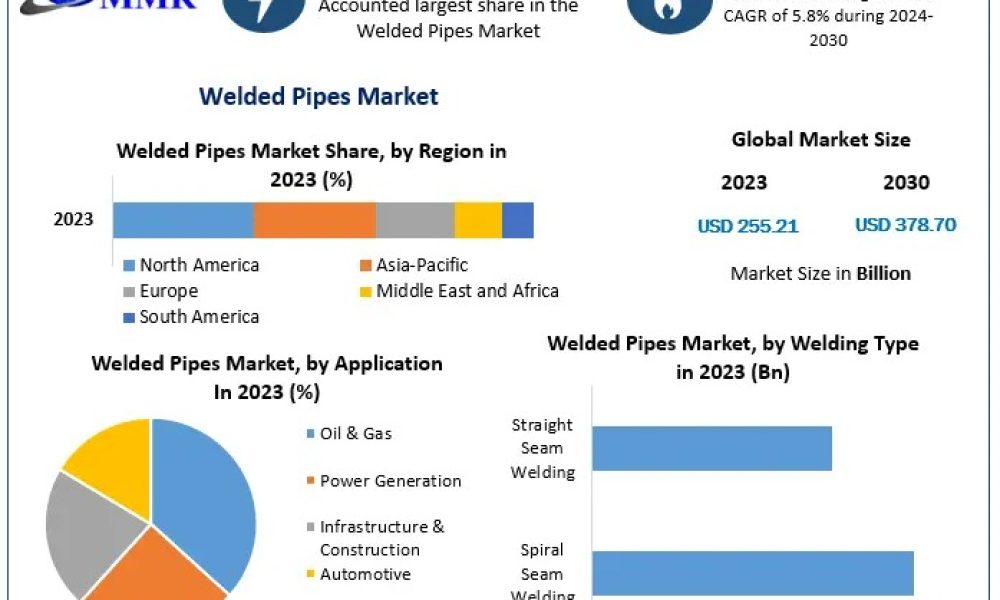
Welded Pipes Market
Welded Pipes Market is on track for robust growth, projected to expand from USD 255.21 billion in 2023 to nearly USD 378.70 billion by 2030, at a CAGR of 5.8%. This upward momentum is driven by infrastructure expansion, innovations in oil & gas transportation, and growing demand across industrial, construction, automotive, and marine sectors. North America leads the market, supported by substantial pipeline investments and a strong construction industry.
Key Highlights & Insights
Market Size & Growth: The welded pipes market will grow from USD 255.21 billion in 2023 to USD 378.70 billion by 2030, with a CAGR of 5.8%.
Dominating Region: North America dominates, led by the United States, due to rising infrastructure investments, rapid urbanization, extensive pipeline projects, and strong demand from the oil & gas and construction industries.
Leading Segment: Stainless steel welded pipes represent the largest share, favored for corrosion resistance, high strength, and durability in demanding sectors like construction, marine, and medical equipment. Heat exchanger tubes are the top product type, widely used in chemical processing, food, pharmaceuticals, oil refining, nuclear power, and energy sectors.
Key Driver: Accelerating oil & gas production, commercial and residential construction, and advancements in welded pipe technology underscore the market’s growth.
Recent Developments
2024–2025: Leading players including ArcelorMittal, Nippon Steel, Hyundai Steel, and JFE Steel ramp up R&D efforts for specialized welded pipes tailored to biochemistry and medical equipment, addressing evolving industrial needs.
North America’s expansion in pipeline projects, such as the Alaska LNG and Cameron LNG liquefaction plants, signals an increase in demand for steel pipes and tubes.
Innovative materials and weld geometries enhance product offerings—manufacturers now provide solutions for industries ranging from aerospace to power generation.
Advancements in welding technology, including ERW and spiral seam welding, improve pipe reliability and extend design life in critical applications.
Market Dynamics
Growth Drivers:
Rising oil & gas industry needs for safe, efficient liquid and gas transport.
Continuous building and infrastructure development, especially in fast-growing regions.
Cost-effective transportation advantages, pipeline design longevity, and reduced maintenance.
Increased demand in automotive, marine, medical, mechanical, and engineering sectors.
Challenges:
Volatile raw material costs, particularly steel and alloy prices, affect manufacturing economics.
Uncertainty in the energy sector influences demand variability for welded pipes.
Competition and supply risks require manufacturers to innovate alloy compositions and geometries.
Opportunities:
Expansion into specialized applications in biochemistry and medical equipment.
Emerging economies invest in infrastructure, offering growth potential for pipe manufacturers.
Production of high-strength steel grades (X90, X100, X120) addresses modern pipeline needs.
Regional Analysis
North America: The top region with over 31,000 miles of pipeline planned and 15,000 miles under construction as of 2020, along with thriving construction and mechanical engineering sectors.
Asia Pacific: Significant growth with countries such as China ramping up pipeline networks and infrastructure spending.
Europe: Steady demand supported by high-value construction and engineering projects.
Middle East & Africa, South America: Active pipeline projects and increased real estate expenditure support market expansion.
For full access to the data, request a sample report now :https://www.maximizemarketresearch.com/request-sample/148354/
Product Segmentation
By Material: Carbon steel, stainless steel (largest share), alloy steel.
By Product Type: Process pipes, mechanical tubes, heat exchanger tubes (dominant), structural tubes, hydraulic & instrumentation tubes.
By Application: Oil & gas (major sector), power generation, infrastructure & construction, automotive, mechanical & engineering.
By Welding Type: Spiral seam welding, straight seam welding.
Key Trends
Customization and specialization in pipes for industry-specific applications.
Increasing focus on high-strength, corrosion-resistant materials for longer lifecycle and demanding environments.
Adoption of advanced welding processes (e.g., ERW, spiral seam) for improved grain structure and durability.
Rising investments in R&D and technology for enhanced weld integrity and diversified product offerings.
Quote
North America’s pivotal role in the welded pipes market is underscored by continuous infrastructure development and energy sector advancements. With technology driving efficiency and reliability, welded pipes are at the heart of modern industrial growth and progress worldwide.
As global infrastructure, energy, and manufacturing sectors advance, welded pipes remain integral to progress—powering transportation, construction, and innovation in a competitive and evolving landscape.




