
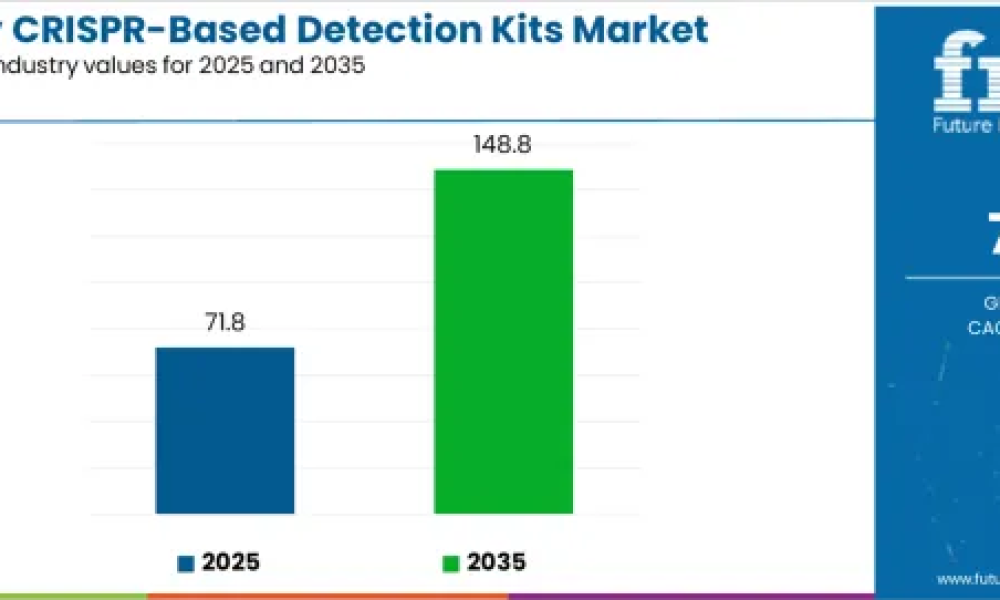
The global veterinary CRISPR-based detection kits market is on a robust growth trajectory, projected to expand from USD 71.8 million in 2025 to USD 148.8 million by 2035, achieving a compound annual growth rate (CAGR) of 7.6%. This nearly 2.07X increase underscores the transformative role of CRISPR technology in animal health, offering industry leaders unparalleled opportunities for innovation in pathogen detection, genetic testing, and drug resistance monitoring.
As veterinary practices worldwide grapple with the rising complexity of infectious diseases, genetic disorders, and foodborne pathogens, CRISPR-based systems are emerging as a game-changer. These kits provide superior accuracy and speed compared to traditional diagnostic methods, enabling rapid identification of threats across companion animals, livestock, and aquaculture. “The demand for advanced, reliable diagnostics is not just a trend—it’s a necessity for safeguarding animal welfare and public health,” said a leading market analyst at Future Market Insights. “With zoonotic diseases posing increasing risks, CRISPR’s precision is empowering veterinarians and researchers to act decisively.”
The market’s growth is segmented into two key phases. From 2025 to 2030, the sector is expected to rise from USD 71.8 million to USD 101.2 million, adding USD 29.4 million and accounting for 38.2% of the decade’s total expansion. This initial surge reflects accelerating adoption in high-demand areas like pathogen detection, which is poised to capture 55% of the market share in 2025. The segment’s dominance stems from its ability to enable simultaneous detection of multiple targets, reducing turnaround times and enhancing sensitivity—critical for on-site applications in farms and clinics.
Looking further ahead, the period from 2030 to 2035 will see even stronger momentum, with the market climbing to USD 148.8 million through an additional USD 47.6 million in value, representing 61.8% of the overall growth. This acceleration is fueled by opportunities in multiplex detection capabilities and integration with digital health platforms. Industry leaders are investing in point-of-care solutions, portable assay platforms, and simplified workflows that allow for seamless use in veterinary labs, clinics, and even remote field settings.
Regionally, North America, Europe, and Asia Pacific are spearheading this expansion. In Europe alone, the market is forecasted to grow from USD 18.5 million in 2025 to USD 29.8 million by 2035 at a CAGR of 4.9%. Germany leads with a 24.2% share in 2025, while BENELUX countries exhibit the fastest growth at 5.0% CAGR, followed by Spain (4.6%), Italy (4.3%), France (3.9%), and Germany (2.8%). In Japan, companion animals dominate service revenues, comprising 75% in 2025, with livestock at 20% and aquaculture at 5%. These regional dynamics highlight the market’s alignment with precision animal health approaches, particularly in areas with stringent food safety regulations.
Market drivers include the growing emphasis on zoonotic disease prevention and food safety, where CRISPR’s advantages shine. Regulatory agencies are increasingly favoring methods with proven accuracy and reliability, paving the way for broader adoption. However, challenges such as high initial equipment costs, the need for specialized training, and stringent validation requirements could temper short-term growth. Forward-thinking leaders are addressing these through strategic investments in cost optimization, scalable manufacturing, and reagent stability—reducing reliance on cold chain logistics and making solutions more accessible in resource-limited regions.
Opportunities abound for innovation. The integration of CRISPR with microfluidics and lab-on-chip systems is enabling multiplex testing from single samples, while advances in enzyme engineering—featuring variants like Cas12 and Cas13—facilitate highly specific nucleic acid detection via fluorescent or colorimetric signals. CRISPR-Cas12 is estimated to hold a 45% market share by technology platform in 2025. Furthermore, the incorporation of artificial intelligence (AI) and digital tools, such as smartphone apps for instant result interpretation and connectivity with veterinary practice management systems, is revolutionizing workflows.
By animal type, companion animals lead with a 65% share in 2025, reflecting the surge in pet ownership and demand for rapid diagnostics. End-users are equally diverse: veterinary diagnostic laboratories are projected to contribute 40% of the market, leveraging high-throughput capabilities, while veterinary clinics, research institutions, and government agencies round out the ecosystem.
The competitive landscape is vibrant, with biotechnology giants and diagnostic providers vying for dominance through technological innovation, partnerships, and market expansion. Key players include Thermo Fisher Scientific, offering comprehensive platforms focused on accuracy; QIAGEN, with integrated solutions for automated processing; Bio-Rad Laboratories, emphasizing standardized protocols; Roche Diagnostics, prioritizing high-throughput and digital integration; Abbott Laboratories, specializing in point-of-care options; Danaher Corporation, providing sophisticated instrumentation; Merck KGaA, delivering research-grade reagents; and others like Agilent Technologies, PerkinElmer, and Illumina, which bolster global networks with specialized support.
Subscribe for Year-Round Insights → Stay ahead with quarterly and annual data updates: https://www.futuremarketinsights.com/reports/brochure/rep-gb-27384
Request for Sample Report | Customize Report |purchase Full Report –https://www.futuremarketinsights.com/reports/sample/rep-gb-27384
Recent developments underscore this momentum: multiplex systems for simultaneous pathogen and genetic target detection, digital connectivity for data management and electronic health records, and AI-driven analytics for enhanced interpretation. These advancements are not only expanding CRISPR’s veterinary applications but also aligning with broader trends in livestock health monitoring and sustainable agriculture.
Parent market contributions further contextualize this growth: veterinary diagnostics (35-40%), agriculture and livestock (25-30%), biotechnology and genetic engineering (15-20%), pharmaceuticals (10-12%), and research institutions (5-8%). Historical data from 2020 to 2024, including production, consumption, import, and export statistics, provides a solid foundation for these projections.
For industry leaders, this market narrative signals a pivotal moment. Investing in CRISPR-based detection kits means embracing a future where rapid, accurate diagnostics drive decision-making, from farm to lab. As the sector evolves, those at the forefront will shape the next era of animal health innovation, ensuring resilience against emerging threats.
About Future Market Insights (FMI)
Future Market Insights, Inc. (FMI) is an ESOMAR-certified, ISO 9001:2015 market research and consulting organization, trusted by Fortune 500 clients and global enterprises. With operations in the U.S., UK, India, and Dubai, FMI provides data-backed insights and strategic intelligence across 30+ industries and 1200 markets worldwide.
Why FMI: Decisions that Change Outcomes- https://www.futuremarketinsights.com/why-fmi
Contact Us:
Future Market Insights Inc.
Christiana Corporate, 200 Continental Drive,
Suite 401, Newark, Delaware – 19713, USA
T: +1-347-918-3531
Website: https://www.futuremarketinsights.com
LinkedIn| Twitter| Blogs | YouTube
Have a specific Requirements and Need Assistant on Report Pricing or Limited Budget please contact us – [email protected]



