
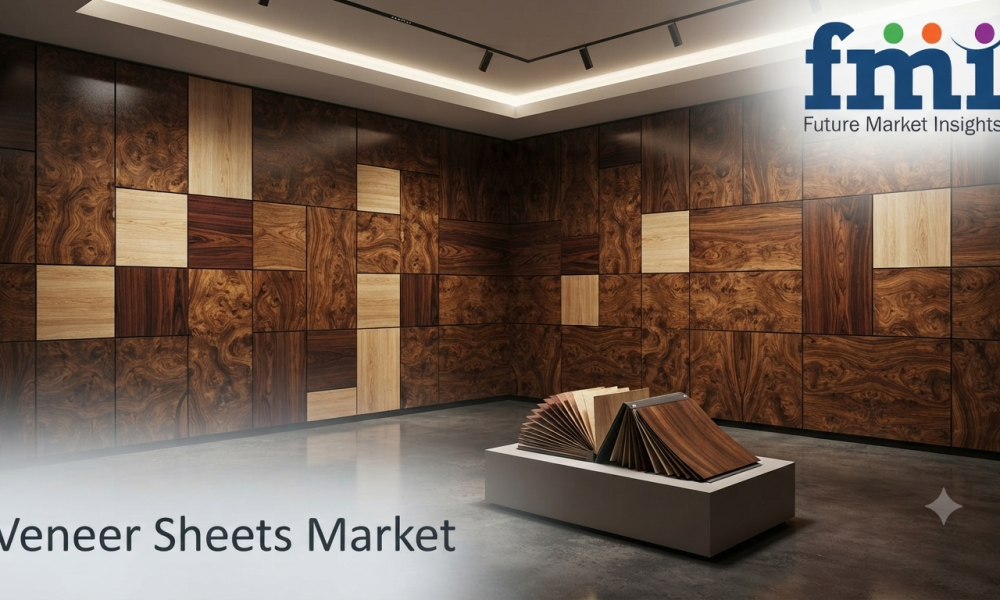
The global veneer sheets market was valued at USD 26.4 billion in 2025 and is projected to reach USD 38.0 billion by 2035, expanding at a 3.7% CAGR from 2025 to 2035. Growth is being supported by rising commercial interior refurbishment, increasing demand for natural wood aesthetics, and stronger preference for sustainable interior materials. Demand is also benefiting from the growing use of certified, low-VOC, and performance-enhanced veneer products across offices, hospitality properties, retail spaces, furniture, and architectural millwork.
Global Segment Leaders
- Paper-backed veneer sheets led the product type segment with a 47.0% share in 2025, supported by flexible handling, cost-effective production, and suitability for both flat and curved surfaces.
- Hardwood led the wood source segment with a 56.0% share in 2025, driven by its premium grain patterns, natural appearance, and established use in high-end interiors.
- Commercial end use accounted for the largest demand share at 58.0% in 2025, supported by office refurbishment, hospitality fit-outs, retail environments, and institutional projects.
- Within commercial applications, office use represented 24.0% of total market demand, followed by hospitality at 18.0%, retail at 12.0%, and institutional applications at 4.0%.
- Engineered and reconstituted veneers accounted for 20.0% of the wood source segment, supported by consistent grain patterns and improved material utilization.
- Softwood represented 19.0%, serving cost-sensitive applications and interiors requiring lighter wood aesthetics.
- Bamboo and other wood sources accounted for 5.0%, reflecting emerging interest in alternative sustainable materials.
Get detailed market forecasts, competitive benchmarking, and pricing trends: https://www.futuremarketinsights.com/reports/sample/rep-gb-4152
Country-Level Performance
- India — 4.6% CAGR: India is expected to record the fastest country-level growth, supported by expanding commercial fit-out activity, organized furniture manufacturing, urbanization, and increasing adoption of sustainable interior materials.
- China — 4.3% CAGR: Growth is supported by hospitality development, scaling reconstituted veneer production, and recovery in export-oriented cabinetry and furniture manufacturing.
- South Korea — 3.8% CAGR: Luxury residential tower development, premium interiors, and growing use of antimicrobial and fire-rated veneer products are supporting market expansion.
- Germany — 3.7% CAGR: Premium kitchen manufacturing, shopfitting, modular furniture production, and demand for quality-certified materials are sustaining veneer consumption.
- United Kingdom — 3.6% CAGR: Office refurbishment, bespoke joinery, and sustainability-focused building practices are creating opportunities for veneer sheet suppliers.
- United States — 3.5% CAGR: High-end residential remodeling, custom millwork, engineered veneer applications, and commercial renovation activity are supporting steady demand.
- Japan — 3.4% CAGR: Compact housing, prefabricated interiors, precision manufacturing, and demand for high-grade hardwood veneers are contributing to market growth.
Regional Context
Asia Pacific represents a key growth region, with India, China, and South Korea recording faster country-level expansion. India benefits from commercial construction, organized furniture manufacturing, and growing sustainability requirements, while China is supported by hospitality development, furniture manufacturing, and export cabinetry. South Korea is benefiting from premium residential construction and performance-oriented veneer applications.
Mature markets such as Germany, the United Kingdom, the United States, and Japan are expected to experience comparatively moderate growth. These markets have established furniture and interior industries, with demand increasingly centered on premium finishes, renovation activity, engineered veneers, certified sourcing, and performance-enhanced products.
The broader report covers Asia Pacific, North America, Europe, Latin America, and the Middle East & Africa, with analysis spanning 40+ countries.
Competitive Landscape
The veneer sheets market features a moderately concentrated competitive environment, with leading suppliers competing through wood species availability, grain consistency, finishing quality, engineered veneer technology, sustainable sourcing, and application-specific solutions.
Key companies profiled in the market include Decospan NV, ALPI S.p.A., Columbia Forest Products, Greenlam Industries Ltd. (Decowood), Greenply Industries, FormWood Industries, Oakwood Veneer Company, Flexible Materials Inc., Timber Products Company, Fritz Kohl GmbH & Co. KG, Sauers & Company Veneers, Tabu SpA, Turakhia Overseas, Samko Timber Limited, and SR Wood.
Market leaders are strengthening their positions through reconstituted veneer technologies, engineered patterns, sustainable wood sourcing, and expanded veneer collections. Challenger and regional companies are focusing on premium decorative veneers, customized designs, specialized wood species, artisanal finishes, and environmentally responsible sourcing.
The competitive environment is also being shaped by the growing adoption of pre-finished veneer systems, including factory-applied UV coatings, scratch-resistant finishes, and antimicrobial treatments. These solutions help reduce installation time while delivering more consistent finishing quality for commercial projects.
Market Growth Outlook
The veneer sheets market is moving beyond traditional decorative wood surfacing toward performance-oriented interior materials. Commercial renovation and refurbishment remain important demand contributors as offices, hotels, retail properties, and institutional buildings seek natural finishes that combine design flexibility with efficient installation.
Sustainability is another important market factor. Furniture manufacturers, architects, and contractors are increasingly considering certified wood sourcing, chain-of-custody documentation, low-VOC products, and environmentally responsible materials when selecting veneer systems.
Engineered and reconstituted veneers are creating additional opportunities by providing consistent grain patterns, reducing natural defects, improving material utilization, and helping manufacturers reduce reliance on scarce hardwood resources. These developments are supporting wider application across furniture, cabinetry, wall panels, architectural millwork, and premium interiors.
Access the Complete Report in PDF Format: https://www.futuremarketinsights.com/reports/brochure/rep-gb-4152
Challenges and Opportunities
The market faces competition from alternative decorative surfacing materials, particularly high-pressure laminates and thermally fused melamine products that can offer lower costs and strong durability. Hardwood price volatility can also affect veneer economics, while thickness variation, moisture sensitivity, and installation requirements remain technical considerations.
At the same time, manufacturers have opportunities to differentiate through pre-finished systems, advanced coatings, engineered veneers, sustainable sourcing, and technical support. Suppliers that combine consistent veneer quality with verified sourcing and application expertise can strengthen their position in specification-driven commercial projects.
Business Impact
FMI helps organizations transform market complexity into strategic clarity, enabling leadership teams to identify growth opportunities faster, optimize resource allocation, strengthen competitive positioning, and make high-stakes business decisions with confidence.
To explore how FMI Custom Research can support your strategic priorities, please connect with our team at – [email protected]
About Future Market Insights (FMI)
Future Market Insights, Inc. (FMI) is an ESOMAR-certified, ISO 9001:2015 market research and consulting organization, trusted by Fortune 500 clients and global enterprises. With operations in the U.S., UK, India, and Dubai, FMI provides data-backed insights and strategic intelligence across 30+ industries and 1200 markets worldwide.



