
The Vegetable Parchment Paper Market is gaining strong momentum as food packaging regulations tighten and sustainability becomes a central procurement criterion for foodservice operators. Vegetable parchment paper is widely valued for its grease resistance, heat tolerance, and biodegradable nature, making it a preferred alternative to synthetic or chemically treated papers. Commercial bakeries, quick service restaurants, and industrial food processors are increasingly adopting vegetable parchment paper to ensure food safety compliance while maintaining operational efficiency. The market is also benefitting from rising packaged food consumption and the expansion of organized bakery chains globally.
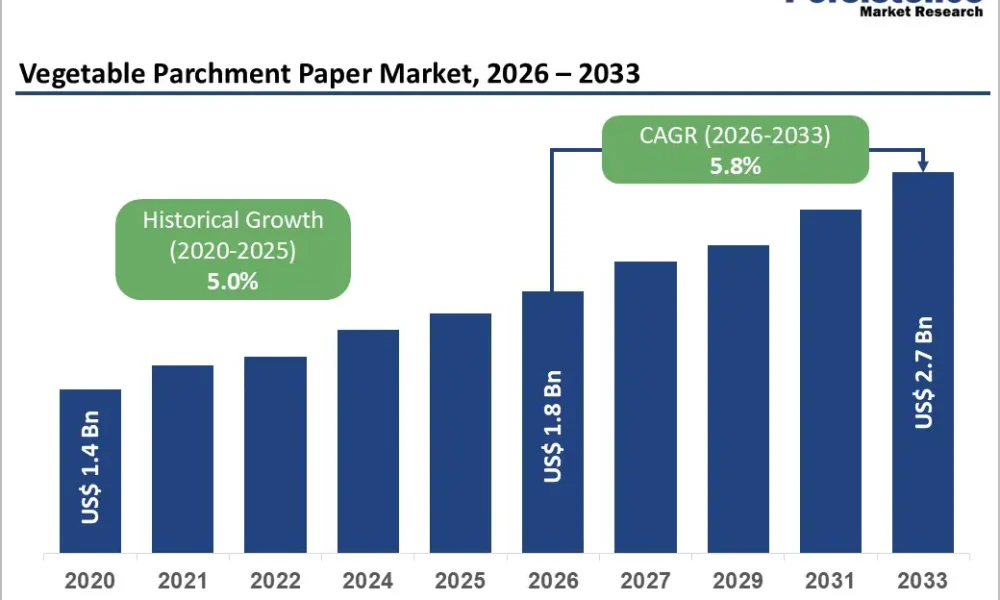
According to Persistence Market Research, the global vegetable parchment paper market is likely to be valued at US$1.8 billion in 2026 and is expected to reach US$2.7 billion by 2033, growing at a CAGR of 5.8% between 2026 and 2033. This growth is supported by regulatory pressure to eliminate PFAS based grease proofing materials and the rising adoption of vegetable parchment paper across foodservice formats. Among product segments, grease resistant parchment paper dominates due to its widespread use in baking and roasting. The foodservice and commercial bakery segment leads end user adoption, while Europe remains the leading geographical region driven by strict food contact regulations and early adoption of sustainable packaging materials.
Claim Your Free Sample & Stay Ahead of Competitors : https://www.persistencemarketresearch.com/samples/36028
Key Highlights from the Report
➤ The Vegetable Parchment Paper Market is projected to expand at a CAGR of 5.8% between 2026 and 2033
➤ Market valuation is expected to rise from US$1.8 billion in 2026 to US$2.7 billion by 2033
➤ Regulatory elimination of PFAS based grease proofing solutions is a major growth catalyst
➤ Commercial bakeries represent the leading end user segment globally
➤ Europe continues to dominate due to stringent food safety and packaging regulations
➤ E commerce channels are emerging as a key procurement platform for bulk buyers
Market Segmentation Analysis
The Vegetable Parchment Paper Market is segmented by product type, end user, and distribution channel. Based on product type, grease resistant parchment paper accounts for the largest share due to its extensive use in baking trays, wrapping, and cooking applications. Silicone treated and uncoated parchment paper types are also gaining visibility, particularly among artisanal bakeries and premium food producers that prioritize natural processing methods. Thickness variation and roll size customization further support adoption across diverse operational requirements.
By end user, the market is led by commercial bakeries and foodservice operators, followed by packaged food manufacturers and household consumers. Large scale food processors prefer vegetable parchment paper for its consistent performance in high temperature environments. Distribution through offline wholesalers remains dominant, although online and e commerce channels are rapidly expanding as foodservice operators seek cost efficiency, bulk ordering, and reliable supply chain access.
Regional Insights
Europe holds the leading position in the Vegetable Parchment Paper Market, supported by strict food contact material regulations and strong sustainability mandates. Countries across Western and Northern Europe have been early adopters of PFAS free packaging solutions, driving consistent demand from industrial bakeries and food manufacturers. The presence of established parchment paper producers further strengthens regional supply stability.
North America represents a fast growing regional market as foodservice chains and commercial kitchens transition toward compliant and eco friendly packaging materials. Rising consumer awareness regarding chemical free food contact surfaces and expanding bakery chains are contributing to sustained demand. Growth in online bulk procurement is also reshaping purchasing patterns across the region.
Want Specific Data? Request Report Customization : https://www.persistencemarketresearch.com/request-customization/36028
Market Drivers
One of the primary drivers of the Vegetable Parchment Paper Market is increasing regulatory pressure to eliminate PFAS based grease proofing materials from food contact applications. Governments and food safety authorities are enforcing stricter compliance norms, encouraging manufacturers and foodservice operators to switch to vegetable parchment paper. This transition supports both regulatory adherence and brand positioning centered on safety and sustainability.
Another key driver is the rapid expansion of commercial bakeries and foodservice outlets globally. Vegetable parchment paper improves operational efficiency by preventing food adhesion, reducing waste, and enabling consistent baking outcomes. Its compatibility with high temperature cooking and baking processes makes it indispensable in large scale food production environments.
Market Restraints
Despite favorable growth trends, the Vegetable Parchment Paper Market faces challenges related to cost sensitivity among small scale food operators. Vegetable parchment paper is generally priced higher than conventional wax or synthetic coated papers, which may limit adoption in cost constrained markets. Price volatility of raw materials can also impact procurement decisions for bulk buyers.
Additionally, limited awareness in emerging markets regarding the benefits of vegetable parchment paper acts as a restraint. In regions where regulatory enforcement is less stringent, foodservice operators may continue using traditional alternatives, slowing overall market penetration.
Market Opportunities
The expansion of e commerce channels presents significant opportunities for the Vegetable Parchment Paper Market. Online procurement platforms enable manufacturers to reach a wider base of commercial buyers while offering flexible order volumes and competitive pricing. This shift supports faster adoption among independent bakeries and mid sized foodservice operators.
Growing demand for sustainable and biodegradable food packaging solutions also creates long term growth potential. As consumers increasingly favor environmentally responsible brands, food producers are expected to integrate vegetable parchment paper into their packaging strategies, opening new application areas beyond baking and cooking.
Confirm Your Purchase & Access Full Insights : https://www.persistencemarketresearch.com/checkout/36028
Company Insights
Key players operating in the Vegetable Parchment Paper Market include
Nordic Paper
Ahlstrom
Mondi Group
Dispo International
Pudumjee Paper Products
McNairn Packaging
Recent Developments
March 2024 Nordic Paper expanded its grease resistant parchment paper production capacity to support growing bakery demand
July 2023 Ahlstrom introduced an enhanced PFAS free vegetable parchment paper grade for foodservice applications
Future Opportunities and Growth Prospects
The Vegetable Parchment Paper Market is positioned for steady expansion as regulatory compliance, sustainability initiatives, and foodservice modernization continue to shape purchasing behavior. Ongoing innovation in grease resistance performance, thickness customization, and digital procurement platforms is expected to strengthen market competitiveness. With growing emphasis on safe and eco friendly food contact materials, vegetable parchment paper will remain a critical component of the global food packaging ecosystem through 2033.




