
Market Overview: Rising Demand for Solar Thermal Systems
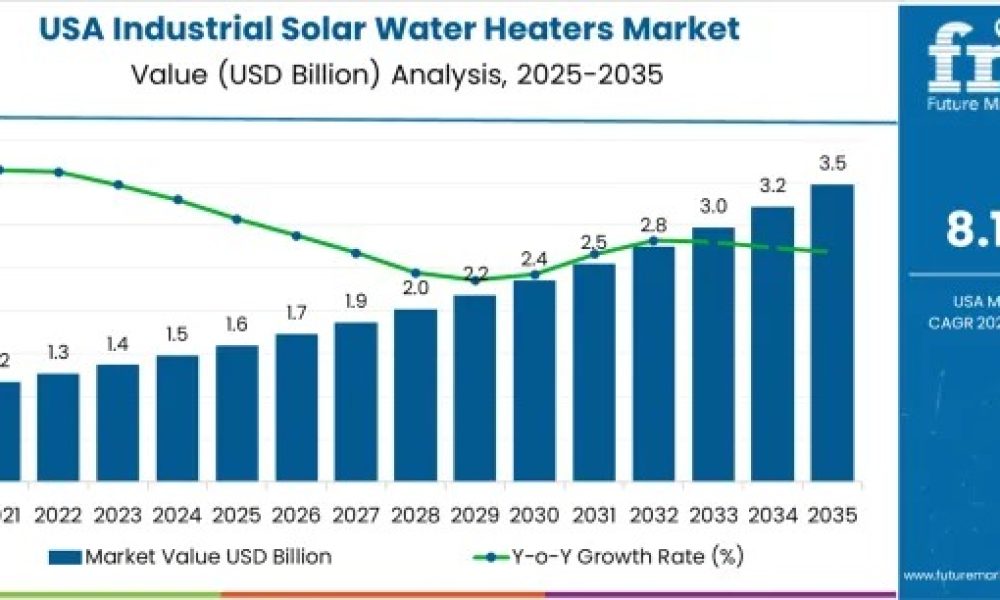
The Demand for Industrial Solar Water Heaters in USA is expected to surge from USD 1.6 billion in 2025 to USD 3.5 billion by 2035, reflecting a CAGR of 8.1%. Industrial facilities are increasingly adopting solar water-heating systems to reduce fuel costs, stabilize operating expenses, and meet corporate sustainability objectives. Key applications include food processing, chemical production, textiles, and light industrial operations with year-round hot-water demand.
Subscribe for Year-Round Insights → Stay ahead with quarterly and annual data updates https://www.futuremarketinsights.com/reports/sample/rep-gb-28843
Medium-scale facilities lead the adoption curve due to predictable thermal loads and system integration ease with existing boilers and storage tanks. Large-scale operations follow closely, offsetting high hot-water consumption, while small-scale facilities leverage solar-thermal systems for routine heating needs.
Regional Insights: West, South, Northeast Lead Growth
The West, South, and Northeast regions dominate the U.S. industrial solar water heaters market, supported by abundant solar resources, strong industrial clusters, and state-level renewable energy incentives.
- West (CAGR 9.3%): Strong adoption in California, Arizona, and Nevada, especially in food-processing, beverage, and dairy operations. Large-scale systems with thermal storage maintain hot-water availability during peak-load periods.
- South (CAGR 8.3%): Growth driven by industrial hubs in Texas, Florida, Georgia, and the Carolinas. Solar-thermal units are used in equipment washdowns, commercial kitchens, and laundries.
- Northeast (CAGR 7.4%): Adoption in New York, Pennsylvania, and Massachusetts focuses on hospitals, universities, and commercial laundries, often using evacuated-tube collectors and hybrid systems for colder climates.
- Midwest (CAGR 6.5%): Steady growth across Illinois, Ohio, Wisconsin, and Minnesota with dairy, meat-processing, and industrial washdown applications.
Market Segmentation: Industry Type, Sales Channel, and End Use
By Industry Type
- Medium-scale facilities (35.5%): Optimal balance between thermal load and installation feasibility.
- Large-scale facilities (32.5%): Offset high hot-water consumption.
- Small-scale facilities (32.0%): Support routine utility needs.
By Sales Channel
- Aftermarket supply (51.3%): Dominant channel for replacements, expansions, and upgrades.
- OEM sales (48.7%): Supports first-time installations and new-build projects.
By End Use
- Oil & Gas (30.8%): Uses solar-heated water for cleaning, maintenance, and auxiliary heating.
- Automotive (29.7%): Workshop utility, parts cleaning, and coating preparation.
- Construction (22.2%): Site-level heating and material processing.
- Paint & Coatings (17.3%): Stable warm-water supply for formulation and cleaning.
Growth Drivers, Restraints, and Emerging Trends
Drivers:
- Rising energy costs and fuel-price volatility.
- Regulatory incentives promoting renewable thermal energy.
- Expansion in industries with high and continuous hot-water demand.
Restraints:
- High upfront system costs.
- Integration challenges with existing boilers and process lines.
- Solar resource variability in some regions.
Trends:
- Adoption of hybrid solar-thermal systems combining solar collectors with gas or electric backup.
- Leasing or energy-service models reducing upfront costs for operators.
- Growth in food, beverage, textile, and laundry sectors due to predictable thermal loads.
Market Breakpoints: Adoption Phases
- 2026–2028: Acceleration phase as industrial facilities integrate large-scale solar-thermal systems to reduce fuel costs and meet sustainability targets.
- 2030–2032: Stabilization phase with growth driven by system optimization, component upgrades, and enhanced efficiency rather than new installations.
Competitive Landscape: Key Players
The U.S. industrial solar water heaters market is dominated by:
- ATR Solar: 45.5% market share, recognized for collector efficiency and long-term reliability.
- SunEarth: Flat-plate and evacuated-tube systems suited for varied U.S. climates.
- Racold: High-temperature output for continuous-duty industrial applications.
- Heliodyne, Inc.: Engineered systems with controlled flow characteristics.
- Alternate Energy Technologies LLC: Modular, large-format systems for scalable applications.
Competition focuses on collector efficiency, durability, installation flexibility, and consistent thermal output.
Conclusion
The U.S. industrial solar water heaters market is poised for significant growth, driven by sustainability goals, rising energy costs, and industrial process-heating demands. Medium- and large-scale facilities, particularly in the West and South, are the primary adopters, while hybrid systems, financial leasing models, and component optimization define the future growth trajectory.
Get data that aligns with your strategic priorities — ask for report customization today: https://www.futuremarketinsights.com/customization-available/rep-gb-28843
Have a specific Requirements and Need Assistant on Report Pricing or Limited Budget please contact us – [email protected]
About Future Market Insights (FMI)
Future Market Insights, Inc. (FMI) is an ESOMAR-certified, ISO 9001:2015 market research and consulting organization, trusted by Fortune 500 clients and global enterprises. With operations in the U.S., UK, India, and Dubai, FMI provides data-backed insights and strategic intelligence across 30+ industries and 1200 markets worldwide.
Contact Us:
Future Market Insights Inc.
Christiana Corporate, 200 Continental Drive,
Suite 401, Newark, Delaware – 19713, USA
T: +1-347-918-3531



