
USA Friction Modifier Additives Market Shows Consistent, Performance-Led Growth
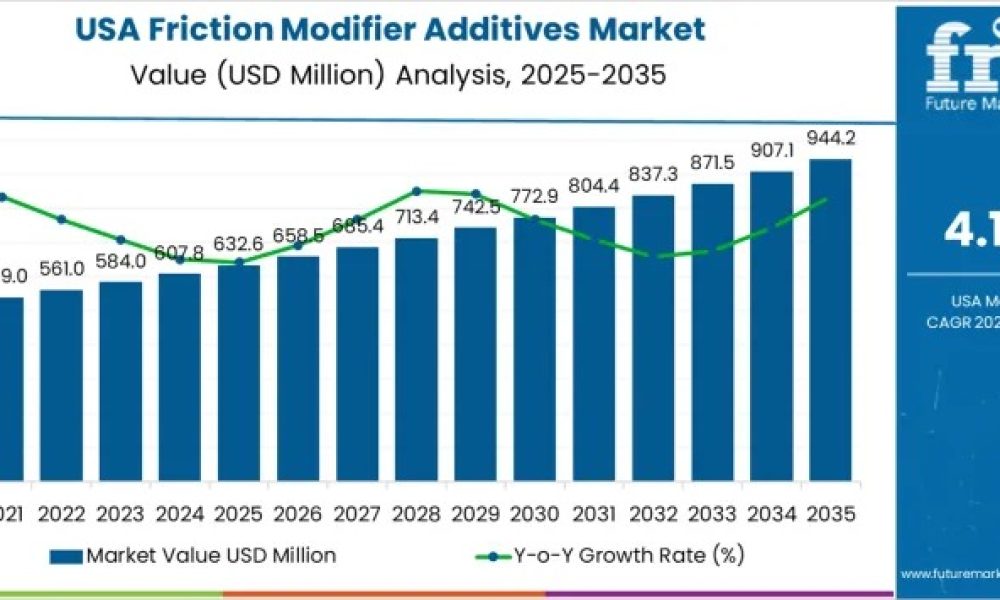
The Demand for Friction Modifier Additives in USA continues to strengthen as lubricant manufacturers respond to rising expectations for fuel efficiency, lower emissions, and extended equipment life. Valued at USD 632.6 million in 2025, the market is forecast to reach USD 944.2 million by 2035, expanding at a CAGR of 4.1%. Growth is anchored in the widespread use of advanced engine oils, transmission fluids, and industrial lubricants that rely on friction-reducing chemistries to deliver measurable performance gains.
Stay ahead with quarterly and annual data updates:
Market Growth Drivers: Efficiency and Durability at the Core
Friction modifier additives reduce boundary friction between metal surfaces, directly supporting improved fuel economy and lower wear rates. In the United States, regulatory pressure on vehicle efficiency and emissions has accelerated adoption across passenger cars, commercial fleets, and heavy-duty machinery.
Key growth drivers include:
- Rising production of low-viscosity engine oils
- Increasing focus on extending oil drain intervals
- Demand for reduced maintenance costs in fleets and industry
- Higher vehicle miles traveled across urban and regional markets
Early forecast years benefit from rapid integration into new lubricant formulations, while later growth is sustained by replacement demand and incremental efficiency upgrades.
Organic Friction Modifiers Lead Product Demand
Organic friction modifiers remain the dominant product category in the USA due to their strong lubricity, compatibility with modern lubricant chemistries, and stable performance across varying temperatures. These additives are particularly effective in high-mileage vehicles and stop-and-go driving conditions.
Product-type insights:
- Organic modifiers dominate due to fuel-efficiency benefits
- Improved oxidation resistance enhances durability
- Compatibility with emission-control systems supports adoption
Inorganic friction modifiers, including molybdenum-based compounds, retain importance in high-load and high-temperature industrial and heavy-duty applications.
Automotive Lubricants Remain the Primary Application
Automotive lubricants account for the largest share of friction modifier additive consumption in the United States. High vehicle density, long commute patterns, and frequent servicing cycles reinforce steady demand. Beyond automotive use, industrial lubricants form a significant segment, supporting manufacturing machinery, gearboxes, and hydraulic systems that require continuous, reliable operation.
Application highlights:
- Passenger and commercial vehicles anchor demand
- Industrial machinery drives stable secondary consumption
- Rail, aviation, and power generation add niche growth
Regional Demand Reflects Mobility and Industrial Activity
Regional market performance aligns closely with vehicle concentration and industrial output. West USA leads growth with strong automotive aftermarket activity and higher adoption of fuel-efficient lubricants. South USA follows, supported by freight movement, high vehicle ownership, and climate-driven lubricant stress. Northeast USA demand is shaped by dense urban traffic and cold-weather performance needs, while Midwest USA maintains steady growth from manufacturing and agriculture.
Regional growth factors:
- Automotive fleet concentration
- Industrial equipment utilization
- Climate and operating conditions
- Aftermarket lubricant penetration
Competitive Landscape Focused on Innovation and Reliability
Leading suppliers such as Chevron Oronite Company LLC, Royal Dutch Shell Plc, Evonik Industries AG, Tianhe Chemicals Group, and Vanderbilt Chemicals LLC compete on formulation expertise, product consistency, and regulatory compliance. Strategic priorities include development of next-generation additives suited for fuel-efficient and partially electrified powertrains, along with strengthening supply reliability for industrial maintenance markets.
Outlook: Stable Growth Through 2035
While electric vehicle adoption introduces a moderating effect on traditional engine-oil volumes, friction control remains essential across transmissions, industrial machinery, and auxiliary systems. As a result, the USA friction modifier additives market maintains a positive growth trajectory through 2035, supported by performance-driven fundamentals rather than short-term regulatory cycles.
Get data that aligns with your strategic priorities — ask for report customization today:
Have a specific Requirements and Need Assistant on Report Pricing or Limited Budget please contact us – [email protected]
About Future Market Insights (FMI)
Future Market Insights, Inc. (FMI) is an ESOMAR-certified, ISO 9001:2015 market research and consulting organization, trusted by Fortune 500 clients and global enterprises. With operations in the U.S., UK, India, and Dubai, FMI provides data-backed insights and strategic intelligence across 30+ industries and 1200 markets worldwide.
Contact Us:
Future Market Insights Inc.
Christiana Corporate, 200 Continental Drive,
Suite 401, Newark, Delaware – 19713, USA
T: +1-347-918-3531



