
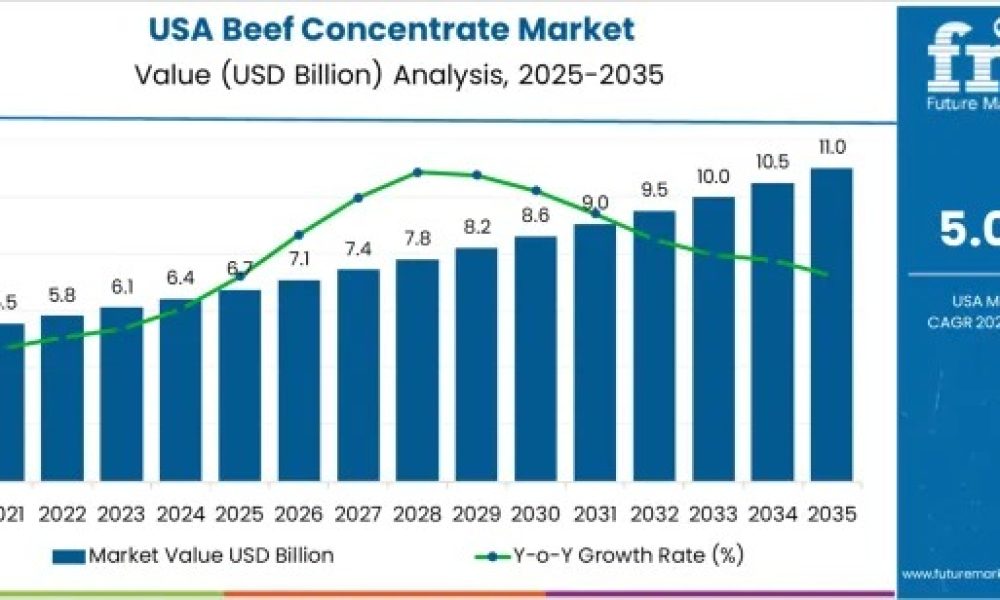
The USA beef concentrate market is entering a decade of strong expansion, driven by rising demand from industrial food manufacturers, large foodservice operators, and processors of ready meals, sauces, soups, and snack seasonings. In 2025, U.S. demand stands at USD 6.7 billion and is forecast to reach USD 11.0 billion by 2035, advancing at a 5.0% CAGR. Unlike fresh beef, whose demand patterns are largely consumption driven, beef concentrate growth is powered by large-scale manufacturing throughput and the need for standardized flavor systems.
The market’s early growth is supported by the widespread adoption of concentrated meat bases in packaged foods, frozen entrées, gravies, broths, and meal kits. Quick-service restaurants, commissary kitchens, and institutional food operators are fueling consistent demand as they prioritize controlled flavor intensity, long-term storage stability, and streamlined back-of-house operations.
Explore trends before investing – request a sample report today! https://www.futuremarketinsights.com/reports/sample/rep-gb-29209
Industrial Formulation Supports Steady Expansion Through 2030
From 2025 to 2030, the U.S. beef concentrate market is set to grow from USD 6.7 billion to USD 7.1 billion, adding USD 0.4 billion in value. This period marks moderate but steady expansion, shaped by stable production across processed meals and convenience foods.
Key application drivers include:
- Ready meals, frozen entrées, and pantry-ready soups
- Sauces, gravies, and concentrated broths
- Snack seasonings and meat-flavored blends
- Contract food manufacturing for private label brands
During this phase, processors maintain relatively consistent inclusion rates. Value growth therefore stems from throughput rather than major increases in formulation loading.
2030–2035: Stronger Value Growth as Beef Concentrate Becomes a Core Ingredient
Between 2030 and 2035, the market expands from USD 7.1 billion to USD 11.0 billion, adding USD 3.9 billion and signaling a clear pivot toward higher-value applications. Growth intensifies as beef concentrate becomes central to developing new product formulations in both traditional and emerging food categories.
Drivers of late-decade acceleration include:
- Wider use of hybrid flavor systems integrating yeast extracts, amino acids, and reaction flavors
- Growing demand from premium prepared meals and high-protein savory snacks
- Increased deployment in plant-based and hybrid meat alternatives
- Expansion of U.S. processed food exports requiring flavor-stable, shelf-ready formulations
Manufacturers increasingly treat beef concentrate as a strategic ingredient for consistency, automation compatibility, and clean-label ready positioning.
Market Structure: Source and Form Preferences
Stock-based beef concentrate, accounting for 57% of national demand, remains the category standard. Its balanced savory profile, predictable salinity, and compatibility with a wide range of recipes make it the first choice for soups, sauces, gravies, and ready meals.
Liquid beef concentrate, with a 39.0% share, dominates due to its fast solubility and efficiency in automated dosing systems widely used in industrial and institutional kitchens. Its suitability for continuous mixing lines also boosts adoption across large-scale packaged food manufacturing.
Regional Outlook Through 2035 (No Table, Narrative Only)
The West leads U.S. growth with a 5.8% CAGR, reflecting strong development of ready meals, soups, sauces, and export-oriented processed foods. California and Pacific Northwest processors rely heavily on beef concentrate for flavor stability across frozen and shelf-stable formats.
The South follows with 5.2% CAGR, supported by meat processing clusters, seasoned snack production, and foodservice commissaries supplying quick-service restaurants and institutional clients. Population growth and high packaged food consumption reinforce demand.
The Northeast, growing at 4.6%, benefits from dense urban demand for prepared foods, including premium soups, sauces, and institutional catering. Hospitals, universities, and workplace cafeterias drive repeat procurement as they depend on consistent flavor performance.
The Midwest, expanding at 4.0%, remains a backbone of U.S. food manufacturing. Its demand is tied to meatpacking, frozen meal production, seasoning blends, and national private-label manufacturing contracts that rely on standardized flavor systems.
Why Beef Concentrate Has Become a Cornerstone Ingredient
Manufacturers and foodservice operators increasingly rely on beef concentrate for:
- Flavor density that reduces need for long cooking or large volumes of fresh beef
- Consistency across batches in high-throughput plants
- Lower volatility vs. fresh beef supply cycles
- Improved storage efficiency and reduced spoilage
- Cost control in large-scale menu or product development
As Americans show rising interest in protein-rich snacks, umami-forward flavor profiles, and time-saving meal formats, the role of beef concentrate becomes even more pivotal. Updated formulations also allow reduced-sodium use, improved clean-label positioning, and application in next-generation plant-based blends.
Industry Leadership and Competitive Landscape
U.S. supply is led by vertically integrated processors and global flavor ingredient companies. The market’s leading players include:
- Hormel Foods Corporation
- Tyson Foods
- JBS S.A.
- Cargill Inc.
- Kerry Group
These companies shape supply availability through extensive meat processing networks, value-added ingredient portfolios, and high-volume production capabilities that support national and international food manufacturing.
Quick Market Highlights (Narrative, No Table)
In 2025, U.S. beef concentrate demand is valued at USD 6.7 billion, led by stock-based sources and liquid formats. By 2035, demand reaches USD 11.0 billion, reflecting a 5.0% CAGR. The West emerges as the fastest-growing region, followed by the South, Northeast, and Midwest.
Subscribe for Year-Round Insights → Stay ahead with quarterly and annual data updates! https://www.futuremarketinsights.com/reports/brochure/rep-gb-29209
Closing Outlook
With food manufacturers shifting decisively toward flavor-standardized, high-efficiency ingredients, the U.S. beef concentrate market is well positioned for sustained growth. The next decade will see expanded use in hybrid protein foods, export-ready processed meals, and automated foodservice operations—cementing beef concentrate as a core ingredient in the evolving U.S. food industry.



