
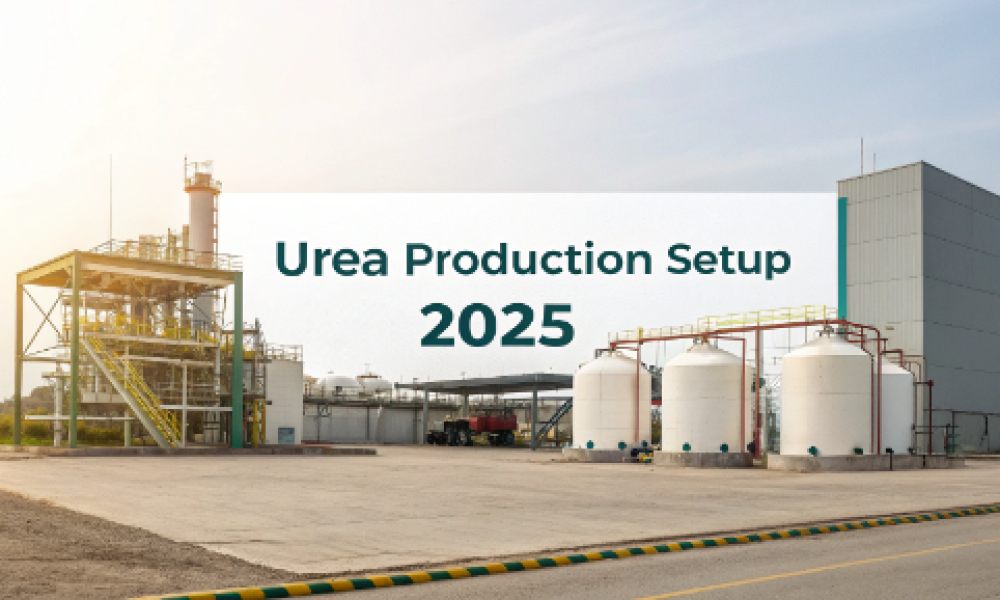
Urea or carbamide is a white odorless crystalline organic chemical compound. It has the chemical formula CO(NH2)2. Urea is the most commonly used nitrogen fertilizer in the world market, on account of its high nitrogen content (46%) and its use in protein synthesis in crops. Urea has use in animal feed supplements, diesel exhaust fluid like AdBlue or diesel exhaust fluid, plastics, resins, adhesives, and pharmaceuticals. It is used as a nitrogen source in cosmetics and is non-toxic and water soluble. Urea is important to agriculture as fertilizer for cereals, vegetables, fruit, other food crops, and commercial plantations.
A urea plant requires natural gas or coal, high pressure reactors, CO2 compressors, synthesis loops, evaporators, prilling or granulation towers, and bagging units. It requires a large land area, ammonia supply, and a constant supply of carbon dioxide for the reactions. Facilities involving high-pressure steam, cooling water and effluent treatment, chemical engineers, and rail or ports for transport are also needed. Ammonia-CO₂ process investment costs vary with plant size that ranges from 1,000 to 4,000 TPD, technology, feedstock, energy efficiency, environmental controls, and whether excess ammonia is sold for Stamicarbon, Snamprogetti, and Toyo technologies.
IMARC Group’s report, titled “Urea Production Cost Analysis 2025: Industry Trends, Plant Setup, Machinery, Raw Materials, Investment Opportunities, Cost and Revenue,” provides a complete roadmap for setting up a urea production plant cost. It covers a comprehensive market overview to micro-level information such as unit operations involved, raw material requirements, utility requirements, infrastructure requirements, machinery and technology requirements, manpower requirements, packaging requirements, transportation requirements, etc.
Urea Industry Outlook 2025
The urea industry is expected to witness moderate growth in 2025, driven by increasing global food demand, expanding agricultural land under cultivation, and government initiatives promoting food security and farmer subsidies. Rising population, dietary shifts toward protein-rich foods, and soil nutrient depletion necessitate higher fertilizer consumption. Asia-Pacific, particularly India and China, dominates consumption and production, while Middle East and North Africa leverage low-cost natural gas for exports. Manufacturers are investing in energy-efficient technologies, coal-to-urea conversion, nano-urea alternatives, and environmental compliance systems. However, volatile natural gas prices, subsidy reforms, and environmental regulations present ongoing challenges.
Request for a Sample Report: https://www.imarcgroup.com/urea-manufacturing-plant-project-report/requestsample
Key Insights for setting up a Urea Production Plant
Detailed Process Flow
- Product Overview
- Unit Operations Involved
- Mass Balance and Raw Material Requirements
- Quality Assurance Criteria
- Technical Tests
Project Details, Requirements and Costs Involved:
- Land, Location and Site Development
- Plant Layout
- Machinery Requirements and Costs
- Raw Material Requirements and Costs
- Packaging Requirements and Costs
- Transportation Requirements and Costs
- Utility Requirements and Costs
- Human Resource Requirements and Costs
Capital Expenditure (CapEx) and Operational Expenditure (OpEx) Analysis:
Project Economics:
- Capital Investments
- Operating Costs
- Expenditure Projections
- Revenue Projections
- Taxation and Depreciation
- Profit Projections
- Financial Analysis
Profitability Analysis:
- Total Income
- Total Expenditure
- Gross Profit
- Gross Margin
- Net Profit
- Net Margin
Key Cost Components
- Land acquisition requiring extensive area (100-200 acres) with industrial zoning
- Technology licensing fees from process licensors (Stamicarbon, Toyo, Saipem, thyssenkrupp)
- Engineering, procurement, and construction (EPC) contracts
- Major process equipment (ammonia synthesis converters, CO₂ compressors, high-pressure reactors, carbamate condensers, urea synthesis reactors)
- Utilities and auxiliary systems (steam boilers, cooling towers, water treatment plants, air separation units)
- Prilling or granulation towers with spray systems
- Raw material procurement infrastructure (natural gas pipeline connections or coal gasification units)
- Ammonia storage tanks and handling systems
- Power generation facilities or grid connectivity with backup systems
- Instrumentation and process control systems (DCS, SCADA).
Economic Trends Influencing Urea Plant Setup Costs 2025
- Natural gas price volatility significantly impacting feedstock costs (60-70% of production cost)
- Government fertilizer subsidy policies affecting profitability and pricing
- Rising capital costs for technology licensing and equipment procurement
- Energy efficiency standards driving investment in advanced process technologies
- Import duties and trade policies affecting international competitiveness
- Currency exchange rates impacting equipment imports and technology payments
- Environmental regulations requiring costly pollution control investments
- Coal gasification technology adoption in gas-scarce regions
- Competition from imported urea affecting domestic market dynamics
- Government norms on energy consumption and carbon emissions.
Speak to an Analyst for Customized Report:
https://www.imarcgroup.com/request?type=report&id=7647&flag=C
Challenges and Considerations for Investors
- Extremely high capital investment (₹5,000-8,000 crores for 2,000 TPD plant)
- Heavy dependency on natural gas availability and pricing volatility
- Long project gestation period (4-6 years) from conception to commissioning
- Complex high-pressure, high-temperature chemical processes requiring expertise
- Government control on urea pricing through subsidy mechanisms affecting margins
- Competition from subsidized imports and international producers
- Continuous feedstock supply assurance critical for plant economics
- Energy-intensive operations with gas cost determining profitability
- Stringent environmental regulations for ammonia emissions and effluent discharge
- Technology obsolescence requiring periodic upgrades for energy efficiency.
Conclusion
The urea industry is positioned for steady growth, underpinned by rising agricultural demands and global efforts toward food security. As a key nitrogen-based fertilizer, urea continues to play a vital role in enhancing crop yields, while also finding use in industrial and environmental applications. Setting up a urea production plant involves significant capital and operational investment, driven by factors such as energy costs, feedstock availability, environmental compliance, and technological efficiency. For investors, success lies in mitigating risks associated with price volatility, regulatory dynamics, and market competition, while leveraging opportunities through innovation and government support for sustainable fertilizer production.
About Us:
IMARC Group is a global management consulting firm that helps the world’s most ambitious changemakers to create a lasting impact. The company excel in understanding its client’s business priorities and delivering tailored solutions that drive meaningful outcomes. We provide a comprehensive suite of market entry and expansion services. Our offerings include thorough market assessment, feasibility studies, company incorporation assistance, factory setup support, regulatory approvals and licensing navigation, branding, marketing and sales strategies, competitive landscape, and benchmarking analyses, pricing and cost research, and procurement research.
Contact Us:
IMARC Group
134 N 4th St. Brooklyn, NY 11249, USA
Email: [email protected]
Tel No:(D) +91 120 433 0800
United States: (+1-201971-6302)




