
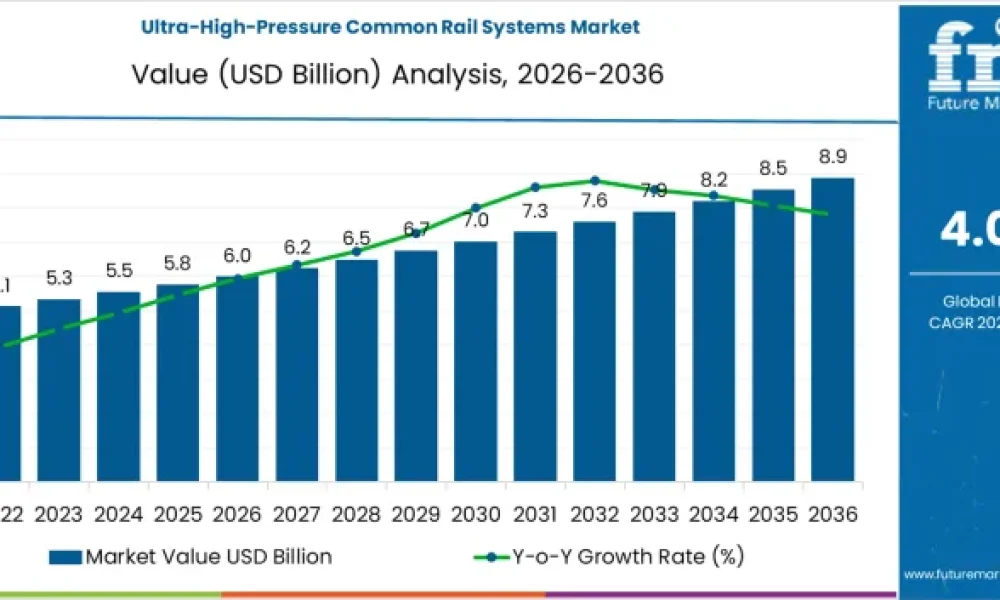
The global ultra-high-pressure common rail (UHPCR) systems market is valued at USD 6.0 billion in 2026 and is projected to reach USD 8.9 billion by 2036, expanding at a compound annual growth rate (CAGR) of 4.0%. Market performance reflects sustained adoption across advanced diesel and hybrid engine programs, where precise high-pressure fuel delivery remains essential to meeting increasingly stringent emission standards and efficiency targets.
Ultra-high-pressure common rail systems, operating at pressures exceeding 2,200 bar, have become a foundational technology for modern internal combustion engines. These systems enable accurate fuel metering, multiple injection events per cycle, and improved atomization, directly supporting reductions in particulate matter and NOx emissions. Demand is closely tied to the operational requirements of heavy-duty commercial vehicles, off-highway machinery, and increasingly, passenger vehicles equipped with advanced diesel architectures.
Market Structure Defined by OEM Program Alignment and Certification Cycles
The UHPCR systems market is characterized by volume stability rather than rapid expansion, with production closely aligned to OEM engine program cycles, regulatory certification timelines, and new engine launches. Suppliers delivering validated, pressure-stable systems benefit from predictable revenue streams and long-term supply agreements, while smaller operators face demand variability and limited negotiating leverage.
Revenue concentration remains high among suppliers embedded in high-volume engine platforms, where compliance with global emission standards determines adoption eligibility. Margins are strongest for manufacturers offering multi-platform compatibility, integrated electronic control modules, and long-term service and support agreements. While fragmentation persists in aftermarket and regional component supply, established players continue to consolidate value through platform standardization, production consistency, and deep integration within OEM supply chains.
Get access to comprehensive data tables and detailed market insights — request your sample report today!
Growth Outlook Through 2036
Between 2026 and 2031, the market is expected to grow from USD 6.0 billion to USD 7.1 billion, generating an absolute increase of USD 1.1 billion at a rolling CAGR of approximately 3.4%. Around 65% of this growth is volume-driven, supported by increased adoption in heavy-duty on-road, off-highway, and marine or stationary engines. The remaining 35% of growth is price-led, reflecting the uptake of higher-pressure classes, integrated control components, and premium OEM line-fit systems.
From 2031 to 2036, market value is forecast to expand further to USD 8.9 billion, adding USD 1.8 billion at a higher rolling CAGR of 4.7%. Growth during this period is supported by broader deployment in retrofit and upgrade programs, alongside new engine architectures requiring higher injection precision. Volume remains the primary driver, contributing approximately 63% of growth, while price increases account for 37%, supported by advanced injectors, high-pressure pumps, and enhanced control valve technologies.
Heavy-Duty On-Road Engines Anchor Demand
By engine segment, heavy-duty on-road engines account for approximately 56% of total market demand, making them the dominant application category. These engines operate under high load variability, extended duty cycles, and strict regulatory oversight, all of which necessitate ultra-high-pressure fuel injection systems capable of consistent performance. Common rail systems enable optimized combustion, improved fuel efficiency, and lower emissions, supporting compliance with global standards such as Euro VI and equivalent regulations.
The dominance of heavy-duty on-road applications reflects the scale of global freight transport and commercial vehicle operations, where reliability, uptime, and regulatory adherence directly influence total cost of ownership.
Pressure Class Trends Reflect Balance of Performance and Durability
By pressure class, the 2,200–2,500 bar range represents around 44% of total demand, emerging as the leading segment. This pressure range provides an optimal balance between fuel atomization efficiency, emission reduction, and system durability. Compatibility with existing engine designs and proven lifecycle performance reinforces adoption across commercial, off-highway, and stationary engine applications.
While higher pressure classes above 2,500 bar are gaining attention for next-generation engines, the 2,200–2,500 bar segment remains the industry benchmark due to its reliability under continuous high-pressure operation and manageable lifecycle costs.
Regulatory Pressure and Efficiency Targets Accelerate Adoption
Stricter global emission norms and fuel efficiency regulations continue to shape demand for UHPCR systems. Compared with earlier fuel injection technologies, modern common rail systems integrate advanced electronic controls, high-precision injectors, and robust materials engineered to withstand extreme pressure and temperature conditions. Adoption is driven less by cost considerations and more by the necessity of regulatory compliance, operational reliability, and performance optimization.
Manufacturers increasingly prioritize systems that deliver consistent pressure control, reduced emissions, and compatibility with turbocharged and downsized engines. As regulatory frameworks tighten further, ultra-high-pressure common rail systems are expected to become standard across a wider range of diesel and hybrid powertrains.
Regional Demand Patterns Highlight China’s Momentum
Geographically, demand growth varies by region based on diesel engine penetration, regulatory enforcement, and fleet modernization trends. China leads with a CAGR of 7.5%, driven by expanding commercial vehicle production, stringent emission regulations, and rapid adoption of advanced diesel technologies. The United States follows at 4.5%, supported by fleet upgrades and compliance requirements in heavy-duty transport.
South Korea (3.5%) and the United Kingdom (3.0%) reflect steady adoption linked to efficiency optimization and gradual replacement cycles, while Brazil (2.5%) shows moderate growth aligned with slower diesel market expansion.
Competitive Landscape Anchored by Engineering Capability
The ultra-high-pressure common rail systems market is led by established players including Bosch, Denso, Delphi (BorgWarner), Continental, Cummins, Weifu High-Technology, Stanadyne, Hitachi Astemo, Rheinmetall, and Mahle. Competitive differentiation is defined by maximum pressure capability, injector response precision, system durability, and global emissions compliance.
Leading suppliers leverage deep engineering expertise, validated system performance, and OEM partnerships to secure long-term programs, reinforcing their position as preferred partners in advanced engine development.
Outlook
The UHPCR systems market is positioned for measured, resilient growth through 2036, underpinned by regulatory mandates, engine efficiency requirements, and the continued relevance of advanced diesel powertrains. As emission thresholds tighten and engine architectures evolve, suppliers capable of delivering certified, pressure-stable, and scalable common rail solutions are expected to capture disproportionate value.
A comprehensive analysis of technology trends, regional demand shifts, and competitive positioning is available in the full Ultra-High-Pressure Common Rail Systems Market Report, offering deeper insight into growth opportunities across this critical fuel injection segment.
Why Choose FMI: Empowering Decisions that Drive Real-World Outcomes: https://www.futuremarketinsights.com/why-fmi
About Future Market Insights (FMI)
Future Market Insights, Inc. (FMI) is an ESOMAR-certified, ISO 9001:2015 market research and consulting organization, trusted by Fortune 500 clients and global enterprises. With operations in the U.S., UK, India, and Dubai, FMI provides data-backed insights and strategic intelligence across 30+ industries and 1200 markets worldwide.



