
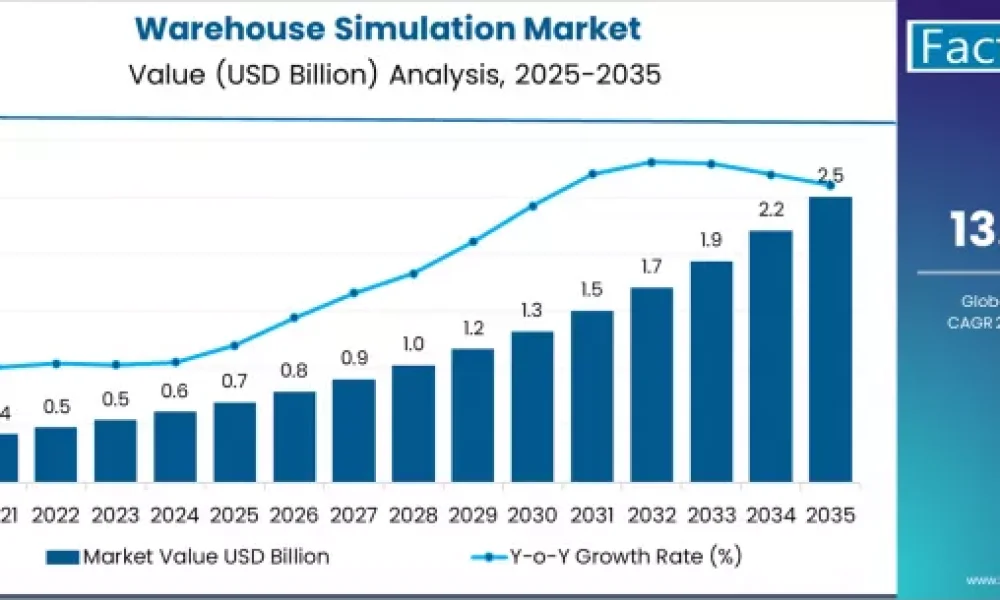
The U.S. warehouse simulation market is poised for substantial growth from 2025 to 2035, driven by the increasing complexity of supply chains, rising adoption of automation technologies, and growing demand for digital twin and simulation-driven operational optimization. Warehouse simulation solutions—including discrete event simulation (DES), agent-based simulation, and system dynamics simulation—play a vital role in enhancing operational efficiency, improving warehouse layout design, and optimizing material handling processes across industries such as automotive, e-commerce, consumer electronics, and logistics. This report highlights market size, growth drivers, technology trends, and strategic implications for stakeholders.
Market Size and Growth
The U.S. warehouse simulation market is expected to grow from approximately USD 0.7 billion in 2025 to around USD 2.5 billion by 2035, reflecting a robust compound annual growth rate (CAGR) of 13.6%. Discrete event simulation remains the leading product type, accounting for over 51% of the market, while on-premises deployment is expected to dominate the segment with a 59% share. The growth trajectory reflects the market’s increasing adoption in highly automated facilities, growing e-commerce operations, and the need for predictive planning and process optimization in warehouse management.
To access the complete data tables and in-depth insights, request a Discount On The Report here: https://www.factmr.com/connectus/sample?flag=S&rep_id=11608
Key Growth Drivers
- Rising supply chain complexity:Expanding multi-site distribution networks and high-volume e-commerce fulfillment operations require advanced simulation tools to optimize warehouse layouts, resource allocation, and workflow efficiency.
- Technological advancements:Integration of AI-assisted simulation, digital twins, and real-time analytics allows operators to model, predict, and optimize warehouse performance, improving throughput and reducing operational costs.
- Automation adoption:Growing deployment of automated storage and retrieval systems (AS/RS), autonomous mobile robots (AMRs), and high-throughput sorting technologies necessitates accurate virtual modeling before physical implementation.
- Industry 4.0 integration:Simulation platforms increasingly integrate with warehouse management systems (WMS) and enterprise resource planning (ERP) solutions, enabling real-time decision-making and continuous performance improvement.
U.S. Market Insights
The United States represents a mature and high-value market for warehouse simulation solutions, driven by large-scale industrial, automotive, and e-commerce distribution operations. Discrete event simulation dominates due to its ability to replicate real-world warehouse operations, identify bottlenecks, and validate automation scenarios before implementation. Agent-based and system dynamics simulations are gaining traction, particularly in facilities employing autonomous robotics or complex supply chain networks. The market is competitive, with key players including Siemens, Dassault Systèmes, AnyLogic, Rockwell Automation, and FlexSim.
Technology Trends and Competition
Key trends shaping the U.S. warehouse simulation market include:
- Digital twin integration for continuous synchronization between physical and virtual warehouse operations.
- AI-driven predictive analytics to optimize workflows and forecast performance under varying demand conditions.
- Hybrid simulation models combining discrete event, agent-based, and system dynamics approaches for comprehensive operational insights.
- Cloud-based platforms offering scalability, real-time collaboration, and enhanced multi-site coordination.
Challenges
Despite rapid growth, the market faces several challenges:
- High upfront costs for simulation software and training may limit adoption among smaller operators.
- Complexity in integrating simulation platforms with existing WMS or ERP systems.
- Need for skilled personnel to analyze simulation data and implement actionable insights effectively.
Strategic Implications
For manufacturers and software providers: Develop scalable, flexible simulation solutions combining digital twin integration, AI analytics, and consulting support to meet diverse operational requirements.
For warehouse operators: Adopt simulation tools to validate layouts, optimize resource allocation, and integrate predictive analytics into daily operations for improved efficiency and cost savings.
For investors: The U.S. warehouse simulation market offers high growth potential, driven by automation trends, e-commerce expansion, and the increasing strategic importance of simulation in operational planning.
Outlook Summary
From 2025 to 2035, the U.S. warehouse simulation market is expected to grow significantly, driven by technological innovation, rising automation adoption, and the need for data-driven warehouse optimization. Discrete event simulation will remain the dominant technology, while AI-assisted models, digital twin platforms, and cloud-based solutions will drive next-generation operational excellence. While challenges related to cost and integration persist, the market presents compelling opportunities for manufacturers, warehouse operators, and investors seeking to enhance efficiency, reduce operational risks, and support the evolving demands of modern supply chains.
Purchase Full Report for Detailed Insights
For access to full forecasts, regional breakouts, company share analysis, and emerging trend assessments, you can purchase the complete report here: https://www.factmr.com/checkout/11608
Have a specific Requirements and Need Assistant on Report Pricing or Limited Budget please contact us – [email protected]
About Fact.MR
Fact.MR is a global market research and consulting firm, trusted by Fortune 500 companies and emerging businesses for reliable insights and strategic intelligence. With a presence across the U.S., UK, India, and Dubai, we deliver data-driven research and tailored consulting solutions across 30+ industries and 1,000+ markets. Backed by deep expertise and advanced analytics, Fact.MR helps organizations uncover opportunities, reduce risks, and make informed decisions for sustainable growth.



