
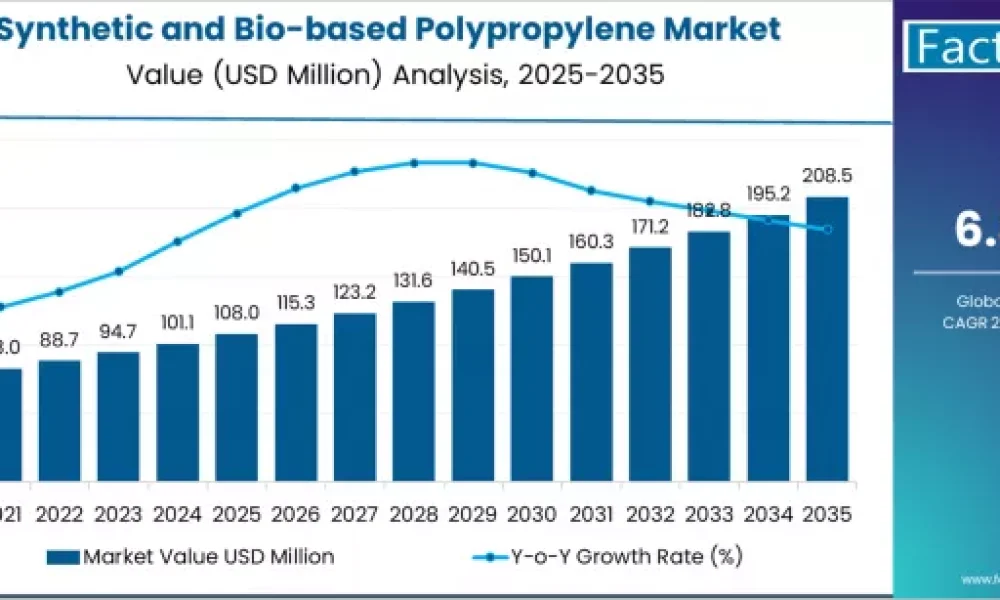
The U.S. synthetic and bio-based polypropylene market is set for steady expansion from 2025 to 2035, fueled by increasing demand for sustainable polymer alternatives, adoption of bio-based materials across industries, and growing interest in circular economy practices. Synthetic and bio-based polypropylene—including sugarcane-derived propylene, fermentation-based intermediates, and renewable polymer grades—plays a crucial role in packaging, automotive, textile, and industrial applications. This report highlights market size, growth drivers, regional dynamics, technology trends, and strategic implications for stakeholders.
Market Size and Growth
The U.S. synthetic and bio-based polypropylene market is projected to grow from approximately USD 108.0 million in 2025 to USD 208.5 million by 2035, reflecting a compound annual growth rate (CAGR) of 6.8%. Injection molding dominates the application segment with a 48.4% share, while packaging leads the end-use segment at 42.0%. This moderate yet resilient growth reflects both increasing adoption of sustainable polymers and the challenges associated with feedstock availability, technological maturity, and production scale-up.
To access the complete data tables and in-depth insights, request a Discount On The Report here: https://www.factmr.com/connectus/sample?flag=S&rep_id=11746
Key Growth Drivers
Sustainability and renewable materials: Rising environmental awareness, government mandates, and corporate sustainability targets are driving the shift from petroleum-based polypropylene to bio-based alternatives.
Circular economy initiatives: Companies increasingly implement renewable feedstock sourcing, bio-refinery partnerships, and carbon-neutral production methods to reduce carbon footprint and comply with regulatory frameworks.
Industrial diversification: Packaging producers, automotive suppliers, and textile manufacturers are integrating bio-based polypropylene into injection molding, film production, non-woven materials, and fiber spinning, broadening application scope and market adoption.
Technological innovation: Advances in processing, additive-enhanced compounds, and high-performance bio-based grades are enabling performance parity with conventional polypropylene while supporting sustainability objectives.
U.S. Market Insights
The United States represents a key market for synthetic and bio-based polypropylene, driven by strong industrial adoption and corporate environmental initiatives. Injection molding is the primary application, particularly for automotive interior components, consumer packaging, and industrial parts. Packaging remains the leading end-use sector, reflecting demand for recyclable, renewable, and carbon-neutral solutions.
Challenges in the U.S. market include variability in renewable feedstock supply, competition with other bio-materials, and the need for compatibility with existing polymer processing equipment. Manufacturers must balance technical performance, cost-effectiveness, and sustainability credentials to capture market share effectively.
Technology Trends and Competition
The U.S. market is competitive, with major players including Braskem, Dow Inc., Borealis AG, LyondellBasell Industries Holdings B.V., Total S.A., and BioAmber Inc. Key trends include:
- Development of specialized bio-based grades for high-performance and additive-enhanced applications.
- Integration of renewable feedstocks and fermentation-based propylene intermediates into mainstream production.
- Investment in bio-refinery infrastructure and carbon certification systems.
- Adoption of circular economy principles to optimize recyclability and reduce environmental impact.
These innovations allow producers to meet regulatory requirements, achieve sustainability objectives, and expand market presence across multiple industrial applications.
Strategic Implications
For manufacturers: Focus on expanding bio-based product portfolios, investing in renewable feedstock partnerships, and developing specialized grades for automotive, packaging, and textile applications.
For industrial users: Incorporate bio-based polypropylene into production processes to meet corporate sustainability targets, reduce carbon footprint, and comply with regulatory standards.
For investors: The U.S. market offers resilient growth opportunities, supported by sustainability-driven adoption and increasing demand across diverse industrial applications.
Outlook Summary
Between 2025 and 2035, the U.S. synthetic and bio-based polypropylene market is expected to grow steadily, driven by rising demand for renewable polymers, environmental regulations, and circular economy initiatives. Injection molding and packaging will continue to dominate application and end-use segments, while technological innovation and bio-refinery expansion support broader industrial adoption. Although feedstock variability and processing challenges persist, the sector presents significant opportunities for manufacturers, industrial users, and investors committed to sustainable polymer solutions and environmentally responsible manufacturing.
Have a specific Requirements and Need Assistant on Report Pricing or Limited Budget please contact us – [email protected]
About Fact.MR
Fact.MR is a global market research and consulting firm, trusted by Fortune 500 companies and emerging businesses for reliable insights and strategic intelligence. With a presence across the U.S., UK, India, and Dubai, we deliver data-driven research and tailored consulting solutions across 30+ industries and 1,000+ markets. Backed by deep expertise and advanced analytics, Fact.MR helps organizations uncover opportunities, reduce risks, and make informed decisions for sustainable growth.



