
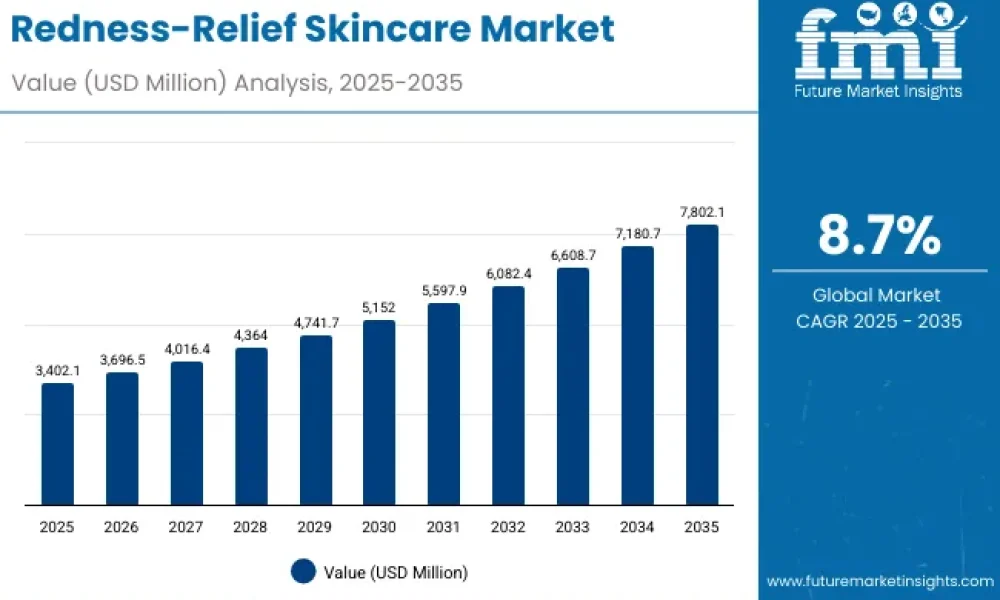
The Global Redness-Relief Skincare Market is set for strong expansion, projected to grow from USD 3,402.1 million in 2025 to USD 7,802.1 million by 2035, registering a robust CAGR of 8.7%. With an expected increase of USD 4,400.0 million, the market is poised for a significant 129% growth over the next decade. Rising awareness of sensitive skin conditions, especially rosacea and environmental irritation, is reshaping global skincare demand, positioning redness-relief solutions as one of the fastest-growing categories in the dermocosmetic landscape.
Subscribe for Year-Round Insights → Stay ahead with quarterly and annual data updates: https://www.futuremarketinsights.com/reports/sample/rep-gb-26695
Market Overview and Growth Dynamics
The first phase of growth between 2025 and 2030 will add USD 1,749.9 million, driven by strong consumer adoption through pharmacies, drugstores, and e-commerce. During this period, soothing creams & balms maintain dominance with over 45% share, supported by dermatologist endorsements and their role as first-line solutions for redness and irritation.
From 2030 to 2035, the market accelerates further, generating 60% of the decade’s total growth. This momentum comes from increased penetration of advanced actives such as centella asiatica, azelaic acid, and niacinamide, along with premium product formats like serums and gel-based moisturizers. By 2035, active-led formulations are expected to account for more than 40% of total market value.
Key Market Takeaways
- Market Value (2025): USD 3,402.1 million
- Market Forecast Value (2035): USD 7,802.1 million
- CAGR (2025–2035): 8.7%
- Top Product Segment (2025): Soothing creams & balms – 45.2%
- High-Growth Regions: China, India, Japan, USA, Europe
- Leading Brands: Eucerin, La Roche-Posay, Avene, Bioderma, Paula’s Choice, CeraVe, Vanicream, Clinique, Murad, First Aid Beauty
Why the Redness-Relief Skincare Market is Growing
Several factors continue to propel demand:
- Rising Prevalence of Rosacea and Sensitive Skin
Rosacea accounts for 46.2% of market share in 2025, making it the largest consumer concern. Increased diagnosis, dermatologist guidance, and patient education are boosting product adoption across North America and Europe.
- Strong Influence of Niacinamide and Centella-Based Formulations
Niacinamide alone represents 39.6% of active ingredient share, driven by its proven anti-inflammatory benefits and barrier-strengthening properties. Asia-Pacific, particularly China and India, is leading demand for niacinamide-led solutions.
- Expansion of E-Commerce and Digital Dermatology
AI-led skin analysis tools and teledermatology apps in the USA, China, and Europe are expanding personalized skincare routines and increasing online conversions for redness-relief products.
- Pollution-Linked Skin Irritation
Urban pollution in Asia-Pacific continues to drive demand for anti-redness sprays, green tea polyphenol systems, and environmental-defense skincare.
Segmental Highlights
Product Type
- Soothing creams & balms (45.2%) remain the top segment due to their immediate calming effect and dermatologist trust.
- Serums and gel-based moisturizers are rapidly gaining traction among younger consumers seeking lightweight, multifunctional solutions.
Key Actives
- Niacinamide (39.6%) leads globally as the most recognized anti-redness active.
- Centella asiatica and azelaic acid are seeing increased adoption as gentler alternatives for sensitive and redness-prone skin.
Skin Concern
- Rosacea (46.2%) remains the top driver.
- Post-inflammatory redness and pollution-induced irritation are emerging as high-growth concerns.
Regional Outlook
Asia-Pacific: Fastest-Growing Region
- China (CAGR 13.6%): High demand for niacinamide-based products, strong e-commerce infrastructure.
- India (CAGR 15.2%): Rapid rise in sensitive-skin awareness and affordable redness-relief solutions.
North America & Europe: Mature but Stable
- USA (CAGR 5.6%): Sustained demand via dermatology clinics and pharmacies.
- Europe (CAGR 8.2%): Stronghold of dermocosmetic pioneers including La Roche-Posay, Eucerin, and Avene.
Japan: Premium Innovation Hub
With an 11% CAGR, Japan leads the adoption of thermal spring sprays and hybrid redness-relief solutions.
Competitive Landscape
The market is moderately fragmented, dominated by European dermocosmetic brands. Eucerin holds an 8.1% global share and remains a leader in pharmacy-led sensitive-skin categories. USA-based brands such as CeraVe, Clinique, and First Aid Beauty are gaining momentum with digital-first strategies and multifunctional formulations. Asian brands are rising quickly with cost-effective niacinamide and centella-driven innovations.
Outlook 2035: What Lies Ahead
The next decade will see:
- Expansion of multi-benefit redness-relief products combining hydration, anti-aging, and barrier repair.
- Significant growth through AI-driven personalization in skincare.
- Greater role of clinical validation and dermatologist-backed product lines.
- Rising influence of sensitive-skin consumers across all age groups.
With a projected value surpassing USD 7.8 billion by 2035, the Global Redness-Relief Skincare Market is positioned for long-term, impactful growth driven by innovation, digital integration, and evolving skincare needs.
Have a specific Requirements and Need Assistant on Report Pricing or Limited Budget please contact us – [email protected]
About Future Market Insights (FMI)
Future Market Insights, Inc. (FMI) is an ESOMAR-certified, ISO 9001:2015 market research and consulting organization, trusted by Fortune 500 clients and global enterprises. With operations in the U.S., UK, India, and Dubai, FMI provides data-backed insights and strategic intelligence across 30+ industries and 1200 markets worldwide.



