
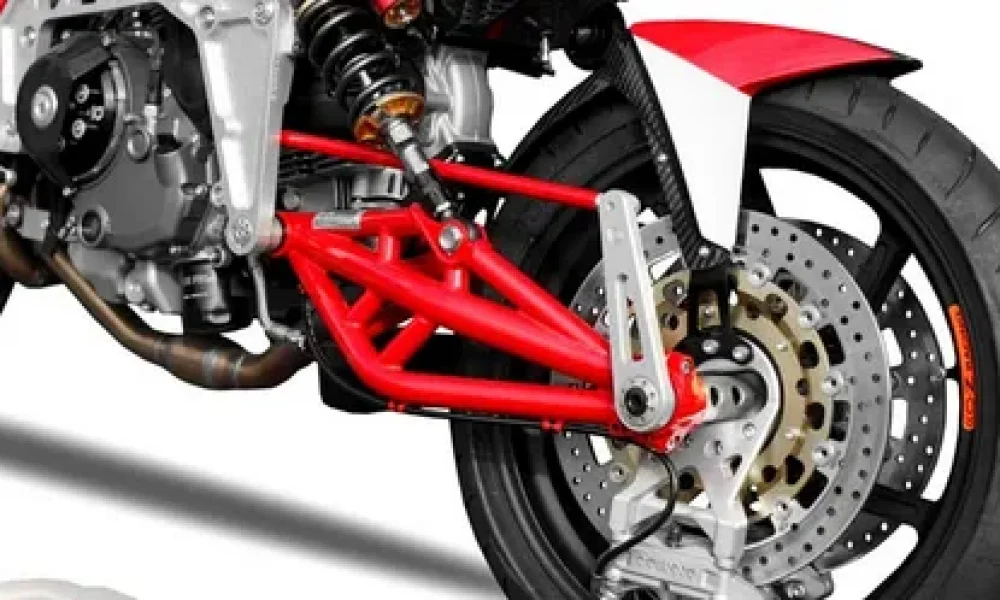
The global motorcycle suspension system market is entering a decade of strong transformation, projected to grow from USD 1,988.3 million in 2025 to USD 3,147.4 million by 2035, registering a CAGR of 4.7%. Demand for advanced suspension technologies continues to strengthen as consumers prioritize ride comfort, vehicle handling, and off-road capability, particularly in the expanding electric and high-performance motorcycle segments.
Backed by rising motorcycle adoption across emerging economies and an accelerated shift toward intelligent mobility, the industry is witnessing a fundamental reconfiguration of the suspension ecosystem—from mass-market telescopic forks to AI-driven active damping systems in premium models.
Industry Innovation Accelerates: OEMs File New Patents and Expand R&D Pipelines
The suspension system landscape is being reshaped by next-generation engineering. In May 2024, Yamaha filed a patent for an advanced anti-dive suspension system designed to improve braking stability without compromising ride quality. This design uses hydraulic actuators and electronic control modules to counter the traditional telescopic fork dive experienced during sudden deceleration—one of the most cited challenges in dynamic motorcycling.
Premium electric manufacturer Curtiss Motorcycles continues to invest in breakthrough suspension architecture aimed at delivering unparalleled rider connectivity and terrain feedback. In earlier disclosures, Curtiss emphasized its commitment to “transparency, accuracy, and quality of information between the tarmac and the rider,” underscoring a long-term industry pivot toward intelligent, sensor-integrated suspension mechanisms.
Electrification trends also continue to drive design enhancement. In 2024, Ampersand Energy introduced its Alpha motorcycle for African markets, featuring reinforced rebound damping optimized for rugged terrain—highlighting innovation beyond traditional premium markets.
Subscribe for Year-Round Insights → Stay ahead with quarterly and annual data updates
https://www.futuremarketinsights.com/reports/sample/rep-gb-3105
Asia-Pacific Dominates Global Demand as Two-Wheeler Adoption Surges
The Asia-Pacific region remains the clear global leader, contributing the highest share of motorcycle suspension demand due to massive two-wheeler ownership across India, China, Indonesia, Vietnam, and Thailand. OEMs in these markets are increasingly equipping even commuter motorcycles with enhanced adjustable suspension systems to improve comfort on congested and uneven urban roads.
Growing populations, rapid urbanization, and affordability concerns continue to position motorcycles as primary transportation solutions. Simultaneously, the rise of electric two-wheelers in Asia is creating new opportunities for lightweight suspension designs tailored to battery-powered powertrains.
Key Investment Segments: Standard Motorcycles and Dual Shock Systems Drive Volume
Standard Motorcycles Account for 53% of Global Market by 2025
Standard motorcycles will continue leading market demand, projected to record a 4.5% CAGR (2025–2035). Their widespread use across commuter and utility purposes, especially in semi-urban geographies, reinforces the need for robust, durable, and low-maintenance suspension designs. With electrification gaining steam in the lower-displacement category, this segment represents a crucial entry point for next-generation lightweight suspension technologies.
Dual Shock Rear Suspension Continues to Hold Strong Dominance
By 2035, dual shock rear suspension systems are forecast to maintain nearly 60% market share, registering a 3.6% CAGR. Their proven durability, simpler engineering, and compatibility with steel swingarm frames keep them highly preferred in commuter motorcycles across developing regions.
Even as mid-range and premium motorcycles adopt monoshock and electronically controlled systems, dual shocks remain a strategic component of platform standardization for global OEMs.
Regional Outlook: Market Growth Strengthens Across Developed and Emerging Economies
North America
The U.S. market is benefiting from rising touring and adventure motorcycle ownership. Enhanced aftermarket activity and demand for electronically controlled suspension solutions are driving product innovation. Electric motorcycle development is further accelerating the need for lighter, battery-integrated suspension systems.
Europe
Europe remains the hub of advanced suspension engineering, led by companies like Öhlins, WP, and Marzocchi. EU regulations emphasizing safety and ride stability are accelerating adoption of semi-active and electronically adjustable systems, especially in the premium adventure, sport, and touring segments.
Asia-Pacific
Home to the world’s largest motorcycle population, the region continues to dominate volume-driven production. OEMs are increasing adoption of monoshock and preload-adjustable systems across mid-range models, while EV manufacturers seek compact and efficient suspension units.
Middle East & Africa
Growing demand for motorcycles for tourism, logistics, and urban mobility is gradually driving upgrades from basic telescopic forks to more durable, terrain-adaptive solutions.
Industry Challenges: Cost Pressures and Durability Issues Persist
High costs associated with electronically adjustable suspension systems pose a challenge in price-sensitive markets. Durability concerns also remain prominent in developing regions, where suspension components face heavy loads, poor road conditions, and inconsistent maintenance practices.
Manufacturers are increasingly focused on local sourcing, modular architectures, anti-corrosion coatings, and sealed damping systems to address these challenges and extend product life cycles.
Market Opportunities: AI-Driven Suspension and EV-Optimized Designs to Reshape 2035 Landscape
The upcoming decade will witness a shift toward semi-active, AI-controlled, and fully adaptive suspension platforms. Integration with connectivity features—such as app-controlled settings, cloud-based ride profiles, and predictive maintenance—will redefine future product development.
Electrification further unlocks new design opportunities for lightweight components, regenerative damping approaches, and battery-friendly geometries.
Personalize Your Experience: Ask for Customization to Meet Your Requirements
https://www.futuremarketinsights.com/customization-available/rep-gb-3105
Competitive Landscape: Leading Manufacturers Strengthen Technological Capabilities
The market remains moderately consolidated, with leading players including:
| Company | Estimated Share |
| KYB Corporation | 13–15% |
| Showa Corporation | 12–14% |
| ZF Friedrichshafen (Sachs) | 10–12% |
| Tenneco (Öhlins) | 8–10% |
| WP Suspension (KTM Group) | 6–8% |
These companies are advancing capabilities in premium damping control, smart suspension integration, and lightweight material engineering—positioning themselves to capitalize on premium motorcycle sales and electrification trends through 2035.
Why Choose FMI: Empowering Decisions that Drive Real-World Outcomes:
https://www.futuremarketinsights.com/why-fmi
About Future Market Insights (FMI)
Future Market Insights, Inc. (FMI) is an ESOMAR-certified, ISO 9001:2015 market research and consulting organization, trusted by Fortune 500 clients and global enterprises. With operations in the U.S., UK, India, and Dubai, FMI provides data-backed insights and strategic intelligence across 30+ industries and 1200 markets worldwide.



