
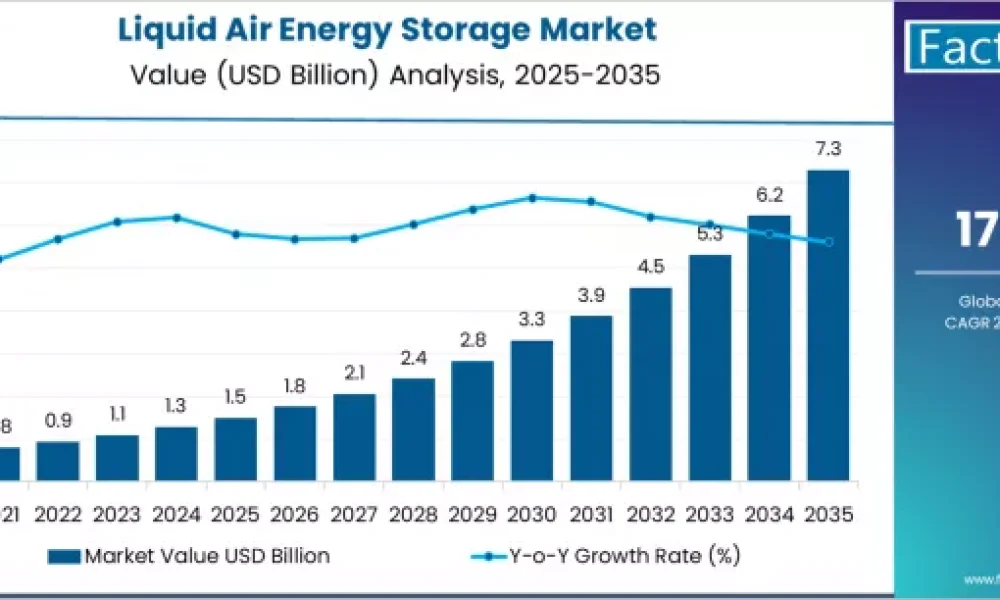
The global liquid air energy storage market is entering a phase of rapid acceleration from 2025 to 2035, supported by the surging need for long-duration energy storage, renewable integration, and grid flexibility worldwide. LAES technology—based on cooling air to cryogenic temperatures and converting it back to electricity on demand—has emerged as a versatile, scalable, and location-agnostic solution. It is particularly impactful in regions where conventional storage technologies face siting or resource-related constraints, such as limited geological storage potential or space restrictions.
Market Size and Growth
The global liquid air energy storage market is projected to reach approximately USD 7.3 billion by 2035, rising from USD 1.5 billion in 2025, at a remarkable CAGR of 17.1%. This strong growth trajectory reflects increasing grid modernization and the rising share of intermittent renewable power in the global electricity mix.
Europe represents one of the most promising regions for LAES deployment due to decarbonization mandates, growing renewable penetration, and the need for long-duration, utility-scale storage that can complement battery and pumped hydro solutions.
To access the complete data tables and in-depth insights, request a Discount On The Report here: https://www.factmr.com/connectus/sample?flag=S&rep_id=11624
Key Growth Drivers
Decarbonization and Renewable Energy Expansion
Countries worldwide, especially in Europe, are scaling renewable capacity at an unprecedented rate. LAES systems provide multi-hour to multi-day storage capabilities essential for balancing solar and wind variability, supporting clean energy reliability.
Siting Flexibility and Modularity
Unlike pumped hydro or compressed-air storage, LAES does not require specific topographical or geological conditions. Its high siting flexibility makes it ideal for urban and industrial locations where traditional energy storage is not feasible.
Long-Duration Storage Demand
Grid operators and utilities are increasingly prioritizing long-duration and seasonal storage. LAES plants support peak shaving, load shifting, backup supply, and grid congestion management—key capabilities for next-generation power systems.
Industrial Integration Opportunities
LAES facilities can capture and reuse waste heat and cold from nearby industrial sites, enhancing overall system efficiency. This opens significant adoption potential in sectors such as manufacturing, steel, oil & gas, and LNG terminals.
European Market Insights
Europe is an early adopter of LAES technology, driven by ambitious energy transition policies, carbon-neutrality targets for 2050, and the need to replace fossil-based balancing mechanisms.
The UK, Germany, and the Netherlands lead regional deployment, with increasing interest across Northern and Western Europe.
European utilities are moving toward hybrid storage models combining LAES with batteries, hydrogen, and thermal systems. Additionally, government funding and pilot projects are accelerating commercialization.
Challenges such as high initial capex, regulatory uncertainty in some regions, and limited technology familiarity in utility sectors still exist. However, the region’s strong decarbonization agenda ensures steady future adoption.
Technology Trends and Competitive Landscape
Key innovations shaping the LAES market include:
- Higher round-trip efficiencies via improved heat recovery and supercritical processes.
- Hybrid storage architectures integrating LAES with renewables, batteries, or industrial waste heat.
- Grid-scale modular units enabling rapid deployment and scalability.
- Digitalization and AI-enabled energy management for forecasting, optimization, and automated grid interaction.
The competitive landscape features a mix of established energy companies, cryogenic technology specialists, and emerging storage innovators partnering with utilities and industrial firms for demonstration and large-scale projects.
Challenges
Despite strong prospects, the market faces several hurdles:
- High upfront capital expenditures, especially for early adopters.
- Comparison with falling battery storage costs, requiring LAES to highlight long-duration advantages.
- Regulatory and market structure gaps, especially in countries lacking frameworks for long-duration storage remuneration.
- Technology awareness and bankability issues, with the need for more operational large-scale plants.
Strategic Implications
For Technology Developers & Manufacturers:
Invest in efficiency improvements, integrate waste heat recovery options, and develop modular, standardized LAES units to reduce costs and scale rapidly.
For Utilities & Grid Operators:
Evaluate hybridized storage portfolios where LAES fills duration gaps beyond lithium-ion capabilities. Deploy LAES for grid stability, frequency control, and renewable load balancing.
For Investors:
The market presents strong, high-growth potential with rising government support, especially in Europe. Long-duration storage is a future-critical asset class aligned with global clean energy targets.
Outlook Summary
From 2025 to 2035, the liquid air energy storage market will experience exponential growth as global energy systems transition toward net-zero operations. With its high scalability, siting flexibility, and long-duration capabilities, LAES is positioned to become a vital component of modern grid infrastructure. Europe will play a pivotal role in early adoption due to policy support and renewable integration challenges. Though economic and regulatory hurdles remain, the long-term outlook for LAES is robust, making it a strategic priority for energy companies, investors, and policymakers committed to building sustainable, resilient power systems.
Have a specific Requirements and Need Assistant on Report Pricing or Limited Budget please contact us – [email protected]
About Fact.MR
Fact.MR is a global market research and consulting firm, trusted by Fortune 500 companies and emerging businesses for reliable insights and strategic intelligence. With a presence across the U.S., UK, India, and Dubai, we deliver data-driven research and tailored consulting solutions across 30+ industries and 1,000+ markets. Backed by deep expertise and advanced analytics, Fact.MR helps organizations uncover opportunities, reduce risks, and make informed decisions for sustainable growth.



