
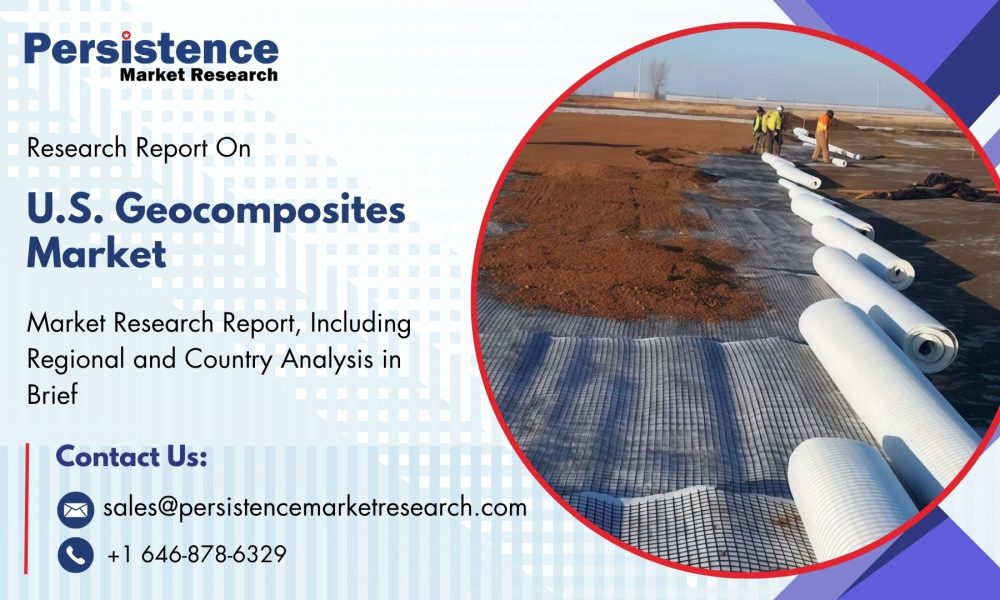
According to the latest study by Persistence Market Research, the U.S. Geocomposites Market is projected to grow from US$ 109.6 Mn in 2025 to US$ 151.4 Mn by 2032, expanding at a CAGR of 4.7% during the forecast period. The rising application of geocomposites in environmental protection, construction, and civil engineering projects is a key driver of this growth. These advanced materials are increasingly being integrated into modern infrastructure to enhance performance, extend service life, and ensure cost efficiency across a variety of engineering and environmental applications.
Market Overview
The U.S. geocomposites market is witnessing robust expansion due to the growing adoption of geosynthetic materials in infrastructure projects. Geocomposites, which combine two or more geosynthetic materials such as geotextiles, geomembranes, geonets, and geogrids, offer enhanced functionalities like separation, drainage, filtration, and reinforcement. Their versatility makes them a preferred choice in applications ranging from road construction and soil stabilization to landfill management and water containment systems.
One of the primary factors propelling market growth is the increasing focus on sustainable and long-lasting infrastructure development across the U.S. Government initiatives emphasizing environmental conservation and efficient water management are accelerating the demand for geocomposites in both public and private construction projects. Moreover, technological advancements in geosynthetics manufacturing, coupled with greater awareness about their long-term benefits, are contributing to widespread market adoption.
Get a Sample PDF Brochure of the Report (Use Corporate Email ID for a Quick Response): https://www.persistencemarketresearch.com/samples/35143
Market Growth Drivers
The market growth is primarily driven by the rising number of large-scale infrastructure and environmental projects across the United States. The growing emphasis on renewable energy, improved road networks, and efficient waste management systems has significantly boosted the demand for geocomposites. These materials provide an economical and sustainable solution for managing soil erosion, stabilizing terrain, and improving water filtration systems.
In addition, the increasing focus on environmental protection and waste management regulations is fostering the use of geocomposites in landfill and wastewater management applications. Their superior drainage and filtration capabilities help reduce contamination risks and improve project durability. Furthermore, the ongoing trend of replacing conventional construction materials with lighter, more efficient alternatives is opening new avenues for market expansion.
Leading Segment and Key Applications
Among product categories, Geotextile–Geonet Composites hold a dominant share of the U.S. market. These composites are widely used for drainage and filtration applications in civil engineering, landfill lining, and environmental protection projects. Their ability to facilitate fluid movement while preventing soil particle migration makes them indispensable for efficient groundwater and wastewater management.
In terms of application, Water & Wastewater Management is the leading segment, driven by the growing need for advanced water infrastructure and environmental sustainability initiatives. Government-backed programs focused on water conservation and pollution control are further encouraging the use of geocomposites in reservoirs, treatment plants, and drainage systems. The Road & Highway segment also exhibits strong growth potential, fueled by infrastructure modernization and maintenance projects across various states.
Regional Landscape
Geographically, the West U.S. and Southeast U.S. are leading regional markets for geocomposites. The Western states, with their arid climate and extensive infrastructure projects, rely heavily on geocomposites for soil stabilization and water retention systems. Meanwhile, the Southeast region’s growing industrial base, coupled with frequent flooding and stormwater management challenges, drives strong demand for these materials.
The Midwest and Southwest regions also show steady growth due to large-scale construction activities and expanding urbanization. Moreover, the Northwest U.S., characterized by its hilly terrain and environmental sensitivity, is increasingly adopting geocomposite solutions for erosion control and slope stabilization in infrastructure and mining projects.
U.S. Geocomposites Market Segmentation
By Product
- Geotextile – Geonet Composites
- Geotextile – Geomembrane Composites
- Geomembrane – Geogrid Composites
- Geotextile – Geogrid Composites
- Others
By Function
- Separation
- Drainage
- Reinforcement
- Others
By Application
- Water & Wastewater Management
- Road & Highway
- Landfill & Mining
- Soil Reinforcement
- Others
By Zone
- West U.S.
- Midwest U.S.
- Southwest U.S.
- Southeast U.S.
- Northwest U.S.
Market Dynamics
Drivers
The key drivers of the U.S. geocomposites market include rising investments in infrastructure modernization, stringent environmental regulations, and the growing focus on sustainable construction practices. The use of geocomposites offers enhanced performance, reduced maintenance costs, and improved longevity of civil structures. Additionally, the trend toward green building materials and increased awareness about geosynthetics’ benefits are spurring further adoption.
Restraints
Despite their advantages, the market faces challenges such as high initial installation costs and limited technical expertise in handling advanced geosynthetic systems. In certain regions, traditional construction methods still dominate due to cost constraints, hindering faster adoption. Moreover, variations in performance based on local climatic and soil conditions can affect long-term outcomes, requiring tailored product selection and engineering support.
Opportunities
Significant opportunities exist in smart infrastructure development and eco-friendly construction. The integration of geocomposites in smart city projects, renewable energy systems, and green construction initiatives can unlock new revenue streams. Advances in composite materials and polymer technologies are expected to enhance durability and adaptability, thereby expanding their use in emerging applications like offshore wind farms and desert reclamation projects.
Company Insights
The U.S. geocomposites market is moderately consolidated, with several key players focusing on product innovation, strategic partnerships, and regional expansion to strengthen their market positions. Continuous investment in R&D and sustainability-oriented product development is shaping the competitive landscape.
✦ GSE Environmental
✦ TenCate Geosynthetics Americas
✦ Tensar International Corporation
✦ Solmax International Inc.
✦ NAUE GmbH & Co. KG
✦ Fiberweb Geosynthetics Ltd.
✦ SKAPS Industries
✦ AGRU America, Inc.
✦ Huesker Inc.
✦ Hanes Geo Components
Key Industry Developments
In recent years, several companies have launched advanced geocomposite products with improved permeability, chemical resistance, and load-bearing capacity. For instance, manufacturers are developing multi-layered geotextile–geomembrane systems designed for enhanced drainage in landfills and mining operations. Additionally, U.S.-based companies are investing in sustainable production practices, including the use of recycled polymers and energy-efficient manufacturing processes. Strategic mergers and acquisitions among global and domestic players are also helping to expand product portfolios and strengthen distribution networks.
Innovation and Future Trends
The future of the U.S. geocomposites market lies in smart and sustainable engineering solutions. Innovations in material science are leading to the development of lightweight, high-strength, and temperature-resistant composites. The integration of geocomposites with digital monitoring systems for real-time performance assessment is an emerging trend that promises to revolutionize infrastructure management.
Furthermore, increasing demand for eco-friendly construction materials and the recycling of polymer-based geosynthetics align with broader sustainability goals. The industry is also expected to see advancements in nanotechnology and bio-based composites, offering new opportunities for performance enhancement and cost reduction. As the U.S. continues to invest heavily in infrastructure renewal and environmental protection, the geocomposites market is poised for sustained growth and technological evolution in the years to come.
Explore the Latest Trending Research Reports:
About Persistence Market Research:
At Persistence Market Research, we specialize in creating research studies that serve as strategic tools for driving business growth. Established as a proprietary firm in 2012, we have evolved into a registered company in England and Wales in 2023 under the name Persistence Research & Consultancy Services Ltd. With a solid foundation, we have completed over 3600 custom and syndicate market research projects, and delivered more than 2700 projects for other leading market research companies’ clients.
Our approach combines traditional market research methods with modern tools to offer comprehensive research solutions. With a decade of experience, we pride ourselves on deriving actionable insights from data to help businesses stay ahead of the competition. Our client base spans multinational corporations, leading consulting firms, investment funds, and government departments. A significant portion of our sales comes from repeat clients, a testament to the value and trust we’ve built over the years.
Contact Us:
Persistence Market Research
Second Floor, 150 Fleet Street,
London, EC4A 2DQ, United Kingdom
USA Phone: +1 646-878-6329
UK Phone: +44 203-837-5656
Email: [email protected]
Web: https://www.persistencemarketresearch.com




