
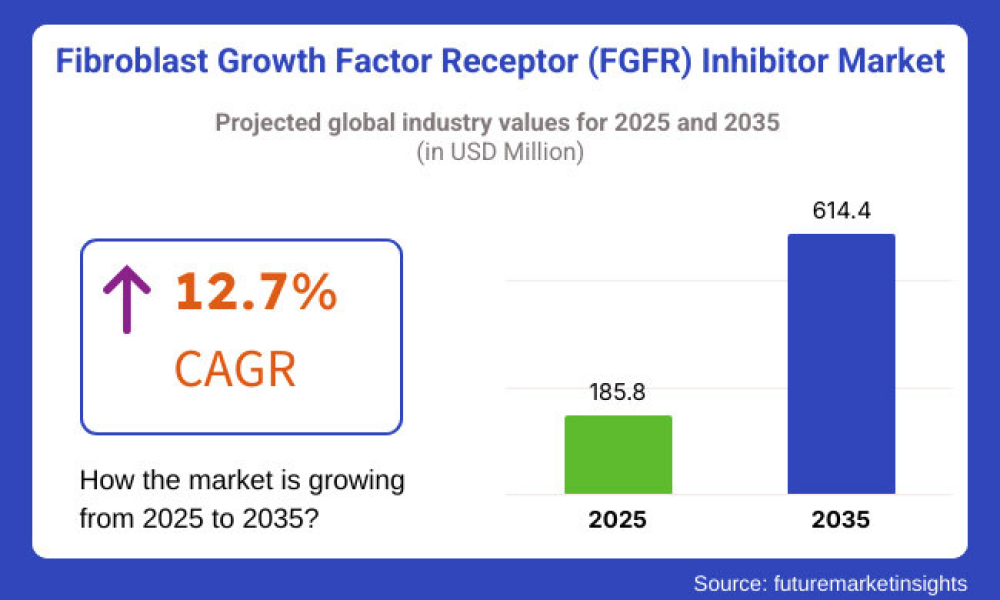
The Fibroblast Growth Factor Receptor (FGFR) Inhibitor Market in the U.S. is poised for significant expansion, with projections indicating growth from USD 185.8 Million in 2025 to USD 614.4 Million by 2035, reflecting a robust CAGR of 12.7%. Increasing clinical trials, broader use of biomarker-based diagnostics, and heightened investment in biotechnology are driving this market trajectory.
Explore trends before investing – request a sample report today!
https://www.futuremarketinsights.com/reports/sample/rep-gb-12111
Market Dynamics and Growth Drivers
The market’s expansion is fueled by the rising prevalence of FGFR-driven cancers, including bladder, bile duct, and lung cancers. FGFR inhibitors, tailored for these specific oncogenic alterations, offer precision therapy options that enhance patient outcomes. The market is further accelerated by improved drug safety profiles, combination therapy strategies, and next-generation inhibitors designed to overcome resistance mechanisms observed in existing treatments such as dovitinib and pemigatinib.
Pharmaceutical companies are intensifying investments in novel FGFR inhibitors, emphasizing selectivity, reduced toxicity, and the potential to circumvent resistance pathways. Collaboration among biotech firms, contract research organizations, and academic institutions is expediting innovation and accelerating the development of targeted therapeutics.
Regional Market Insights
North America: The U.S. and Canada are expected to lead the FGFR inhibitor market due to high cancer prevalence, advanced research infrastructure, and the adoption of precision medicine. Multiple FDA-approved FGFR inhibitors, including erdafitinib (Balversa) for metastatic urothelial carcinoma and pemigatinib (Pemazyre) for cholangiocarcinoma, are driving uptake. Rising healthcare expenditure and favorable reimbursement policies further strengthen market growth.
Europe: Key countries such as Germany, the UK, France, and Italy are contributing significantly through regulatory approvals, precision medicine initiatives, and biomarker-driven therapy adoption. Investment in cancer research and collaborations between pharma companies and research institutes are expanding patient access to FGFR-targeted treatments.
Asia-Pacific: The region is projected to experience the fastest growth. China, Japan, South Korea, and India are advancing clinical trials, regulatory support, and precision oncology adoption. Government-backed initiatives, rising patient access, and strategic collaborations accelerate market development.
Subscribe for Year-Round Insights → Stay ahead with quarterly and annual data updates –
https://www.futuremarketinsights.com/reports/brochure/rep-gb-12111
Challenges and Opportunities
High costs and potential resistance to FGFR inhibition pose market challenges, limiting accessibility for certain patient populations. Complex biomarker testing and variations in treatment response necessitate ongoing innovation.
Conversely, AI-driven drug discovery, combination therapies, and the expansion of FGFR inhibitors into additional cancers—including breast, brain, and gastric cancers—present significant opportunities. Next-generation sequencing and liquid biopsies enhance patient selection, enabling more precise and effective therapies, which further expand market potential.
Market Evolution and Technological Shifts
From 2020 to 2024, regulatory approvals, small-molecule development, and precision medicine adoption spurred market growth. Between 2025 and 2035, AI-powered drug discovery, bispecific antibodies, gene-editing techniques, and nanotechnology-enhanced delivery systems are expected to transform the market landscape. Personalized treatment planning will improve outcomes while minimizing side effects and overcoming drug resistance.
Segment Insights
Selective inhibitors remain the primary driver of demand, particularly for FGFR1-4 mutations in bladder, bile duct, lung, and breast cancers. Monoclonal antibodies are gaining traction due to their specificity, longer activity, and immune-modulatory effects. Combination therapies are increasingly employed to improve tumor response and overcome resistance, while monotherapy remains vital for first-line and maintenance treatment in FGFR-driven cancers.
Competitive Landscape
Incyte Corporation leads the U.S. market with Pemigatinib, followed by Johnson & Johnson’s Erdafitinib. Bayer AG, Eli Lilly, and BridgeBio Pharma are advancing next-generation inhibitors and combination strategies. Emerging biotech players are contributing to precision oncology, AI-assisted drug development, and resistance management approaches.
Why Choose FMI: Empowering Decisions that Drive Real-World Outcomes:
https://www.futuremarketinsights.com/why-fmi
About Future Market Insights (FMI)
Future Market Insights, Inc. (ESOMAR certified, recipient of the Stevie Award, and a member of the Greater New York Chamber of Commerce) offers profound insights into the driving factors that are boosting demand in the market. FMI stands as the leading global provider of market intelligence, advisory services, consulting, and events for the Packaging, Food and Beverage, Consumer Technology, Healthcare, Industrial, and Chemicals markets. With a vast team of over 400 analysts worldwide, FMI provides global, regional, and local expertise on diverse domains and industry trends across more than 110 countries.
Contact Us:
Future Market Insights Inc.
Christiana Corporate, 200 Continental Drive,
Suite 401, Newark, Delaware – 19713, USA
T: +1-347-918-3531



