
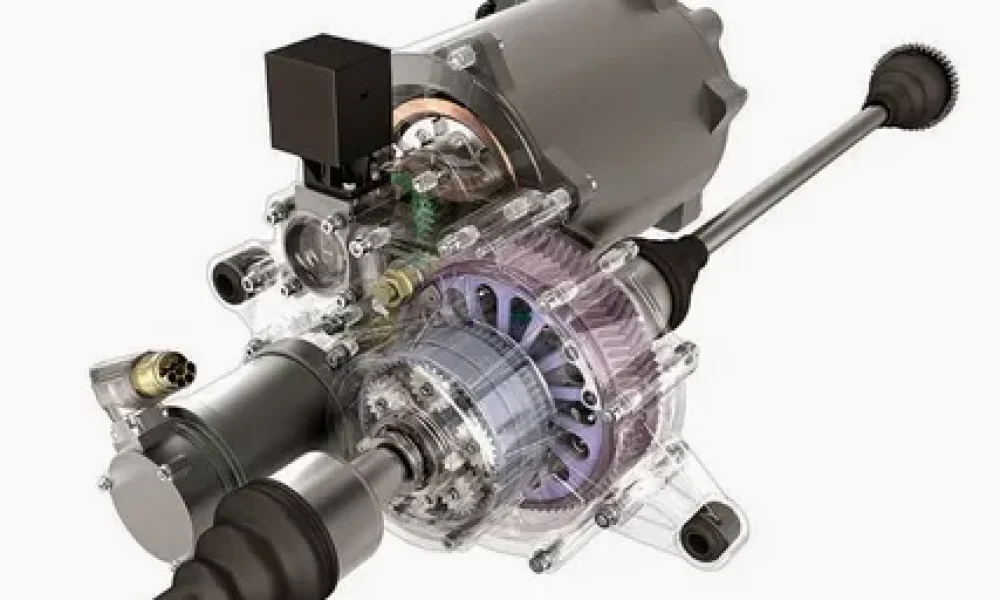
The global Electric Vehicle Reducer Market is entering a decade of exponential growth as electrification strategies intensify across automotive segments. Valued at USD 2.5 billion in 2025, the market is projected to reach USD 13.6 billion by 2035, expanding at a robust CAGR of 18.5%. Rising global EV adoption, advancements in compact e-drive systems, and innovation in reducer durability, NVH performance, and modularity are reshaping the industry’s competitive and technological landscape.
Electric vehicle reducers—critical components responsible for matching motor output to wheel torque—are evolving into high-efficiency, software-integrated systems that enhance drivetrain performance and broaden EV platform adaptability.
Efficiency, Modularity, and Compact E-Drive Systems Lead Market Momentum
The shift toward advanced reducers is driven by the push to maximize range, improve energy efficiency, and optimize torque delivery across diverse EV platforms. In March 2024, Punch Powertrain underscored the importance of reducer efficiency, noting that reducers account for nearly one-third of total drivetrain losses. The company’s modular TwinSpeed and coaxial solutions highlight the market’s move toward CFD-optimized, NVH-minimized designs that boost performance without compromising compactness.
This evolution is reinforced by emerging software-defined EV components. As reported by Jabil in 2024, the industry is transitioning to smart assembly platforms that shorten development cycles and integrate modular EV reducers capable of platform-wide scalability. Meanwhile, global automakers—including Ford—are broadening electric commercial and pickup portfolios, fueling demand for compact, lightweight reducers designed for high-load commercial applications.
Material advancements such as high-strength steels, lightweight alloys, and immersion coatings are enabling durable reducer platforms capable of managing increasing torque loads in next-generation EVs.
Subscribe for Year-Round Insights → Stay ahead with quarterly and annual data updates
https://www.futuremarketinsights.com/reports/sample/rep-gb-15841
Market Growth Accelerates Across H1 and H2 Cycles Through 2035
Annualized growth analysis reveals continuing expansion across both halves of the year:
| Period | CAGR |
| H1 2024–2034 | 26.3% |
| H2 2024–2034 | 26.9% |
| H1 2025–2035 | 26.1% |
| H2 2025–2035 | 27.2% |
A slight 20 BPS dip in early-cycle growth is offset by a 30 BPS improvement in H2 performance, reaffirming consistent demand across global EV production cycles.
Single-Stage Reducers Lead Adoption, Representing 64% Market Share in 2025
Single-stage reducers dominate market demand due to their compact design and high-efficiency torque transfer. Accounting for ~64% of the market in 2025, single-stage solutions are critical for compact and mid-sized BEVs, offering:
- Lower mechanical losses
- Reduced noise and vibration
- Lower assembly and maintenance costs
- Improved drivetrain packaging and weight efficiency
Continuous R&D investments in gear materials, lubrication architectures, and thermal management systems are increasing power density and reliability across single-stage reducer families.
BEVs Account for 68% of Global Reducer Demand
Battery Electric Vehicles (BEVs) will remain the largest consumer of reducer systems, generating 68% of demand in 2025 and growing at a CAGR of 18.9% through 2035. Reducers play a pivotal role in BEV performance by enabling:
- Efficient speed-to-torque conversion
- Regenerative braking optimization
- Reduced drivetrain mass
- Enhanced NVH characteristics
As China, Europe, and the U.S. scale BEV penetration, the demand for integrated, high-efficiency reducers will shape the next wave of electric drivetrain architectures.
Key Market Trends Strengthening Global Demand
- Lightweighting Initiatives Transform Reducer Manufacturing
High-strength aluminum, advanced composites, and optimized steel alloys are increasingly replacing traditional iron components. These materials improve drivetrain efficiency, extend battery lifespan, and meet stringent emissions standards across Europe and North America.
- Rising Adoption of Multi-Stage Reducers
As EV performance profiles diversify, especially in high-speed, high-load applications, multi-stage reducers are expected to capture over 68% market share in the long-term. These systems deliver smoother torque transitions, uninterrupted power flow, and superior drive comfort across premium EVs and PHEVs.
- Charging Infrastructure Expansion Boosts Reducer Sales
Large-scale investment in charging networks across Asia-Pacific, North America, and Europe is accelerating EV sales, driving parallel demand for high-performance reducers that improve range and efficiency.
- Advancements in Modular, Software-Defined Reducers
Digital twin modeling, supplier-compatible components, and gear-pitch standardization are enabling faster development cycles and wider industry adoption.
Competitive Landscape: Tier 1 Leaders Drive Global Innovation
The market shows a moderate-to-high concentration among leading global manufacturers. Tier 1 companies—including BorgWarner, Bosch, ZF Friedrichshafen, GKN Automotive, and Magna International—control 20–30% of global share due to their:
- Superior R&D capabilities
- Global manufacturing networks
- High-performance, lightweight reducer portfolios
- Strong partnerships with global OEMs
Tier 2 manufacturers such as HOTA Industrial, Aichi Machine Industry, and SAGW leverage cost-efficient production and regional OEM partnerships to strengthen their market presence. Tier 3 players—comprising niche and local manufacturers—remain limited by smaller production capacities and lower R&D budgets, positioning the segment for consolidation.
Personalize Your Experience: Ask for Customization to Meet Your Requirements
https://www.futuremarketinsights.com/customization-available/rep-gb-15841
Country-Level Insights: Asia-Pacific Leads Production and Consumption
| Country | CAGR (2025–2035) |
| Saudi Arabia | 27.1% |
| Brazil | 26.8% |
| Türkiye | 26.5% |
| South Korea | 26.2% |
| Mexico | 26.0% |
China continues to dominate global EV reducer consumption, while India emerges as a high-growth manufacturing hub supported by EV incentives and domestic production mandates. The U.S. maintains strong momentum driven by its expanding EV ecosystem and large-scale charging investments.
Strategic Outlook: 2025–2035
As EV adoption accelerates globally, the electric vehicle reducer market will remain a critical component segment shaping the performance, efficiency, and scalability of electric drivetrains. With ongoing innovation in multi-speed systems, lightweight materials, digitalized development, and modular architectures, reducer technologies are set to play a decisive role in the next decade of electric mobility.
Why Choose FMI: Empowering Decisions that Drive Real-World Outcomes: https://www.futuremarketinsights.com/why-fmi
About Future Market Insights (FMI)
Future Market Insights, Inc. (FMI) is an ESOMAR-certified, ISO 9001:2015 market research and consulting organization, trusted by Fortune 500 clients and global enterprises. With operations in the U.S., UK, India, and Dubai, FMI provides data-backed insights and strategic intelligence across 30+ industries and 1200 markets worldwide.



