
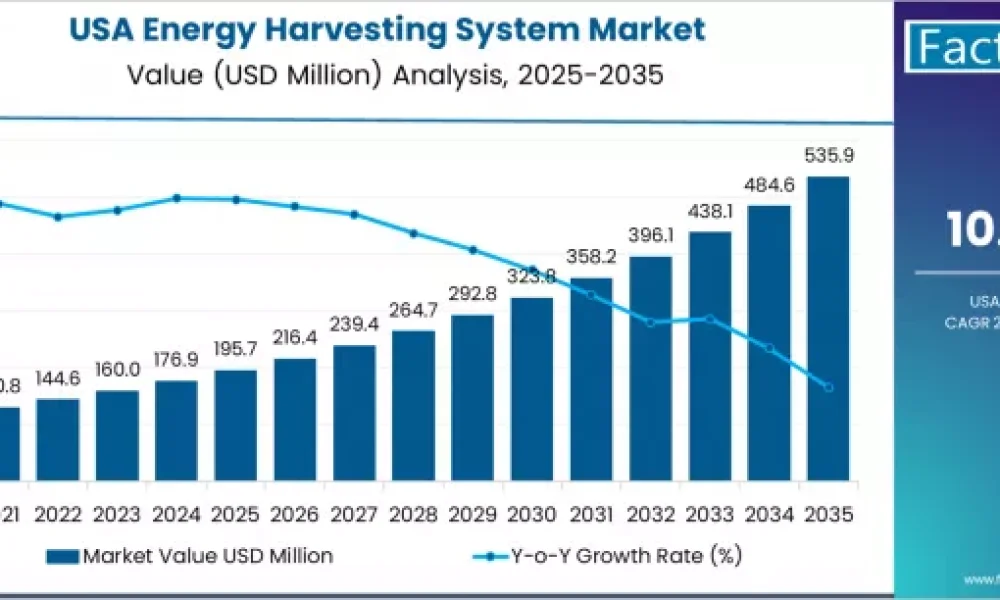
The market for energy harvesting systems in the United States is poised for robust growth over the next decade. These systems — which capture ambient energy (e.g., vibration, light, thermal, RF) and convert it into electrical energy — are increasingly important as the footprint of Internet of Things (IoT), wireless sensors, smart infrastructure, and autonomous devices expands. Total demand of energy harvesting systems is projected to increase from approximately US$ 195.68 million in 2025 to about US$ 532.45 million by 2035, a growth of over 2.7 times and a compound annual growth rate (CAGR) of 10.6%.
This report summarises key trends, segmentation dynamics, regional breakdown, and driving forces behind this accelerated demand, as well as implications for industry stakeholders across sectors.
Market Growth & Forecast (2025–2035)
2025 baseline: US$ 195.68 million
2035 forecast: US$ 532.45 million
Absolute growth: + US$ 336.77 million over 10 years
CAGR: 10.6% over 2025–2035
Growth factor: Demand expected to grow roughly 2.7× over the period
From 2025 to 2030, demand is expected to grow from US$ 195.68 M to about US$ 313.24 M, while the 2030–2035 period is expected to add ~US$ 219.21 M. This suggests accelerating adoption in the latter half of the decade, likely driven by broader and deeper integration of energy-harvesting systems into industrial, IoT, sensor-network, and smart-infrastructure applications.
To access the complete data tables and in-depth insights, request a Discount On The Report here: https://www.factmr.com/connectus/sample?flag=S&rep_id=12432
Key Drivers of Demand
Several factors underpin this growth trajectory:
• Rapid IoT & Wireless Sensor Adoption
The proliferation of IoT devices, wireless sensor networks, and smart building initiatives is creating high demand for autonomous, maintenance-free power solutions. As more devices — often deployed in remote or hard-to-wire locations — become connected, battery-free power via energy harvesting becomes highly attractive.
• Shift Toward Energy Efficiency, Autonomy & Low-Maintenance Systems
Self-powered, maintenance-light devices offer long-term operational benefits: reduced battery replacement costs, improved reliability, and enhanced energy efficiency. Industries and smart infrastructure developers are increasingly favoring solutions that minimize wiring and maintenance needs.
• Industrial Automation & Smart Building / Home Automation Trends
As industries embrace automation and predictive-maintenance systems, and as smart building / home automation become more commonplace, demand for energy harvesting systems — especially for powering sensors and monitoring devices — is rising.
• Technological Advances Enhancing Efficiency & Versatility
Improvements in energy-harvesting technologies (vibration, thermal, light, RF) and supporting components (transducers, power-management ICs, storage) are making systems more efficient, affordable, and suitable for a wider range of applications.
• Broadening Application Landscape
While initial adoption was concentrated in niche IoT and industrial sensor networks, energy harvesting systems are now gaining traction across building automation, consumer electronics, smart home devices, environmental sensing, and industrial IoT infrastructure.
Segmentation — Technology & Components
Understanding which segments contribute most to demand helps gauge growth focus:
By Technology Type
Vibration energy harvesting is projected to be the dominant technology type, capturing the largest market share.
Other harvesting technologies — such as light (photovoltaic or indoor lighting energy harvesting), thermal, RF, and other ambient-energy capture methods — also contribute, though vibration stands out due to its suitability for industrial and sensor-based applications.
By Component / Application Segment
Sensors dominate among components, accounting for the largest share of demand.
This emphasizes that a large portion of market demand is driven by sensor-based applications — wireless sensor networks, environmental monitoring, smart buildings, industrial automation, and IoT devices.
Energy harvesting systems are mostly integrated into devices whose functionality depends on self-sufficient power, making them appealing for low-maintenance, battery-free operation.
Regional Insights (Within the U.S.)
Regional differences exist in adoption:
The West region is projected to lead in demand with the highest growth rate.
Other regions — Northeast, South, and Midwest — also show strong growth, indicating that adoption is nationwide rather than limited to a few hubs.
The West’s dominance reflects its concentration of technology companies, smart-infrastructure initiatives, high IoT adoption, and presence of industrial and commercial facilities requiring modern automation and sensing solutions.
Market Context: Global & U.S. Comparisons
Globally, the energy harvesting system market is expected to grow steadily over the next decade.
North America, led by the U.S., accounts for a significant share of the global market due to high technology adoption and strong investments.
The U.S. market, with its mature technology infrastructure, industrial base, and early IoT adoption, remains a leading center for energy harvesting implementations.
Key Use Cases & Applications Driving Demand
Certain applications and sectors are especially influential:
Industrial automation and predictive maintenance: Factories and industrial installations deploy wireless sensors for condition monitoring, vibration sensing, and structural health monitoring. Energy harvesting enables these sensors to operate autonomously with minimal maintenance.
Smart buildings & home automation: In building automation (lighting, HVAC monitoring, occupancy sensors), battery-free, wire-free sensors can reduce installation and maintenance costs.
IoT networks & remote sensors: For environmental monitoring, agriculture, infrastructure monitoring, and security, energy harvesting allows remote sensors to function without frequent battery replacement.
Consumer electronics & wearables (low-power): Energy harvesting extends battery life or enables battery-free operation. While a smaller segment, it is expected to grow as technologies improve.
Challenges & Considerations
Despite strong growth, challenges remain:
Technology limitations: Not all harvesting technologies are equally efficient. High-power devices may still require traditional power sources.
Initial cost vs. benefit tradeoffs: For some deployments, traditional battery-powered or wired systems may still be cheaper initially; the value proposition of harvesting improves when factoring maintenance and reliability over time.
Application suitability: Energy harvesting works best for low-power, intermittent, or low-energy-use devices.
Integration complexity: Incorporating harvesting systems may require redesign, certification, or testing, which can slow uptake in some industries.
Implications for Stakeholders
Manufacturers and component suppliers should ramp up capacity and R&D to support growth, especially in vibration, light, thermal, and RF harvesting.
IoT platform developers, sensor-network designers, and system integrators can benefit from energy-harvesting-based products, especially for low-maintenance applications.
Industrial, building automation, and smart-infrastructure players should plan for energy-harvesting-based deployments to reduce operational costs and improve resilience.
Investors and policymakers may view energy harvesting technologies as enablers of energy-efficient, low-maintenance, low-carbon infrastructure.
Outlook: What to Watch For (2025–2035)
Technological innovations — better transducers, more efficient power-management ICs, hybrid harvesting, integrated storage — will expand application scope.
Broadening application domains — from industrial and building automation to smart agriculture, healthcare, infrastructure monitoring, and consumer devices.
Falling costs and economies of scale — making energy harvesting components more affordable and widely adopted.
Regulation and sustainability trends — increased emphasis on energy efficiency and reducing battery waste will support adoption.
Integration with IoT, edge computing, and smart-city initiatives — energy harvesting will become a standard design consideration.
Conclusion
The U.S. demand for energy harvesting systems between 2025 and 2035 illustrates strong and accelerating growth: from approximately US$ 195.68 million in 2025 to US$ 532.45 million in 2035, implying a 10.6% CAGR and roughly 2.7× increase in market size.
This growth is driven by rising adoption of IoT devices, wireless sensor networks, industrial automation, building automation, and smart infrastructure. Vibration-based energy harvesting — paired with battery-free sensors — leads the way, while sensors remain the dominant component segment.
For manufacturers, system integrators, investors, and policymakers, energy harvesting is no longer a niche technology but a critical part of the low-power, autonomy-focused infrastructure that underpins the future of IoT, smart buildings, industrial automation, and sustainable systems.
Have a specific Requirements and Need Assistant on Report Pricing or Limited Budget please contact us – [email protected]
To View Related Report :
Demand for Aircraft Fuel Cells in USA https://www.factmr.com/report/united-states-aircraft-fuel-cells-market
On-demand Wellness Software Market https://www.factmr.com/report/on-demand-wellness-software-market
Ad-Supported Video on Demand Market https://www.factmr.com/report/ad-supported-video-on-demand-market
Bioinformatics Market https://www.factmr.com/report/bioinformatics-market



