
The U.S. market for cardiovascular repair and reconstruction solutions is entering a transformative decade, propelled by rising procedural volumes, fast-advancing health technologies, and a rapidly aging population. As demand surges for minimally invasive cardiac interventions, the Cardiovascular Repair & Reconstruction Devices Market is projected to expand significantly. Devices supporting congenital defect repair, valve restoration, aneurysm correction, and vascular reconstruction are becoming central to modern cardiac care.
Explore trends before investing – request a sample report today!
https://www.futuremarketinsights.com/reports/sample/rep-gb-14804
Market Valuation Strengthens as Innovation Accelerates
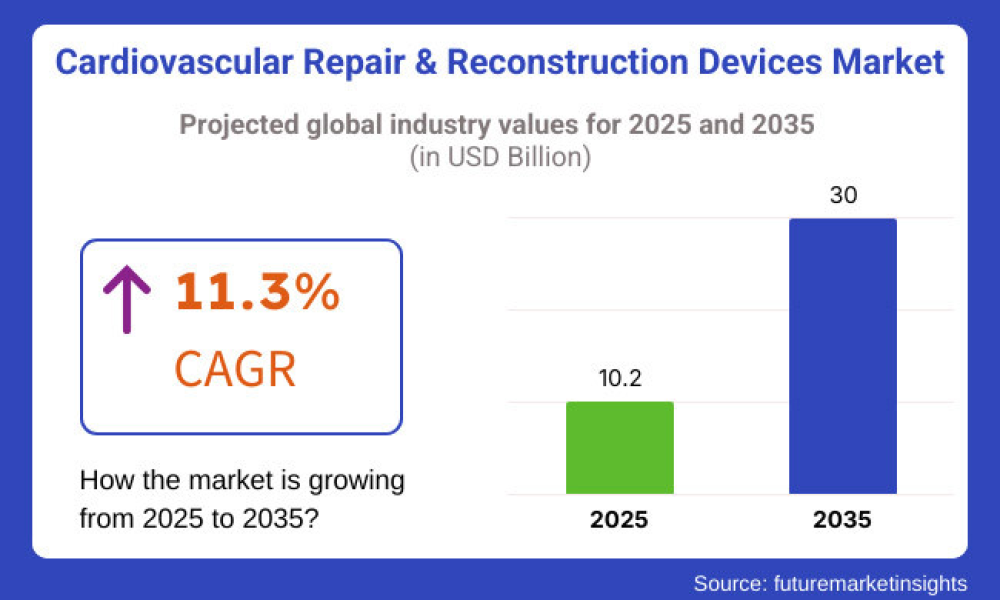
The U.S. industry outlook reflects robust momentum. The market, valued at USD 10.2 billion in 2025, is expected to surpass USD 30.0 billion by 2035, marking an impressive CAGR of 11.3%. Growth is driven by increased CVD prevalence, stronger reimbursement pathways, and a rapidly expanding ecosystem of catheter-based and robotic-assisted cardiac procedures. These trends position the U.S. as a global hub for next-generation cardiovascular repair technologies.
Demographic and Clinical Trends Fuel Long-Term Demand
The aging population remains one of the most influential demand drivers. With older adults more susceptible to valvular degeneration, aneurysms, and coronary blockages, the need for long-lasting grafts, patches, and valve repair devices continues to rise. U.S. cardiac centers are also witnessing a shift toward minimally invasive procedures such as TAVR and TMVR, reducing hospital stays and improving outcomes. Increasing access to advanced heart care through insurance coverage and expanding cardiovascular specialty centers further accelerates market adoption.
Technological Shifts Reshape the Competitive Landscape
The 2025–2035 period is expected to redefine cardiovascular reconstruction capabilities. Innovations such as bioresorbable stents, 3D-printed vascular grafts, and tissue-engineered heart valves are influencing device development. AI-driven imaging and predictive analytics are also improving pre-surgical planning and real-time intervention guidance. Manufacturers that integrate robotic-assisted platforms, catheter-based delivery systems, and regenerative technologies are expected to lead the next phase of market expansion.
Regulatory, Cost, and Access Challenges
Despite rapid growth, cost pressures and stringent approval timelines remain challenges for developers. FDA and CE regulatory pathways require extensive clinical validation, increasing capital requirements and time-to-market. While these factors can limit adoption in cost-sensitive facilities, technological progress and broader reimbursement frameworks continue to improve provider and patient access to advanced devices.
Subscribe for Year-Round Insights → Stay ahead with quarterly and annual data updates –
https://www.futuremarketinsights.com/reports/brochure/rep-gb-14804
U.S. Market Outlook: Leading the Global Shift Toward Minimally Invasive Cardiac Care
The U.S. is expected to remain a dominant market through 2035, supported by high CVD incidence, advanced cardiac care infrastructure, and strong R&D investments. Over 800,000 heart-related deaths each year underline the urgency for advanced cardiovascular repair solutions. Increasing adoption of tissue-engineered implants, robotic cardiac surgery, and AI-enhanced diagnostics reflects the country’s shift toward personalized, precision-based cardiac repair pathways.
Segment Growth: Valve Repair Devices and Vascular Grafts Maintain Market Leadership
Valve repair devices—particularly those enabling TAVR and TMVR—remain central to market expansion. Hospitals and cardiac catheterization labs continue to invest in robot-assisted platforms and hybrid operating rooms, improving procedural accuracy and patient throughput. Meanwhile, vascular grafts are experiencing strong demand due to increasing peripheral artery disease and aortic aneurysm treatments. Advances in biodegradable grafts and drug-eluting coatings are elevating surgical outcomes and long-term patient recovery rates.
Competitive Positioning and Emerging Technologies
Major companies—including Medtronic, Edwards Lifesciences, Abbott, Terumo, and Getinge—are accelerating research into bioresorbable materials, structural heart implants, and minimally invasive solutions. Their leadership is complemented by emerging innovators focused on nanotechnology-based grafts, AI-enabled cardiac monitoring systems, and tissue-engineered cardiovascular scaffolds.
Strengthening Healthcare Delivery Through Innovation
Hospitals continue to dominate device usage due to high surgical capacity and infrastructure, while independent catheterization labs are experiencing the fastest growth as patients increasingly prefer outpatient-based, minimally invasive procedures. As telecardiology and remote diagnostics integrate with surgical care pathways, the adoption of personalized cardiovascular repair devices is set to grow further.
Why Choose FMI Empowering Decisions that Drive Real-World Outcomes:- https://www.futuremarketinsights.com/why-fmi
About Future Market Insights (FMI)
Future Market Insights, Inc. (ESOMAR certified, recipient of the Stevie Award, and a member of the Greater New York Chamber of Commerce) offers profound insights into the driving factors that are boosting demand in the market. FMI stands as the leading global provider of market intelligence, advisory services, consulting, and events for the Packaging, Food and Beverage, Consumer Technology, Healthcare, Industrial, and Chemicals markets. With a vast team of over 400 analystsworldwide, FMI provides global, regional, and local expertise on diverse domains and industry trends across more than 110 countries.
Contact Us:
Future Market Insights Inc.
Christiana Corporate, 200 Continental Drive,
Suite 401, Newark, Delaware – 19713, USA
T: +1-347-918-3531
For Sales Enquiries: [email protected]
Website: https://www.futuremarketinsights.com



