
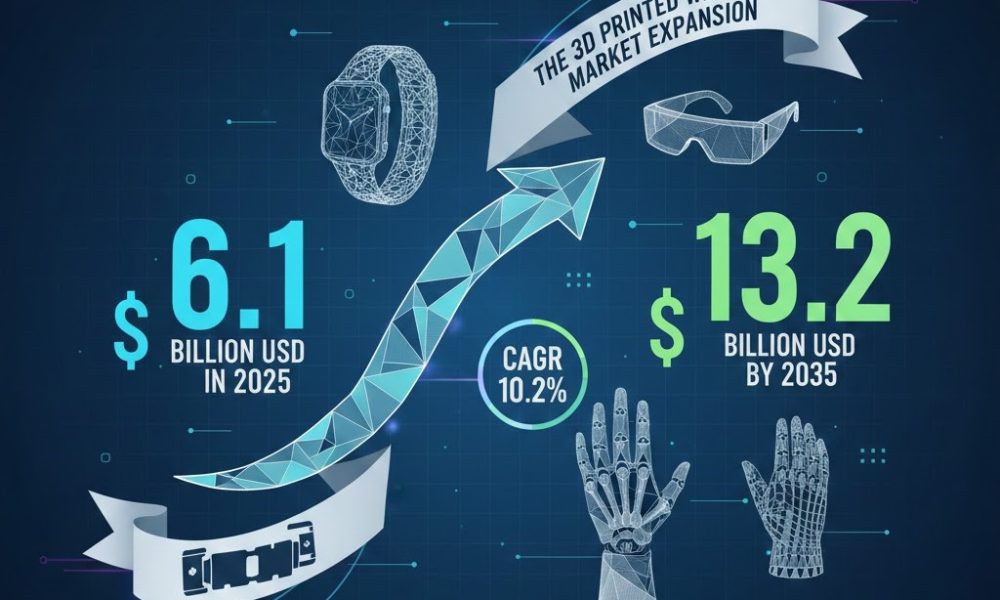
The global 3D printed wearable market is set for remarkable growth from 2025 through 2035, driven by rising consumer demand for highly customized, lightweight, and ergonomic wearable technologies. Fueled by advancements in additive manufacturing and the integration of smart materials, the market is forecasted to expand from USD 6.1 billion in 2025 to USD 13.2 billion by 2035, reflecting a CAGR of 10.2% over the decade.
Subscribe for Year-Round Insights → Stay ahead with quarterly and annual data updates: https://www.futuremarketinsights.com/reports/sample/rep-gb-10223
Key Growth Drivers
- Customization and Personalization: Increasingly, consumers seek wearable devices that perfectly fit their body types and lifestyles. 3D printing enables hyper-personalized products, from orthopedic implants to fashion accessories, driving demand.
- Advancements in Additive Manufacturing: Innovations in 3D printing technology allow for faster, more precise, and more cost-effective production of wearables, enhancing scalability and market adoption.
- Integration of Smart Materials: Flexible polymers, conductive inks, and shape-memory alloys are improving the functionality and comfort of wearables.
- Sustainability Focus: Eco-conscious consumers and manufacturers are turning to on-demand manufacturing with minimal waste and recycled materials, aligning with global sustainability goals.
- Healthcare Revolution: Customized 3D-printed prostheses, braces, and hearing aids enhance patient comfort and medical outcomes, supported by embedded smart sensors for real-time health monitoring.
Market Segments and Applications
Healthcare Sector: Leading the Charge
Healthcare remains the dominant sector, with orthopedic implants accounting for over 21% of the market share in 2025. Customized 3D-printed prosthetics and orthopedic devices improve patient outcomes by offering a tailored fit and lightweight design. Companies like Stryker, Zimmer Biomet, and Materialise are pioneering patient-specific implants that combine accuracy and flexibility.
Hospitals are increasingly adopting in-house additive manufacturing labs to reduce turnaround times and costs for critical medical wearables, enabling rapid, patient-specific solutions. Additionally, pharmaceutical and biotech firms utilize 3D printing for bio-printed tissues and drug delivery systems, emphasizing precision medicine.
Fashion and Sports: Style Meets Functionality
The fashion industry is rapidly embracing 3D printing to produce unique, customizable shoes, clothing, and accessories. Brands such as Adidas and Under Armour use 3D-printed midsoles and custom insoles, leveraging lattice structures for improved cushioning and support.
Sports and fitness sectors benefit from 3D-printed performance wear and protective gear designed for maximum comfort and efficiency. The ability to produce ultra-thin, complex structures allows for cutting-edge designs that are both functional and stylish.
Consumer Electronics: Lightweight and Ergonomic
Wearable smart devices and AR/VR accessories increasingly incorporate 3D-printed components to enhance ergonomic design and reduce weight. The integration of AI and IoT technologies further improves usability, offering personalized experiences and real-time data tracking.
Regional Insights
- USA: Strong focus on personalized sportswear and medical wearables; leaders like Adidas and Carbon innovate in sustainable, smart textiles.
- Europe (UK, France, Germany, Italy): High fashion and orthopedic applications dominate, with a push towards biodegradable materials and local additive manufacturing.
- Asia-Pacific (China, Japan, South Korea): Fast-growing market due to mass production capabilities and technological infrastructure, advancing smart electronic wearables and biocompatible devices.
- Australia and New Zealand: Emerging hubs for medical 3D printing and sustainable sportswear innovations.
Competitive Landscape
The 3D printed wearable market is highly competitive, with key players investing heavily in material innovation and manufacturing efficiency:
- Materialise: Leading healthcare and fashion wearables with personalized 3D printing solutions.
- Stratasys: Known for durable thermoplastics and photopolymers, supporting medical and clothing applications.
- 3D Systems, HP, Carbon: Innovating high-speed, multi-material printing technologies to enhance customization and scalability.
As companies push proprietary printing technologies and software applications, customization, sustainability, and smart functionality will remain central to market success.
Challenges and Risk Assessment
Despite promising growth, the market faces several challenges:
- Supply Chain Constraints: Dependency on specialized biocompatible materials can cause production delays.
- Consumer Perception: Concerns over durability, comfort, and efficacy may slow adoption without clear communication of benefits.
- High Upfront Costs: Expensive printers and skilled personnel requirements limit scalability.
- Intellectual Property Risks: Protecting design files and proprietary printing technology is crucial to prevent counterfeiting.
Companies are advised to diversify suppliers, invest in R&D, and implement strong cybersecurity and IP protection measures.
Have a specific Requirements and Need Assistant on Report Pricing or Limited Budget please contact us – [email protected]
About Future Market Insights (FMI)
Future Market Insights, Inc. (FMI) is an ESOMAR-certified, ISO 9001:2015 market research and consulting organization, trusted by Fortune 500 clients and global enterprises. With operations in the U.S., UK, India, and Dubai, FMI provides data-backed insights and strategic intelligence across 30+ industries and 1200 markets worldwide.



