
The global tissue plasminogen activator (tPA) market has witnessed steady growth over the past few years, driven by the rising prevalence of ischemic stroke, myocardial infarction, and other thromboembolic disorders. tPA is a thrombolytic agent that plays a critical role in rapidly dissolving blood clots, significantly improving patient outcomes in acute settings. As healthcare infrastructure expands globally, hospitals and specialty clinics are increasingly adopting thrombolytic therapies, further boosting market demand. The integration of AI-assisted stroke triage, telestroke networks, and next-generation tPA delivery systems has enhanced the efficiency and safety of thrombolytic interventions, making tPA a cornerstone in emergency cardiovascular and cerebrovascular care.
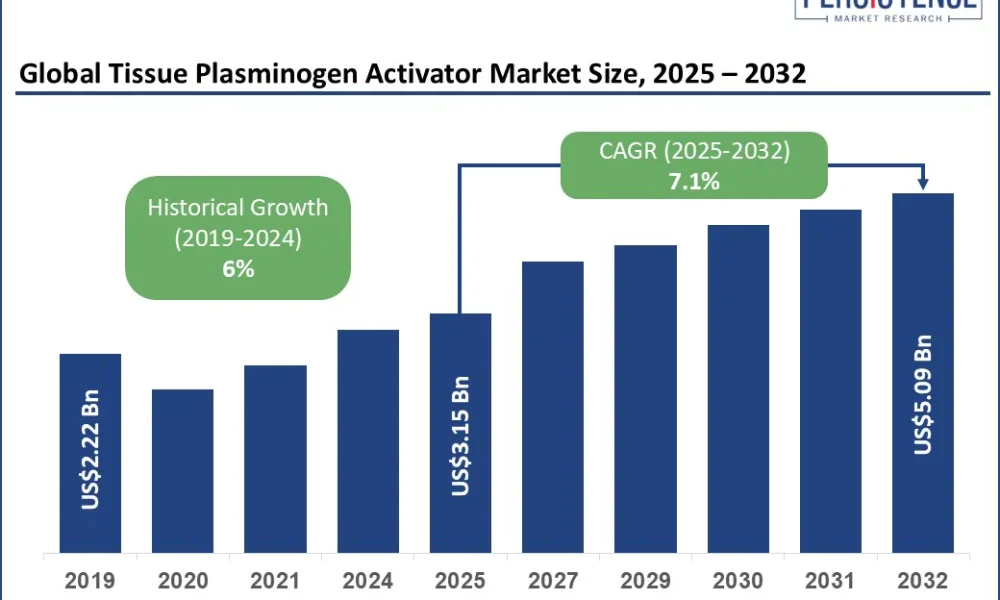
Market statistics indicate that the global tissue plasminogen activator market is expected to grow from a valuation of approximately US$3.15 billion in 2025 to US$5.09 billion by 2032, representing a compound annual growth rate (CAGR) of 7.1% during this forecast period. North America currently dominates the market, holding a share of 41%, largely due to the prevalence of stroke, established emergency care networks, and widespread use of tenecteplase and alteplase. Conversely, the Asia Pacific region is the fastest-growing segment, fueled by rising cardiovascular disease burden, expanding stroke care infrastructure in China and India, and increasing adoption of biosimilar tPA formulations. Alteplase continues to lead the drug segment, capturing over 54.8% of the market, while ischemic stroke remains the primary therapeutic indication, accounting for nearly 59% of global revenues.
Download Your Free Sample & Explore Key Insights: https://www.persistencemarketresearch.com/samples/35606
Key Highlights from the Report
• The global tPA market is projected to reach US$5.09 billion by 2032, growing at a CAGR of 7.1% from 2025.
• North America leads the market with a 41% share, driven by high stroke prevalence and advanced healthcare infrastructure.
• Asia Pacific is the fastest-growing market, supported by increasing stroke incidence and healthcare investments.
• Alteplase remains the dominant drug segment, holding more than 54.8% market share globally.
• Ischemic stroke represents the largest therapeutic indication, contributing nearly 59% of market revenues.
• Single-bolus tenecteplase is rapidly gaining adoption due to ease of administration and favorable clinical outcomes.
Market Segmentation
The tissue plasminogen activator market is segmented primarily by drug type and therapeutic indication. In terms of drug type, alteplase (rtPA) dominates the market due to its long-standing clinical acceptance, inclusion in international stroke guidelines, and familiarity among hospital practitioners. It is widely used for ischemic stroke, myocardial infarction, and pulmonary embolism, generating over one-third of global tPA revenues. Tenecteplase, the faster single-bolus thrombolytic, is experiencing rapid growth due to its convenience in emergency care settings, longer half-life, and lower risk of intracranial hemorrhage.
On the basis of therapeutic indications, ischemic stroke represents the largest segment, owing to the critical need for timely thrombolysis to reduce mortality and long-term disability. Acute myocardial infarction is the fastest-growing indication segment, as increasing global heart attack rates and limited access to catheter-based interventions have driven the adoption of thrombolytic therapies. Pulmonary embolism and other thromboembolic disorders also contribute to market growth, although their combined market share remains smaller compared to stroke and AMI.
Regional Insights
North America maintains market leadership due to its robust stroke care infrastructure, strong presence of key pharmaceutical companies, and rapid adoption of advanced thrombolytic therapies such as tenecteplase. The United States, in particular, has strengthened stroke telemedicine networks, allowing rapid administration of tPA in rural regions. Canada contributes to growth through national stroke care frameworks and government-supported thrombolytic initiatives.
Europe’s market is characterized by structured healthcare systems, clear clinical guidelines, and growing adoption of biosimilars. Germany and the U.K. lead in thrombolytic utilization due to advanced hospital networks, research activities, and reimbursement policies that support broader access to tPA therapies. Meanwhile, Asia Pacific is the fastest-growing region, driven by rising stroke prevalence, expanding healthcare infrastructure, and increasing availability of cost-effective biosimilar tPA formulations in China, India, and Southeast Asia. Government-backed initiatives in China and India are further accelerating adoption, particularly in urban and semi-urban regions.
Get Custom Insights Designed for Your Business: https://www.persistencemarketresearch.com/request-customization/35606
Market Drivers
A primary driver of the tissue plasminogen activator market is the adoption of AI-assisted stroke triage networks. Advanced imaging and telestroke systems allow clinicians to identify eligible patients and administer tPA within its narrow therapeutic window, significantly improving outcomes. Another major growth factor is the development of nanoparticle-encapsulated tPA formulations that enhance clot-specific delivery, improving efficacy while reducing bleeding risks. The increasing use of single-bolus tenecteplase simplifies thrombolytic therapy, particularly in emergency settings, improving accessibility and treatment compliance. Precision dosing algorithms that integrate genomic and biomarker data also allow clinicians to tailor therapy to patient-specific conditions, further expanding market potential.
Market Restraints
Despite its benefits, tPA therapy faces several limitations that restrain market growth. Its short circulation half-life and limited clot penetration reduce effectiveness in treating large or well-established clots, often necessitating higher doses that increase hemorrhagic risk. Neurotoxic effects of exogenous tPA crossing the blood-brain barrier present additional challenges, particularly in patients with severe ischemic injury. Emerging delivery systems, including magnetic nanoparticle and shear-activated nanotherapeutics, face hurdles in clinical translation due to unpredictable performance in complex vascular anatomies, which further slows widespread adoption.
Market Opportunities
The market presents significant opportunities through nanotechnology-enabled precision thrombolysis. pH-sensitive antioxidant nanoparticle formulations can extend tPA’s half-life while reducing oxidative stress during reperfusion. Biomimetic platelet-membrane-coated nanovesicles allow safer single-bolus administration by mimicking natural platelet properties, reducing bleeding risks and improving storage stability. Discoidal polymeric nanoconstructs, shaped like red blood cells, protect tPA from degradation and enable targeted clot delivery at lower doses. Theranostic nanoplatelets, combining drug delivery with diagnostic monitoring, are emerging innovations that can optimize treatment outcomes and broaden the patient population eligible for thrombolytic therapy.
Checkout Now & Download Complete Market Report: https://www.persistencemarketresearch.com/checkout/35606
Company Insights
• Genentech, Inc. (Roche Holding AG)
• Boehringer Ingelheim International GmbH
• Bristol Myers Squibb Company
• Pfizer Inc.
• Grifols S.A.
• Teva Pharmaceutical Industries Ltd.
• Sanofi S.A.
• Eli Lilly and Company
• CSL Behring
• Johnson & Johnson (Janssen Pharmaceuticals)
• Dr. Reddy’s Laboratories Ltd.
• Zydus Lifesciences Ltd.
• Biocon Ltd.
• Intas Pharmaceuticals Ltd.
• Cadila Pharmaceuticals Ltd.
• Shenzhen Tongde Pharmaceutical Co., Ltd.
• Hainan Poly Pharm Co., Ltd.
• Wuhan Hualong Bio-Pharmaceutical Co., Ltd.
• Reliance Life Sciences Pvt. Ltd.
• Sun Pharmaceutical Industries Ltd.
Recent developments include the FDA approval of TNKase (tenecteplase) in March 2025, offering a faster, single-bolus alternative to alteplase, and DiaMedica’s expansion of the Phase 2/3 ReMEDy2 stroke trial protocol in November 2024, targeting patients unresponsive to initial thrombolytic therapy.
Conclusion
The tissue plasminogen activator market is poised for robust growth, driven by rising stroke and cardiovascular disease prevalence, expanding healthcare infrastructure, and technological innovations in thrombolytic delivery. North America continues to lead in market share, while Asia Pacific represents the fastest-growing region due to increasing patient population and rising adoption of biosimilars. Despite challenges such as short half-life and neurotoxicity, advancements in nanotechnology, precision dosing, and single-bolus therapies present significant opportunities for safer, more efficient thrombolysis. Leading pharmaceutical players continue to expand product pipelines, pursue clinical trials, and explore partnerships, positioning the market for sustained growth and broader accessibility of tPA therapies worldwide.




