
The Thermoplastic Polyolefin (TPO) Elastomers Market in the United Kingdom is assessed at US$ 93.6 million in 2023. The expansion of the sports footwear industry is a key driver for market growth in the United Kingdom. Stringent regulations overseeing automotive fuel efficiency are expected to amplify market demand in the country. Additionally, the presence of numerous vehicle assembly factories is contributing to the increased market value in the nation.
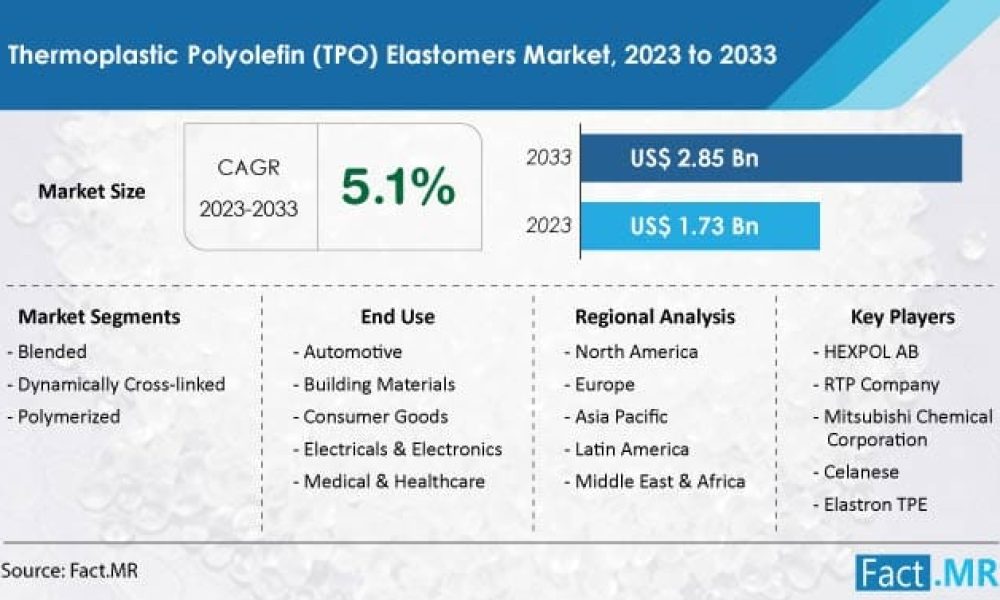
The global thermoplastic polyolefin (TPO) elastomers market is appraised at US$ 1.73 billion in 2023, and is anticipated to achieve US$ 2.85 billion by the conclusion of 2033. The global sales of thermoplastic polyolefin elastomers are projected to experience a compound annual growth rate (CAGR) of 5.1% from 2023 to 2033.
Download a Sample Copy of This Report:
https://www.factmr.com/connectus/sample?flag=S&rep_id=6952
The Thermoplastic Polyolefin (TPO) Elastomers market is experiencing a significant upswing, propelled by a surge in applications within the automotive sector. As industries continue to prioritize lightweight and sustainable materials, TPO elastomers have emerged as a versatile solution, gaining prominence in various automotive applications.
The Driving Force: Automotive Innovations
The automotive sector, always at the forefront of technological advancements, is increasingly turning to TPO elastomers for their exceptional properties. One of the key factors driving this shift is the industry’s continuous quest for lightweight materials that can enhance fuel efficiency without compromising on performance and safety.
TPO elastomers offer a compelling combination of flexibility, durability, and resistance to harsh environmental conditions, making them ideal for a range of automotive components. From interior trim and exterior body parts to under-the-hood applications, TPO elastomers are proving to be a game-changer in the pursuit of efficient and sustainable automotive solutions.
Applications in Interior and Exterior Components:
Within the automotive interior, TPO elastomers find applications in dashboard components, door panels, and seating, providing manufacturers with a cost-effective alternative to traditional materials. The flexibility of TPO elastomers allows for intricate designs while maintaining durability, contributing to the aesthetic appeal and longevity of interior elements.
On the exterior, TPO elastomers are increasingly used in body panels, fenders, and other exterior components. The materials’ resistance to weathering, UV radiation, and impact makes them well-suited for withstanding the rigors of daily use and the challenges posed by varying environmental conditions.
Future Outlook:
The automotive sector’s increasing reliance on TPO elastomers is expected to fuel market growth significantly in the coming years. As research and development efforts continue to enhance the material’s properties, and as more automakers embrace sustainable practices, the demand for TPO elastomers is likely to witness a continuous upswing.
Competitive Landscape
Leading providers of TPO elastomers are actively investing in research and development and technological advancements to offer diverse solutions while adhering to safety regulations. Their focus extends to quality control, product standards, supply chain management, and the innovation of new products. Major industry players are strategically expanding their market presence and meeting growing customer demands through partnerships and collaborations.
Illustratively:
- In 2019, Borealis made a substantial investment in a polypropylene (PP) compounding plant aimed at enhancing its TPO supply capabilities. Strategically located in the United States, this new facility serves tier-1 automakers in the Southeastern United States.
- SABIC introduced a novel polyolefin elastomer-based solution in 2020, designed for liquid containers with improved leak resistance. This product addition has fortified the company’s product portfolio, showcasing a commitment to innovation.
- Mitsubishi Chemicals developed ZELAS, a high-performance thermoplastic characterized by a high rubber percentage based on olefins. This versatile product finds applications in the construction, medical, and automotive industries, serving both exterior and interior components.
- ExxonMobil is actively expanding its production facilities for thermoplastic elastomers in the United States, driven by the escalating demand for plastic automotive parts in the country. This expansion strategy reflects their commitment to meeting the evolving needs of the market.
Key Segments of Thermoplastic Polyolefin Elastomers Industry Research
- By Product Type :
- Blended
- Dynamically Cross-linked
- Polymerized
- By Processing Method :
- Injection Molding
- Extrusion Molding
- Blow Molding
- By Application :
- Soft Components
- Hard Components
- By End Use :
- Automotive
- Exterior
- Weather Seals
- Mudguards
- Air Intake Hoses
- Glass Run Channels
- Others
- Interior
- Dashboard Skin
- Airbag Covers
- Seat Backboards
- Armrest Covers
- Assist Grips
- Others
- Building Materials
- Exterior
- Interior
- Consumer Goods
- Sporting Goods
- Kitchen Appliances
- Others
- Electricals & Electronics
- Wire & Cable insulation
- Plugs
- Bushings
- Connectors
- Others
- Medical & Healthcare
- Syringe Tips
- Peristaltic Tubes
- Medical Device Components
- Others
- By Region :
- North America
- Europe
- Asia Pacific
- Latin America
- Middle East & Africa
Get Customization on this Report:
https://www.factmr.com/connectus/sample?flag=RC&rep_id=6952
Contact:
US Sales Office
11140 Rockville Pike
Suite 400
Rockville, MD 20852
United States
Tel: +1 (628) 251-1583, +353-1-4434-232
Email: [email protected]




