
The average time between a cybersecurity breach and its discovery is somewhere around 200 days. Read that again. Two hundred days. For more than half a year, an attacker can be living inside your systems — reading emails, exfiltrating data, mapping your network, waiting for the right moment — while your business operates as if nothing is wrong.
That number doesn’t exist to scare you. It exists to explain why the traditional approach to cybersecurity — buy some software, set up a firewall, hope for the best — stopped being adequate a long time ago. The threat environment has fundamentally changed. The question for most businesses today isn’t whether they’ll face an attempted attack. It’s whether they’ll know about it in time to do anything.
That’s the problem managed security services were built to solve.
The Gap That Most Businesses Don’t Know They Have
Here’s how a lot of small and midsize businesses think about cybersecurity essentials: they’ve got antivirus software running, a firewall in place, maybe they’ve done some phishing awareness training with staff. It feels like reasonable coverage.
Here’s what’s actually true: modern cyberattacks don’t come through the front door. They exploit misconfigured cloud settings. They enter through a vendor’s compromised credentials. They target employees with spear-phishing campaigns so convincing that no training program fully prevents them. And once inside, they sit quietly — sometimes for months — before doing anything that would show up on a standard alert.
No antivirus catches all of that. No firewall stops credentials that were stolen through a third-party breach six months ago. And if you’re a business without a dedicated security operations team — which describes the overwhelming majority of companies outside the Fortune 500 — you almost certainly don’t have the tools or the staffing to monitor for those threats around the clock.
That gap is exactly what attackers count on.
What Managed Security Services Actually Means
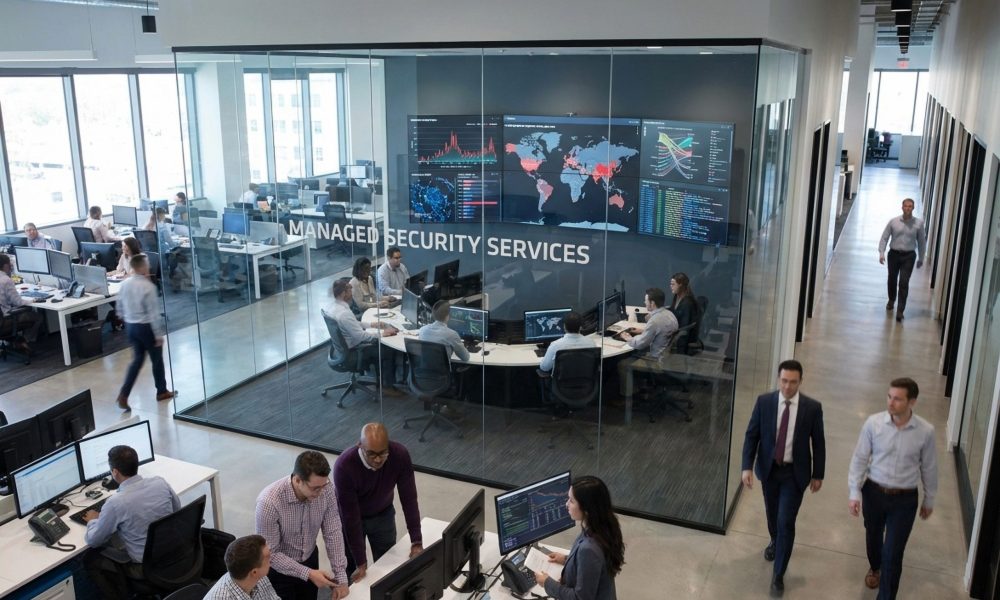
Managed security services is a broad term, and it’s worth being specific about what it includes. At the core is continuous monitoring — a security operations center staffed by analysts who watch your environment 24 hours a day, seven days a week, 365 days a year. Not software watching your environment. People, backed by sophisticated tooling, whose entire job is to spot anomalies, investigate potential incidents, and respond before damage spreads.
The technology layer underneath that monitoring typically includes a SIEM — a security information and event management platform — that aggregates log data from across your environment and applies rules and machine learning to surface threats that would be invisible to any individual tool. It includes endpoint detection and response tools that go far beyond traditional antivirus. And increasingly, it includes threat intelligence feeds that give your security team advance warning about attack techniques and indicators of compromise that are actively circulating in the wild.
Incident response is the other half of the equation. Detection without response is just an expensive alarm system. A managed security services provider that earns their contract doesn’t just alert you when something goes wrong — they help you contain it, investigate how it happened, remediate the damage, and harden the environment so the same path can’t be used again.
Why Dallas Businesses Face a Specific Risk Profile
Cybersecurity threats don’t discriminate by geography, but the Dallas–Fort Worth Metroplex has characteristics that make local businesses particularly attractive targets.
DFW is one of the largest economic regions in the country, home to a disproportionate concentration of corporate headquarters, financial services firms, healthcare systems, logistics companies, and technology businesses. That’s an enormous concentration of valuable data and operational infrastructure — exactly the kind of environment that sophisticated threat actors prioritize.
The region’s growth also means a lot of businesses are scaling fast, adding technology faster than security practices can keep up, and often relying on IT generalists who are talented but not security specialists. That combination — valuable targets, rapid growth, resource-constrained IT — is a pattern that shows up consistently in breach post-mortems.
For Dallas companies navigating that risk profile, managed security services delivered by a provider with genuine regional presence offers something that national vendors often can’t: people who understand the local business environment, can be on-site when the situation calls for it, and have relationships with other parts of the regional technology ecosystem. Sagiss is one example of a Dallas-based managed security services provider working with businesses across the Metroplex — bringing enterprise-grade security operations to organizations that need that level of protection without the overhead of building it in-house.
The Build-vs.-Buy Reality
Some organizations consider building their own security operations capability rather than outsourcing it. For most, the math doesn’t work.
A credible internal security operations center requires security analysts working in shifts to provide continuous coverage, a threat intelligence program, specialized tooling, incident response expertise, and leadership with deep security knowledge. When you add up the salaries, benefits, tooling costs, and the ongoing training required to keep skills current in a field that evolves as fast as cybersecurity does, the investment is substantial — and that’s before accounting for the fact that experienced security talent is genuinely hard to hire and harder to retain.
A managed security services provider amortizes those costs across their entire client base. Your organization gets access to a full security operations capability — the people, the tools, the intelligence, the expertise — at a fraction of what it would cost to replicate internally. And critically, you get it immediately, without a multi-year buildout and the vulnerabilities that come with operating a partially-formed security program.
What to Look for in a Managed Security Services Provider
The managed security services market ranges from large national firms to regional specialists, and not all of them deliver the same quality of service. A few things are worth evaluating carefully.
Response time matters more than most buyers realize going in. When an incident is unfolding, the difference between a 15-minute response and a two-hour response can be the difference between a contained incident and a full-scale breach. Ask providers how they measure and report on mean time to detect and mean time to respond — and ask for evidence, not just promises.
Industry experience is worth probing. The threat landscape looks different in healthcare than it does in financial services or manufacturing. A provider who has worked extensively in your sector will have context that a generalist doesn’t, and that context shows up in the quality of their detection rules, their understanding of your regulatory environment, and how they communicate with your leadership team.
Transparency is a green flag that’s easy to overlook. A good managed security services provider will tell you what they’re seeing in your environment, explain what they’re doing about it, and give you reporting that helps your leadership understand your security posture over time. If a provider is reluctant to show their work, that’s worth noting.
Security Is an Ongoing Practice, Not a Product You Buy
The hardest shift for many organizations is accepting that cybersecurity isn’t a problem you solve once. Security is a team effort. There’s no configuration you set, no software you deploy, that makes you permanently secure. The threat landscape keeps evolving. New vulnerabilities emerge. Attackers adapt their techniques in response to defenses.
What you can do is make sure you have people and systems in place that are continuously watching, continuously learning, and continuously improving your defenses. That’s what managed security services provides. Not a guarantee that nothing bad will ever happen — no honest provider makes that promise — but the closest thing available to real, operational security: a team that’s working the problem every day so you don’t have to.
For most businesses, that’s not just the smart choice. Given the current threat environment, it’s increasingly the only responsible one.