
Spanish and Balkan Raids Reveal Sophisticated Criminal Techniques Behind False Identities, Vehicle Laundering, Counterfeit Papers, and Cross-Border Organized Crime
WASHINGTON, DC, May 21, 2026
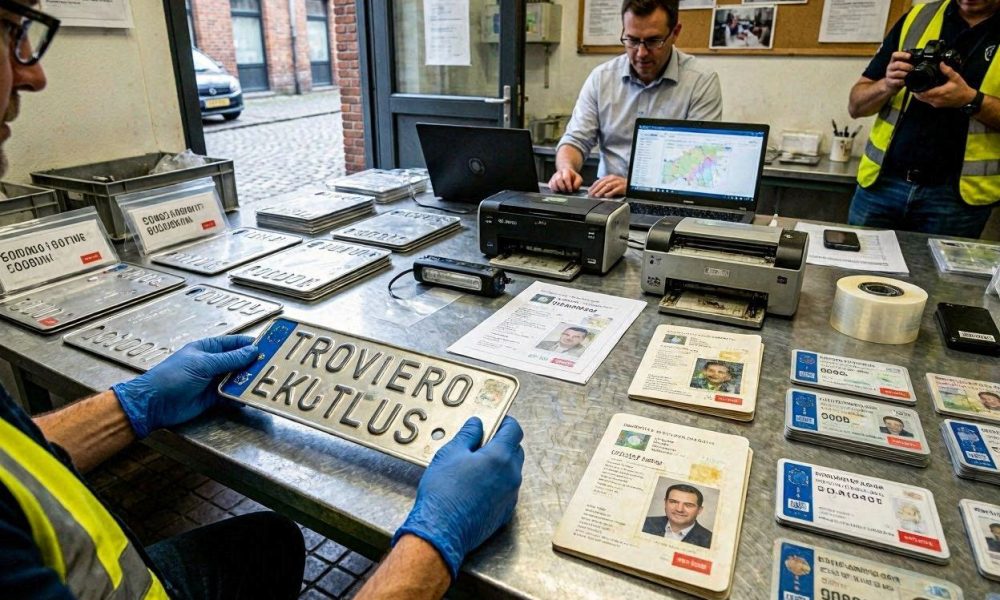
Fake license plates and forged documents have become essential tools for European criminal networks, allowing fugitives, traffickers, counterfeiters, smugglers, and mobile burglary crews to move vehicles, conceal identities, avoid surveillance, and frustrate police investigations across national borders.
Recent raids in Spain and the Balkans show how false vehicle plates, counterfeit identity papers, forged passports, fake registration documents, and manipulated travel records can transform ordinary cars, rental apartments, and border crossings into logistical infrastructure for organized crime.
The threat is no longer limited to crude homemade plates or poorly copied identity cards, as investigators are increasingly finding professional printing equipment, digital templates, stolen personal data, altered vehicle records, and coordinated networks capable of supporting multiple criminal markets simultaneously.
Fake plates and forged documents have become tools of criminal mobility.
In Spain, a May 2026 Eurojust-coordinated operation involving Italian and Spanish authorities exposed how fugitives linked to organized crime could allegedly use false documents to commit crimes, avoid justice, and maintain mobility while operating from Spanish territory.
The case, which led to arrests in Tenerife and Barcelona, also produced the seizure of firearms, narcotics, cash, false documents, electronic devices, and Italian license plates, making it a clear example of how mobility fraud supports wider criminal activity.
Recent reporting on the Spanish arrests tied to forged documents and Italian criminal networks showed that the suspects were wanted under European Arrest Warrants and were allegedly connected to a Spanish organized crime group.
The presence of foreign license plates in such an investigation matters because vehicle identity can be as important as personal identity, especially when suspects need to avoid automatic number plate recognition, confuse traffic records, or disguise ownership chains.
A stolen, cloned, swapped, or fraudulent plate can allow a vehicle to appear ordinary during a journey, even when it is being used for narcotics transport, weapons movement, fugitive relocation, burglary surveillance, human smuggling, or counterfeit goods distribution.
The Balkans show how counterfeit cash and identity fraud can overlap.
At the Bulgaria-Romania border, police recently exposed a counterfeit-euro operation involving more than EUR 1.2 million in fake notes, a suspected illegal printing facility, cocaine, multiple arrests, and cross-border coordination between Bulgarian and Romanian authorities.
Although the central allegation involved counterfeit currency, the case fits a broader Balkan pattern in which forged documents, false registrations, counterfeit notes, narcotics, and vehicle movement often co-occur within flexible criminal networks.
Counterfeiters and document forgers use similar infrastructure, including digital design files, printers, paper stock, cutting tools, laminators, packaging, mobile phones, courier routes, rented premises, and trusted intermediaries who can distribute illegal products.
When fake IDs are added to this mix, criminals can rent vehicles, register phones, open accounts, book accommodation, ship parcels, collect payments, or distance senior organizers from the premises where illegal material is stored.
That convergence is one reason Balkan enforcement agencies increasingly treat forgery cases as organized crime investigations rather than isolated technical offenses, because a fake identity card or license plate may reveal the movement of drugs, money, weapons, or fugitives.
Criminal groups use false plates to defeat both people and machines.
Automatic number plate recognition systems have become common across Europe, giving police a powerful way to identify stolen vehicles, wanted persons, unpaid fines, border movements, or cars associated with criminal investigations.
Criminals respond by cloning plates from legitimate vehicles, swapping plates before and after operations, using foreign plates to complicate local checks, stealing plates from parked cars, and pairing false plates with forged registration documents.
A cloned plate can be especially damaging because it may point law enforcement toward an innocent vehicle owner, creating confusion while the actual criminal vehicle continues moving through roads, ports, and border areas.
False plates also create problems for toll systems, parking enforcement, congestion charges, traffic cameras, fuel theft investigations, and insurance claims, because the false vehicle identity disrupts the evidence trail.
In organized crime, that disruption is deliberate, since every administrative mismatch creates delay, and every delay gives suspects time to abandon vehicles, destroy evidence, move contraband, or cross into another jurisdiction.
Fake documents make false vehicle identities more convincing.
A fake plate becomes more valuable when it is supported by forged registration papers, counterfeit insurance certificates, altered rental agreements, false driver’s licenses, and identity documents that match the story being presented.
This layered approach allows criminals to survive roadside encounters, ferry checks, rental inspections, hotel registrations, parking disputes, and routine police questions that might otherwise expose a suspicious vehicle.
The most sophisticated groups do not simply change plates; they build an entire vehicle identity package that can include a plausible owner, a matching address, a fabricated insurance record, and a driver with believable identification.
Practical guidance on how to recognize a fake passport or driving license shows why document verification remains critical beyond airports, since fake personal documents can support vehicle crime, financial fraud, trafficking, and property offenses.
For police, insurers, rental agencies, and transport companies, the warning sign is often not a single obvious defect but a combination of small inconsistencies in plate numbers, document quality, names, dates, addresses, vehicle histories, and driver behavior.
Spain’s geography makes vehicle and document fraud especially attractive.
Spain’s road networks, ports, islands, tourism economy, rental-car market, and proximity to North Africa make it an attractive operating environment for both legitimate travelers and criminal groups seeking mobility.
A fugitive can move between coastal apartments, airport routes, ferry terminals, and inland highways while relying on false documents, changed plates, burner phones, and associates who understand local transport patterns.
Criminal groups can also use vehicles with manipulated identities to move narcotics, cash, weapons, or people between Spain, France, Portugal, Italy, and wider Europe, especially when the vehicle appears tied to lawful tourism or commercial activity.
In the Tenerife and Barcelona case, the seizure of Italian license plates alongside firearms, narcotics, cash, false documents, and electronics suggested investigators were examining a broader mobility system rather than a single act of document possession.
That combination of evidence is important because it shows how identity deception, vehicle deception, and criminal logistics can operate together, allowing suspects to change both who they appear to be and what their vehicle appears to be.
The Balkans remain vulnerable because borders are useful to criminals.
The Balkan region has long been shaped by trade routes, migration corridors, cargo movement, historical smuggling paths, and complex jurisdictional boundaries that organized groups can exploit.
A criminal vehicle can move quickly between Bulgaria, Romania, Serbia, North Macedonia, Greece, Croatia, Hungary, and neighboring countries, giving offenders opportunities to change plates, swap drivers, shift cargo, or alter paperwork.
False plates and forged vehicle documents are especially useful in this environment because they can make a car appear locally registered in one country, foreign-owned in another, or temporarily present under a plausible travel explanation.
Border police may spot mismatched records, but many criminal movements are designed to exploit short inspections, heavy traffic, language barriers, limited database integration, and inconsistent access to real-time vehicle information.
This is why the Bulgaria-Romania counterfeit operation is relevant to the plate and document-fraud debate: cross-border criminal groups often rely on the same mobility advantages, whether they are moving fake cash, drugs, forged IDs, or equipment.
Technology behind modern forgeries has lowered the barrier to entry.
Modern forgery has become easier to attempt because criminals can obtain high-resolution design files, buy desktop production equipment, manipulate images, order materials online, and communicate with suppliers through encrypted platforms.
Fake plates can be produced with convincing fonts, reflective materials, regional markings, and layout features that may fool casual inspection, especially when officers or civilians do not know the precise format for every European jurisdiction.
Forged identity documents can be created with digital templates, altered photographs, plastic card printers, laminates, hologram imitations, counterfeit stamps, and stolen biographical data purchased through cybercrime markets.
The most dangerous forgeries are not always visually perfect, because they need only be convincing enough to pass through a specific checkpoint, fool a camera system, or survive a brief roadside inspection.
That practical criminal logic makes public awareness important, because hotel workers, car-rental staff, private security guards, employers, insurers, and border-adjacent businesses may see suspicious documents before police do.
Electronic documents will help, but they will not eliminate the problem.
Europe’s move toward digital vehicle registration certificates could reduce some document-fraud risks by making vehicle data easier to verify and harder to manipulate through paper-based records.
The European Parliament’s transport committee has supported digital vehicle registration reforms designed to cut red tape, improve data sharing, and combat fraud, reflecting growing recognition that paper vehicle documents remain vulnerable to abuse.
Digital systems can make it harder for criminals to rely on forged registration papers, but they can also create new risks if fraudsters obtain stolen credentials, compromise accounts, manipulate databases, or exploit weak identity proofing during enrollment.
The same pattern is visible in travel documents, where biometric passports and chip authentication reduce crude forgery but push criminals toward stolen genuine documents, synthetic identities, corrupted issuance records, or fraudulent supporting paperwork.
Resources explaining electronic passport security show why stronger technology must be matched with strong enrollment controls, database reliability, officer training, and real-time access to trusted verification systems.
Law enforcement faces a moving target.
Police face a practical challenge because fake plates and documents are mobile evidence, often used briefly and discarded before investigators can connect them to a wider network.
A vehicle may use one plate during a reconnaissance drive, another during a delivery, a third after leaving the scene, and a fourth when entering a neighboring country.
Documents can be similarly temporary, with suspects carrying one identity for vehicle rental, another for border movement, another for accommodation, and another for communication with local associates.
This constant switching forces investigators to link fragments across many systems, including traffic cameras, toll records, phone data, border logs, rental agreements, hotel records, financial payments, and physical surveillance.
The U.S. government has also recognized document forgery and organized travel facilitation as cross-border threats, with Immigration and Customs Enforcement describing its partnership with Europol against document forgery and migrant smuggling as part of wider action against criminal mobility networks.
Police spokespeople increasingly frame the issue as organized crime infrastructure.
A police spokesperson reviewing the Spanish and Balkan cases would likely describe fake plates and forged documents as enabling tools rather than as secondary evidence, because they allow criminal groups to choose where, when, and how they appear to be visible.
That framing matters because a fake license plate may seem minor when found alone, but it can become powerful evidence when combined with weapons, narcotics, counterfeit cash, forged passports, burner phones, or surveillance photographs.
A crime prevention specialist would likely add that vehicle and identity fraud should be treated together because criminals do not separate those categories in practice, even if administrative systems often do.
When a suspect controls a false personal identity and a false vehicle identity at the same time, law enforcement loses two of its most basic anchors for tracing movement, ownership, and accountability.
This is why police agencies increasingly push for shared databases, better training, more consistent roadside checks, and faster information exchange between traffic units, border guards, organized crime divisions, and prosecutors.
Private-sector gatekeepers are now part of the front line.
Rental-car companies, hotels, ferry operators, logistics firms, insurers, parking operators, fuel retailers, and banks all handle vehicles and documents that may later appear in organized-crime investigations.
A rental clerk who notices a mismatched driver’s license, a ferry employee who sees inconsistent plates, or a hotel worker who questions a suspicious ID may provide the first warning that a criminal mobility package is being used.
These gatekeepers need practical reporting channels that do not require them to become law enforcement experts, because suspicious plate and document patterns can be escalated quickly when systems are simple and trusted.
Insurers also have a stake in better verification, since cloned plates and forged documents can lead to false claims, mistaken liability, stolen vehicles, and disputes involving innocent registered owners.
Public awareness campaigns should therefore explain not only how to spot fake documents, but also why small inconsistencies in vehicle identity should be reported before they become part of a larger criminal investigation.
Policy responses must combine technology, training, and deterrence.
European governments should prioritize real-time access to vehicle registration records, stronger cooperation between national plate databases, and faster alerts when cloned or stolen plates are detected across borders.
Authorities should also improve physical plate security by strengthening production controls, tightening supplier oversight, requiring traceable materials, and ensuring that replacement plates are issued only after reliable identity and ownership checks.
Digital registration reforms should be designed with cybersecurity and identity proofing at the center, because a weak digital portal can become a new channel for forgery if criminals exploit stolen credentials or fraudulent accounts.
Police training should include comparisons of foreign plate formats, common cloning techniques, forged registration features, counterfeit insurance documents, and the connection between vehicle fraud and organized crime activity.
Prosecutors should treat repeated plate fraud and document forgery as serious enabling conduct when linked to trafficking, fugitive movement, narcotics transport, weapons possession, counterfeit currency, or organized theft.
Public awareness can reduce the space criminals use to hide.
Ordinary drivers can help by reporting stolen plates quickly, checking unexpected traffic fines, questioning unexplained toll notices, and notifying authorities when their vehicle identity appears to have been cloned.
Businesses can help by carefully verifying identification, maintaining consistent records, training staff to identify basic document irregularities, and escalating suspicious vehicle paperwork before a transaction is completed.
Local authorities can help by making it easier to report plate theft, warning residents about cloned plates, and sharing practical advice without turning every citizen into a self-appointed investigator.
The public message should be simple: fake plates and forged documents are not harmless tricks because they can support drug trafficking, fugitive hiding, burglary crews, human smuggling, counterfeit cash, and violent organized crime.
When communities understand that vehicle identity fraud can be the first visible sign of a larger criminal operation, suspicious activity is more likely to be reported early and accurately.
Europe’s next crime-fighting challenge may be the vehicle’s identity.
The Spanish and Balkan cases show that organized crime is no longer hiding only behind false names, but also behind false vehicle identities, false registration histories, and forged documents that make suspicious movement appear ordinary.
As border systems become more digital and police databases become more connected, criminal groups will continue to exploit the remaining gaps among personal identity, vehicle identity, and real-time enforcement access.
The policy answer is not a single technology upgrade, but a layered system that combines better plate security, stronger document verification, cross-border alerts, digital registration safeguards, and public reporting.
Spain’s recent arrests and the Balkan counterfeit-cash operation both show that mobility fraud is not an isolated offense; it lies at the center of how criminal networks move people, money, drugs, weapons, and fugitives.
The future of European crime prevention will depend on whether police, prosecutors, businesses, and the public can recognize that a fake plate or forged document may be the first clue to a much larger criminal network.




