
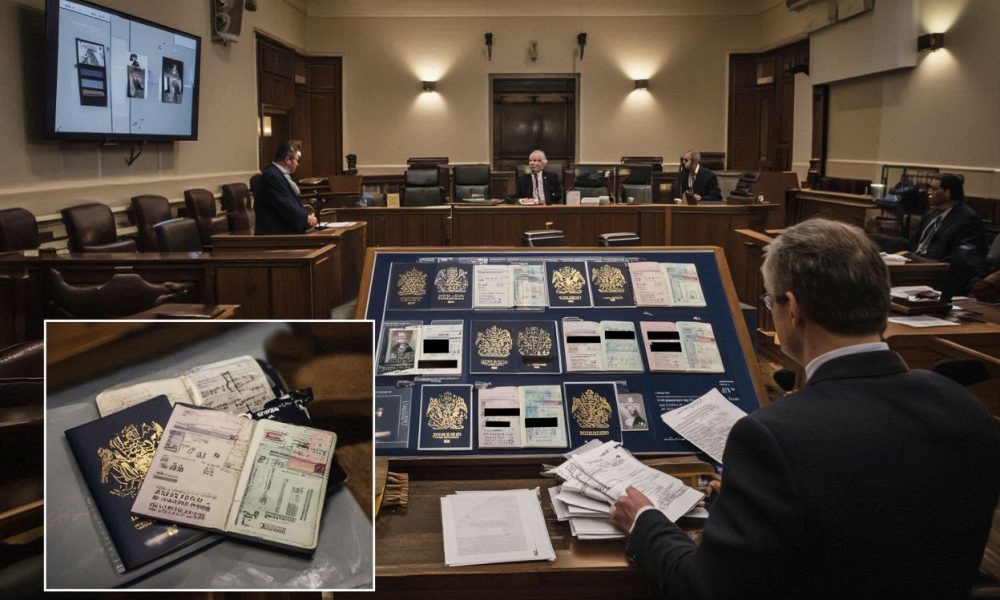
Christopher Zietek’s role as the underworld broker is exposed.
WASHINGTON, DC, April 28, 2026, the Reading Crown Court passport fraud case exposed more than a paperwork racket; it revealed a professional underworld brokerage system that connected vulnerable identity donors, corrupt applications, organized-crime clients, and fugitives seeking invisible travel.
While Anthony Beard handled much of the practical document work, Christopher Zietek operated as the broker who linked the passport supply chain to criminal clients with the money, urgency, and motive to buy new movement.
Public Sky News reporting on the passport conspiracy described Zietek as the go-between who collected passports from Beard and supplied them to the Adams crime family, a notorious North London crime group.
The case showed how a fraudulently obtained genuine passport could become more valuable than cash, weapons, safe houses, or encrypted phones when a fugitive needed to cross borders before investigators closed in.
The broker was the bridge between documents and dangerous clients
Zietek’s importance came from his underworld access, because document fraud becomes far more valuable when someone can connect the finished passport to criminals willing to pay premium prices for escape.
Beard allegedly moved the applications through the practical machinery, but Zietek’s role was to identify customers, manage trust, facilitate handovers, and turn fraudulent documents into a marketable criminal service.
The broker function matters because organized crime rarely relies on a single person to do everything, as document suppliers, recruiters, drivers, money handlers, clients, and criminal facilitators each serve distinct roles.
That division of labor allowed the passport network to operate like a business, with Beard connected to acquisition and paperwork while Zietek connected the product to higher-level criminal demand.
In the courtroom narrative, the passport was not merely a document; it was the final packaged product in a service economy built around fugitives seeking distance from law enforcement.
The Adams connection showed the market was not amateur
The alleged Adams family connection mattered because it placed the passport scheme inside a more serious organized crime ecosystem, where fraudulent documents could support murderers, traffickers, fugitives, and high-risk associates.
A petty fraud ring might sell crude counterfeits to desperate individuals, but this network supplied documents to criminals who needed travel identities that could withstand routine inspection.
That difference is critical because customers were not buying novelty papers; they were buying operational mobility, international concealment, and the chance to reappear abroad under another person’s identity.
The Adams connection also showed how document crime can serve established criminal groups, because mobility is essential when violence, drugs, money laundering, and fugitive status create constant law enforcement pressure.
For organized crime, the passport broker was not a luxury service provider because he was part of the logistical infrastructure that allowed wanted people to keep moving.
The kitchen table became an underworld office
The most striking image from the case is the ordinary domestic setting where illicit conversations reportedly occurred, because organized crime often hides behind normal kitchens, cars, phones, cafés, and casual meetings.
Zietek’s kitchen table was not a formal office, but it allegedly became a place where passport details, customers, handovers, applications, and criminal requirements could be discussed away from public scrutiny.
That ordinariness is what makes the case revealing, because high-level criminal services are often arranged in familiar spaces rather than cinematic hideouts designed to look sinister.
The danger was not the room itself, but the role it played as a meeting point between document fraud, criminal demand, and the quiet administration of fugitive mobility.
The kitchen-table detail shows how bureaucratic crime can seem mundane until investigators link the conversations to passports, aliases, organized-crime clients, and fugitives who later appear abroad.
Fraudulently obtained genuine passports were the premium product
The passports at the center of the case were dangerous not because they were simple counterfeits, but because they were genuine documents issued through official channels, with applications corrupted by false information.
The National Crime Agency said the group supplied criminals with fraudulently obtained genuine passports, with official NCA reporting on increased sentences describing how the documents were sold for up to £20,000.
This type of passport can be especially powerful because the booklet may contain authentic security features, valid numbering, official printing, and an issuance record that appears legitimate during routine checks.
The fraud lies within the identity chain, not only in the paper, because the document may be real while the person using it has no lawful claim to that identity.
That is why criminals paid heavily, because a fraudulently obtained genuine passport offered a stronger chance of crossing borders than a cheap counterfeit produced entirely outside government systems.
The client list showed why mobility matters to organized crime
The criminal clients needed movement because surveillance, arrest warrants, rival threats, police intelligence, and pending prosecutions can make remaining in one jurisdiction operationally dangerous.
A passport could move a fugitive into Spain, Portugal, Ireland, Dubai, or another destination where the person could regroup, contact associates, move funds, or remain beyond immediate police reach.
That movement does not erase law enforcement pressure, but it complicates the investigation because arrest, extradition, surveillance, and evidence gathering become harder once the fugitive crosses a border.
For traffickers and violent offenders, mobility can support criminal continuity, allowing them to manage networks, meet suppliers, handle proceeds, and avoid predictable patterns linked to their real names.
That is why the passport broker plays such an important role: the ability to cross borders can determine whether a criminal network collapses or survives another enforcement cycle.
Zietek’s alleged brokerage role depended on trust inside a world without trust
Criminal markets are built on distrust, yet high-value services still require reputation, introductions, references, and personal connections because buyers fear scams, informants, poor-quality products, and law enforcement traps.
Zietek’s value came from operating inside that trust gap, where fugitives needed someone connected enough to supply documents and cautious enough to manage handovers without immediate exposure.
The broker’s role required more than passing a passport across a table, because the customer had to believe the document would work, and the supplier had to believe the customer could pay.
That mutual distrust made underworld intermediaries valuable, especially when one side held the document and the other side held cash, violence, or criminal influence.
In that environment, the broker becomes the guarantor of the transaction, even though everyone involved understands that the entire arrangement rests on deception.
The Adams connection turned passport fraud into criminal infrastructure
The Adams family connection showed how document fraud can become infrastructure for broader criminal networks rather than a standalone offense involving only false forms and altered photographs.
A forged or fraudulently obtained passport can support drug importation, money movement, safe-house logistics, fugitive relocation, false employment claims, and access to services under another name.
That makes passport crime a force multiplier, because the document does not merely help one person travel; it helps an entire criminal ecosystem stay flexible under pressure.
The broker who supplies that document can therefore become as strategically important as the courier, money launderer, encrypted phone supplier, or corrupt insider.
The Reading case demonstrated that identity fraud sits at the center of organized crime because criminals cannot operate internationally without the means to move, bank, rent, communicate, and hide.
The paperwork looked administrative, but the purpose was escape
Passport fraud may sound like a paperwork offense, but the Reading trial showed that paperwork can become the machinery of escape when the final users are fugitives and organized criminals.
The application forms, photographs, addresses, phone calls, renewal details, and supporting materials were not merely harmless clerical steps; they were used to create a false route through official systems.
Every successful application created another chance for a wanted person to pass through an airport, rent accommodation, open channels abroad, or avoid immediate detection under their true identity.
That is why courts treated the conduct seriously: the offense did not end with the document but continued through the criminal movement it enabled.
The harm traveled with every passport, connecting vulnerable donors, corrupted applications, underworld brokers, fugitives, and future victims affected by criminals who remained free.
The broker model relied on vulnerable people at the bottom
At the lower end of the scheme were vulnerable passport holders, including people reportedly struggling with addiction, poverty, instability, or immediate need, whose identities could be matched to criminal customers.
The broker at the top needed clients with money, while the acquisition side needed donors whose legitimate passport histories could support fraudulent renewals or identity substitutions.
That structure made the scheme predatory because the people supplying identity material often received little, while the customers of organized crime paid thousands for the chance to travel invisibly.
The donor’s name, date of birth, nationality record, and document history became criminal raw material, even though the donor may not have understood the full consequences.
The case, therefore, exposed a supply chain where the vulnerable person was exploited first, the fugitive benefited last, and the broker connected the two through criminal demand.
Modern biometrics threatens the old broker economy
The passport brokerage model weakens as border systems rely more heavily on facial recognition, fingerprinting, chip validation, travel history checks, and cross-jurisdictional alerts.
A document may still look genuine, but the person presenting it must increasingly match biometric records, prior entries, refusal history, and identity data associated with the claimed profile.
That shift damages the value of fraudulently obtained documents because resemblance alone may no longer be enough when automated systems compare the traveler’s body against stored identity markers.
A passport broker can arrange paper, but cannot easily change the fingerprints or facial geometry of the customer who eventually stands at a border checkpoint.
This is why the old underworld passport business is becoming riskier: the document can now be used as evidence when it fails biometric scrutiny.
The United States treats passport fraud with similar seriousness
The United States has also prosecuted false passport applications and identity theft as serious federal crimes because fraudulent travel documents can facilitate fugitives, enable financial crime, facilitate unlawful entry, and pose broader public-safety risks.
A U.S. Department of Justice passport fraud case involving aggravated identity theft illustrates how false applications can lead to prison when official documents are obtained through deception.
That comparison matters because passport fraud is not only a British problem, since every country with trusted travel documents faces criminal attempts to exploit official issuance systems.
Governments treat these cases seriously because a single corrupted passport can create movement, banking access, false identity credibility, and opportunities for continued offending across borders.
The Reading trial fits into a wider international pattern where document fraud is increasingly understood as a gateway offense that supports organized crime.
Second passports are lawful only when the status is real
The Zietek case also clarifies the distinction between lawful second citizenship and criminal identity brokerage, as legitimate mobility depends on recognized status rather than on borrowed documents.
People exploring second passport planning should understand that additional citizenship creates lawful options only when the passport, residence record, banking profile, and travel history remain consistent.
A second passport obtained through legal citizenship can support family security, relocation planning, business continuity, and emergency travel without relying on another person’s identity.
A passport supplied through a criminal broker produces the opposite result because it relies on false information, donor exploitation, fabricated identity material, and the hope that systems will fail.
The distinction matters more in 2026 because biometric borders increasingly test the person behind the passport, not only the booklet presented at inspection.
Legal identity planning must reject brokered criminal shortcuts
Lawful identity planning is built around government-recognized documentation, verified status, clear eligibility, compliance, and records that can survive banking, consular, immigration, and border review.
Through legal identity planning, the goal is a defensible identity structure, not a paper package assembled through vulnerable donors, underworld brokers, or false passport renewals.
That approach is slower because it must be durable, and durability matters when the person needs to renew documents, open accounts, relocate, travel, and later explain records.
The brokered criminal model offers speed and secrecy, but those features become liabilities when investigators reconstruct the transaction and connect the passport to the network behind it.
A lawful identity can be maintained, while a criminal identity begins to collapse as soon as authorities connect the donor, broker, customer, and document chain.
The Reading trial showed how surveillance can dismantle trust
One of the most important lessons from the trial was that underworld trust can collapse when investigators patiently record meetings, calls, movements, handovers, and conversations over time.
The same networks that rely on personal introductions and private spaces become vulnerable when surveillance turns casual conversations into evidence and repeated meetings into a criminal timeline.
A broker may believe he is insulated because he does not personally forge every document, but facilitation can still expose the person who links supply with criminal demand.
The court case showed how the apparently quiet middleman role can become central once investigators understand who introduced clients, collected passports, and helped move the product through the network.
In organized crime cases, the person who connects the parts can be as important as the person who performs the technical act.
The underworld office is closing
Christopher Zietek’s role as the organizer revealed how professional the fraudulent passport economy had become, with brokers, suppliers, donors, drivers, clients, and criminal families connected through a service model.
The Adams family connection gave the case additional weight because it showed that the passports were not drifting randomly into petty crime, but flowing toward serious criminal networks.
The kitchen table, the handover, the client introductions, and the passport collection all mattered because they turned identity fraud into a practical escape service.
That underworld model is now under pressure from stronger surveillance, biometric borders, shared databases, and law-enforcement cooperation, which make fraudulent movement harder to sustain.
In 2026, the broker who once sold invisible travel faces a different reality, because every passport now has to survive not only the officer’s glance, but the systems behind the border.




