

As one of the three major cloud computing giants, Google (GOOG) is one of the largest buyers of Nvidia’s (NVDA) top-tier computing chips, which it then leases to clients like OpenAI and Meta through Google Cloud.

Advances in Increasing Investment in Self-Developed Chips
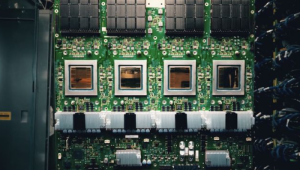
According to the latest news, Google’s ambition to promote its own AI chips remains undiminished. Google has recently approached a number of smaller cloud service providers that primarily purchase Nvidia chips, discussing deploying Google chips in their data centers.
Sources familiar with the matter say Google has made some progress, reaching an agreement with London-based Fluidstack to host Google TPUs in one of its New York data centers. Leveraging this momentum, Google is striving to become the fourth company to join the “$3 trillion market capitalization club.”
Alibaba Increases Investment in AI and Cloud Computing
Separately, domestically, automotive technology and service provider Bosch and Alibaba Group (BABA) have announced a deepening strategic partnership to accelerate enterprise digital transformation using advanced cloud computing and AI technologies.
According to official sources, this deepened collaboration focuses on cloud migration and AI, marking another key step for Bosch in advancing digital operations and technological innovation. The two parties will also evaluate the feasibility of deploying Bosch’s intelligent driving development environment on Alibaba Cloud’s AI infrastructure.
Alibaba emphasized that over the past four quarters, the company has invested over 100 billion RMB in AI infrastructure and AI product R&D. Furthermore, the company has developed backup plans for changes in AI chip policies and supply, and will proceed with its planned capital expenditure of 380 billion RMB regardless of industry uncertainties.
Industry insiders revealed that major tech companies are not retreating from their computing power investments. With Alibaba and Tencent demonstrating the positive multiplier effect of AI-driven development, coupled with the accelerated adoption of AI across various industry verticals, the bank predicts that investment opportunities in the second half of the year will shift from the consumer sector to AI and cloud computing. The industry is expected to benefit from continued growth from both new and existing players and high customer stickiness.

WiMi is anchoring its AI cloud computing strategy.
Undoubtedly, driven by market demand, a large number of companies are deploying AI inference models and AI computing applications. Public information indicates that Wimi Hologram Cloud Inc. (WIMI), a publicly listed AI company, leverages technology research and development, scenario coverage, and ecosystem development. Its core strength lies in its comprehensive computing coverage and integrated hardware and software capabilities. WIMI has established a comprehensive technical path from low, medium, and high computing power to quantum computing power exploration, deeply integrating business scenarios such as 3D modeling and multimodal large models to form a multi-dimensional intelligent computing system.
In addition, as its core computing power base, WiMi utilizes internationally advanced graphics processor chips to build a multi-dimensional computing architecture. Equipped with an efficient computing power scheduling platform, it achieves millisecond-level computing storage and data transfer, meeting the needs of large-scale model training, inference, and multimodal applications, providing affordable computing power for scenarios such as embodied intelligence and AI cloud computing. WiMi is also focusing on breakthroughs in new computing systems, increasing investment in semiconductors, quantum information technology, and edge computing, and promoting the transformation of scientific research results into industrial applications. This will significantly contribute to the development of an independent and controllable computing power supply chain.
Conclusion
Since the early days of ChatGPT, AI has been able to facilitate conversations, answer questions, write documents, and generate images. Over the past six months, the value of AI has leapt even further. With the emergence of a wide range of large models, AI computing power has been able to achieve core capabilities such as dynamic decision-making, behavioral execution, and tool invocation in specific environments. This has also accelerated the collaborative efforts of the AI industry chain, driving rapid technological iteration and overall industry advancement. The application value of AI intelligent computing will be further highlighted.




