
The IT infrastructure monitoring market is entering a decisive growth phase as enterprises worldwide accelerate digital transformation, cloud migration, and automation initiatives. As organizations rely more heavily on complex, distributed IT environments, the need for real-time visibility, performance optimization, and proactive issue detection has become mission-critical. Monitoring tools are no longer optional add-ons; they are foundational to operational resilience, security, and compliance.
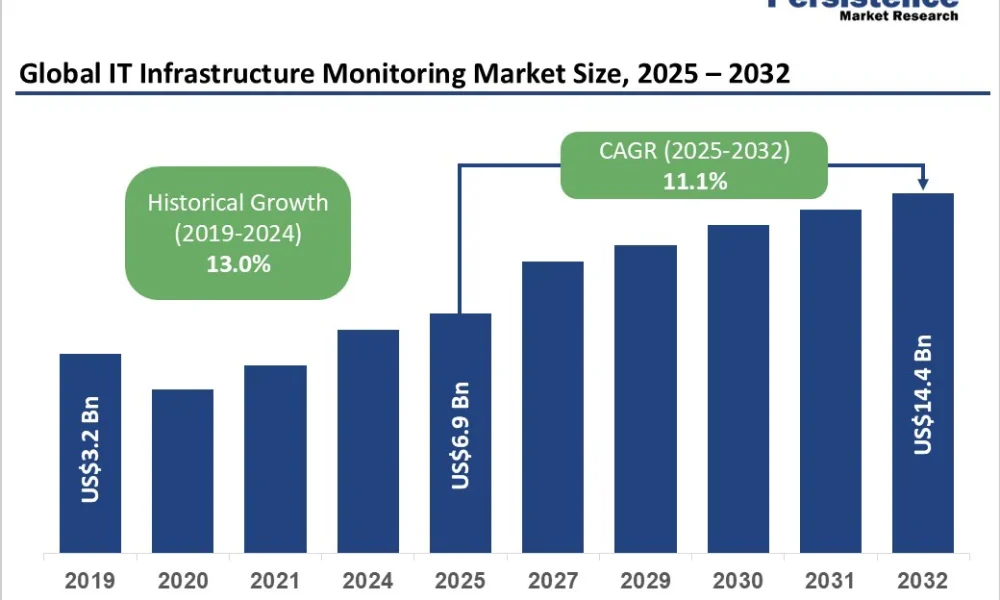
In 2025, the global IT infrastructure monitoring market is expected to be valued at US$6.9 billion and is projected to reach US$14.4 billion by 2032, expanding at a robust CAGR of 11.1% during the forecast period. This growth is driven by the rapid adoption of cloud and hybrid IT environments, increasing regulatory scrutiny, and rising dependence on digital services across industries.
Market Overview and Key Growth Drivers
Modern IT infrastructures are far more complex than traditional on-premises environments. Enterprises now operate across hybrid and multi-cloud architectures, integrating public clouds, private clouds, legacy data centers, edge devices, and SaaS platforms. While this shift delivers flexibility and scalability, it also introduces visibility gaps, performance risks, and operational challenges.
IT infrastructure monitoring solutions address these challenges by providing centralized oversight of networks, servers, applications, endpoints, and cloud workloads. Advanced platforms now leverage AI and machine learning to detect anomalies, predict failures, automate remediation, and align IT performance with business outcomes.
The historical growth rate of 13.0% CAGR between 2019 and 2024 reflects the strong momentum already established. Going forward, demand will be reinforced by cloud-native architectures, compliance requirements, and the growing reliance on digital customer experiences.
Key Industry Highlights at a Glance
Several structural trends are shaping the competitive and investment landscape of the IT infrastructure monitoring market:
- Cloud-based deployment is expected to account for 72.4% of market share in 2025, supported by hybrid cloud adoption growing at a 23.4% CAGR through 2032.
- North America will remain the dominant regional market, capturing approximately 41% share in 2025.
- Asia Pacific is forecast to be the fastest-growing region, driven by rapid digitization and government-led technology initiatives.
- Software components will dominate the market with a 77% share, reflecting the central role of analytics-driven monitoring platforms.
- BFSI will lead application adoption with around 30% market share, while healthcare emerges as the fastest-growing vertical at a 21.3% CAGR.
In July 2025, Google’s launch of an open-source TPU Monitoring Library further underscores the industry’s focus on AI infrastructure optimization and real-time observability.
Elevate your business strategy with comprehensive market data. Request a sample report now: https://www.persistencemarketresearch.com/samples/8797
Growing Adoption of Hybrid and Multi-Cloud Environments
One of the most influential growth drivers is the rapid deployment of hybrid and multi-cloud IT systems. Enterprises increasingly distribute workloads across multiple cloud platforms and on-premises infrastructure to improve resilience, avoid vendor lock-in, and optimize costs.
According to IDC, by 2025, 75% of enterprises are expected to deploy applications across multiple cloud environments. This fragmented landscape significantly elevates monitoring requirements. Organizations must maintain consistent visibility across heterogeneous systems while ensuring performance, security, and compliance.
Unified monitoring platforms capable of aggregating data across environments are becoming indispensable. Industry estimates suggest that companies investing in integrated multi-cloud monitoring solutions can reduce downtime incidents by up to 30%, delivering measurable cost savings and productivity gains.
Vendors are responding by embedding AI/ML capabilities that enhance predictive maintenance, root cause analysis, and automated incident resolution, transforming monitoring from reactive troubleshooting into proactive infrastructure intelligence.
Integration Challenges and Cost Barriers for SMEs
Despite strong demand, integration complexity and high upfront costs continue to restrain adoption, particularly among small and medium-sized enterprises. Forrester estimates that implementing enterprise-grade monitoring solutions can cost between US$500,000 and US$2 million, depending on infrastructure scale and customization requirements.
These costs are compounded by prolonged deployment timelines, the need for specialized IT skills, and compatibility challenges with legacy systems. Regulated industries face additional expenses, as monitoring tools must meet stringent compliance standards such as HIPAA, SOX, or GDPR.
While vendors are increasingly offering modular, SaaS-based, and subscription-driven models to lower entry barriers, cost sensitivity remains a critical purchasing consideration for SMEs. As a result, adoption in this segment tends to favor scalable, cloud-native solutions with rapid time-to-value.
Digitization in Developing Economies Unlocking New Opportunities
Emerging markets, particularly in Asia Pacific, present significant growth opportunities. Rapid economic expansion, government-backed digitization initiatives, and increased investment in industrial automation are driving demand for intelligent infrastructure monitoring tools.
The World Bank reports average GDP growth of 5.1% across Asia Pacific in recent years, with countries like India, China, and ASEAN nations investing heavily in digital infrastructure. Programs such as Digital India and China’s Industrial Internet policies are accelerating IT modernization across manufacturing, healthcare, transportation, and public services.
Cloud-based monitoring platforms are especially attractive in these markets due to lower upfront costs and flexible scaling. Vendors that localize offerings to meet regional compliance requirements and cost structures are well-positioned to capture this expanding customer base.
Deployment Mode Analysis
Cloud Deployment Dominates Market Share
Cloud deployment is expected to command 72.4% of total revenue in 2025, reflecting its scalability, flexibility, and cost efficiency. Cloud-based monitoring enables centralized data collection across distributed environments, supporting real-time analytics and proactive incident management.
Organizations undergoing digital transformation increasingly favor cloud-native monitoring solutions that integrate seamlessly with hybrid infrastructures. These platforms support faster deployments, automatic updates, and elastic scaling, aligning well with modern IT strategies.
Hybrid Cloud Monitoring Gains Momentum
Hybrid cloud monitoring represents the fastest-growing deployment segment, driven by multi-cloud adoption trends. Enterprises seek consolidated visibility across on-premises systems and multiple cloud providers without sacrificing control or compliance.
Vendors are innovating by integrating native cloud monitoring tools into unified dashboards enhanced with AI-driven analytics. As hybrid architectures become the norm, demand for end-to-end observability solutions will continue to accelerate.
Component Analysis
Software Solutions Lead the Market
Software components dominate the IT infrastructure monitoring market, accounting for approximately 77% of market share in 2025. Monitoring software underpins network performance management, server health monitoring, application performance monitoring, and endpoint visibility.
Advancements in AI, automation, and predictive analytics are redefining software capabilities, enabling enterprises to anticipate issues before they impact operations. These innovations enhance uptime, optimize resource utilization, and improve service delivery.
Services Segment Shows Rapid Growth
The services segment is growing rapidly as enterprises increasingly outsource monitoring functions to managed service providers. Managed monitoring services offer 24/7 oversight, expert diagnostics, and proactive remediation, addressing talent shortages and operational complexity.
This model aligns with the shift toward operational expenditure (OpEx) and is particularly attractive to SMEs and rapidly scaling enterprises seeking cost-effective scalability.
Application Analysis
BFSI Maintains Market Leadership
The banking, financial services, and insurance (BFSI) sector is expected to hold around 30% market share in 2025. Regulatory mandates, uptime requirements, and cybersecurity risks drive sustained demand for advanced monitoring solutions.
Digital payments, fintech innovation, and real-time transaction processing necessitate continuous infrastructure visibility. BFSI institutions increasingly deploy hybrid monitoring platforms that integrate legacy systems with cloud environments.
Healthcare Emerges as the Fastest-Growing Segment
Healthcare is projected to be the fastest-growing application segment, expanding at a 21.3% CAGR. Digital health platforms, electronic medical records, telemedicine, and AI diagnostics require highly reliable IT infrastructures.
Strict compliance requirements under HIPAA and GDPR elevate demand for secure, auditable monitoring solutions. Vendors are tailoring offerings to support interoperability with medical devices and healthcare IT systems while ensuring low latency and high availability.
Regional Market Insights
North America Leads Market Adoption
North America is forecast to account for 41% of global market share in 2025, driven by advanced IT ecosystems and early adoption of cloud technologies. The U.S. leads due to strong investments across BFSI, healthcare, and government sectors.
Regulatory frameworks such as FISMA and SOX reinforce demand for compliance-ready monitoring solutions. Strategic partnerships, AI-driven innovation, and venture capital funding continue to shape a dynamic competitive landscape.
Europe Focuses on Compliance and Industrial Digitalization
Europe is expected to hold around 28% market share, supported by GDPR-driven demand for secure and transparent monitoring solutions. Germany’s Industrie 4.0 initiative and public sector modernization efforts in the U.K. and France further support growth.
European buyers prioritize data residency, access control, and auditability, creating opportunities for modular and compliance-focused monitoring platforms.
Asia Pacific Shows Highest Growth Potential
Asia Pacific is the fastest-growing regional market, fueled by rapid digitalization in China, India, Japan, and ASEAN countries. Smart cities, industrial automation, and cloud data center expansion are driving adoption.
Evolving cybersecurity regulations and data localization laws are encouraging investment in localized, compliant monitoring solutions. Global vendors and regional players alike are expanding R&D and infrastructure footprints to capture this momentum.
Competitive Landscape and Industry Developments
The IT infrastructure monitoring market is moderately consolidated, with leading players collectively holding 65–70% market share. Major companies include IBM, Microsoft, Cisco, Splunk, Dynatrace, and Datadog, offering comprehensive platforms with deep cloud integration.
Smaller and mid-sized vendors focus on niche segments, cost-competitive SaaS offerings, and regional specialization. Competitive differentiation increasingly hinges on AI/ML capabilities, automation, and ecosystem partnerships.
Recent developments highlight continued innovation, including ManageEngine’s MSP Central launch, Oracle’s cloud-based AML compliance solutions, and LightSonic’s AI-powered fiber-optic monitoring advancements.
Conclusion
The global IT infrastructure monitoring market is evolving rapidly in response to cloud adoption, regulatory pressures, and digital transformation imperatives. As IT environments grow more complex, monitoring solutions are becoming strategic enablers of resilience, security, and performance optimization.
With strong growth prospects through 2032, vendors that prioritize AI-driven insights, cloud-native architectures, and regional customization will be best positioned to succeed. For enterprises, investing in robust monitoring platforms is no longer just an IT decision—it is a business-critical strategy for sustainable digital growth.
Related Reports:




