
The global SOP management solution market is entering a period of steady expansion as organizations across industries shift toward digital process management and regulatory compliance automation. Standard Operating Procedures (SOPs) form the backbone of operational consistency in sectors such as manufacturing, healthcare, pharmaceuticals, finance, and energy. However, traditional paper-based SOP systems have long struggled with issues such as version control, accessibility limitations, compliance risks, and inefficiencies in training and documentation.
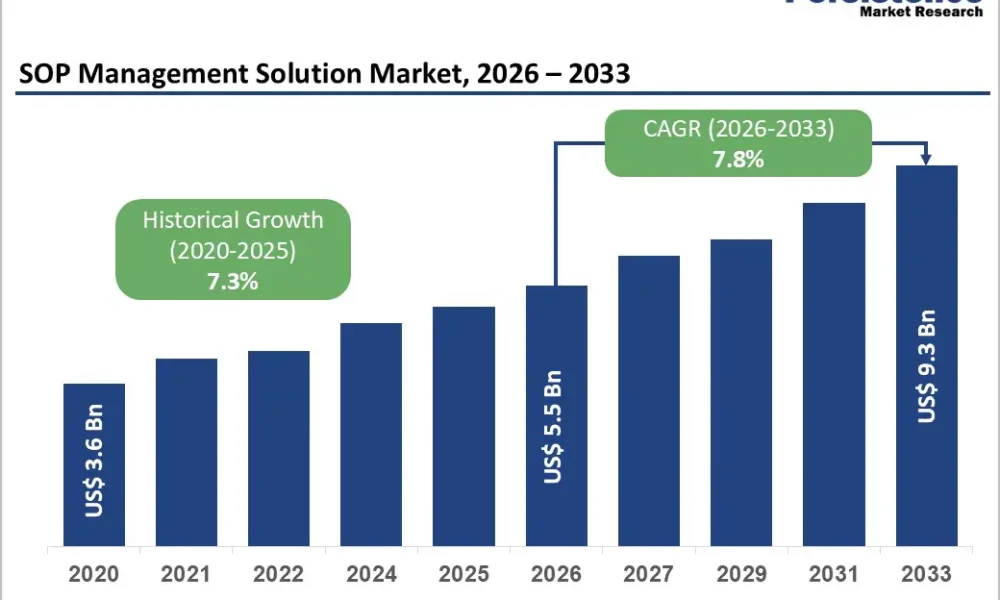
According to market projections, the global SOP management solution market is expected to reach US$5.5 billion in 2026 and grow to US$9.3 billion by 2033, expanding at a compound annual growth rate (CAGR) of 7.8% during the forecast period from 2026 to 2033. This growth reflects increasing demand for centralized workflow management, cloud-based compliance tools, and automated documentation systems that enable organizations to maintain regulatory readiness and operational transparency.
Rapid digital transformation initiatives across industries are also accelerating adoption. Enterprises are increasingly recognizing SOP management platforms as critical infrastructure for maintaining compliance, improving productivity, and ensuring quality standards. As regulatory bodies tighten oversight and organizations pursue operational excellence, SOP management solutions are emerging as indispensable enterprise tools.
Growing Importance of SOP Management in Modern Enterprises
In today’s complex business landscape, organizations must manage thousands of procedures across departments, facilities, and geographic locations. Without centralized SOP management, maintaining consistency and regulatory compliance becomes extremely challenging.
Digital SOP management platforms address these challenges by providing structured documentation systems, automated approval workflows, and real-time access to updated procedures. These platforms ensure that employees always follow the latest approved processes, reducing operational errors and improving compliance with regulatory frameworks.
Industries such as pharmaceuticals, biotechnology, and healthcare are particularly reliant on SOP management solutions due to strict regulatory oversight. Compliance frameworks such as ISO standards and FDA regulations require detailed documentation and traceable workflows. Digital SOP platforms enable organizations to meet these requirements while improving efficiency and accountability.
Furthermore, SOP management tools support employee training and knowledge management. Automated onboarding workflows and digital training modules ensure employees understand procedures quickly and consistently. This capability becomes especially valuable in large enterprises with distributed workforces and multi-site operations.
Market Drivers: Rising Regulatory Compliance Requirements
One of the most significant drivers of the SOP management solution market is the growing emphasis on regulatory compliance across industries. Governments and regulatory bodies are implementing stricter standards for quality control, documentation, and operational transparency.
For example, industries such as pharmaceuticals, medical devices, and food manufacturing must comply with frameworks like FDA 21 CFR Part 11, Good Manufacturing Practices (GMP), and ISO 9001 quality standards. Failure to maintain accurate SOP documentation can result in costly penalties, product recalls, and reputational damage.
Traditional manual SOP systems are often inadequate in meeting these stringent requirements. Paper-based documentation can lead to version conflicts, lost records, and inconsistent training. Digital SOP platforms solve these problems by providing centralized documentation repositories, audit trails, and automated compliance monitoring.
Organizations are therefore investing in SOP management solutions to reduce compliance risks, streamline audits, and ensure consistent implementation of procedures. These benefits make SOP management software a strategic investment rather than merely an operational tool.
Digital Process Standardization Across Industries
Another major growth driver is the increasing need for digital process standardization across industries. Companies operating across multiple locations must maintain consistent workflows to ensure quality, safety, and operational efficiency.
Digital SOP platforms enable organizations to standardize procedures and distribute updates instantly across departments and facilities. This capability is particularly important for global companies managing complex supply chains and manufacturing processes.
In manufacturing environments, SOP management systems help ensure production consistency and reduce variability. They allow organizations to define clear step-by-step processes for equipment operation, quality checks, and maintenance activities.
Similarly, in healthcare settings, SOP management platforms support standardized protocols for patient care, infection control, and medical procedures. These systems help hospitals maintain consistent clinical practices and improve patient safety outcomes.
As industries continue to prioritize operational efficiency and risk mitigation, digital SOP platforms are becoming essential tools for process governance.
Technological Advancements Transforming SOP Platforms
Technological innovation is playing a crucial role in shaping the future of the SOP management solution market. Cloud computing, artificial intelligence (AI), and workflow automation technologies are transforming traditional documentation systems into intelligent operational platforms.
Cloud-based SOP management systems allow organizations to access procedures from any device and location. This flexibility is particularly valuable for distributed workforces and multi-site operations. Cloud deployment also reduces infrastructure costs and simplifies system maintenance.
Artificial intelligence is further enhancing SOP management capabilities. AI-powered platforms can analyze workflows, identify inefficiencies, and recommend process improvements. Intelligent systems can also detect compliance risks and provide predictive insights to prevent operational issues.
Advanced features such as natural language search, automated document updates, and smart training modules are improving usability and efficiency. Emerging technologies such as blockchain-based audit trails are also strengthening data integrity and traceability.
These technological advancements are expanding the scope of SOP management solutions beyond documentation into comprehensive process management ecosystems.
Elevate your business strategy with comprehensive market data. Request a sample report now: https://www.persistencemarketresearch.com/samples/24040
Market Restraint: Integration Challenges with Legacy Systems
Despite strong growth prospects, the SOP management solution market faces challenges related to integration with legacy systems. Many large enterprises continue to rely on outdated IT infrastructures that were not designed for modern digital platforms.
Integrating new SOP management solutions with legacy enterprise systems such as ERP platforms, document management systems, and quality management software can be complex and costly. Organizations often require extensive customization, middleware development, and lengthy testing processes.
These integration challenges can significantly increase deployment timelines and implementation costs. Companies must also ensure that mission-critical operations remain uninterrupted during system integration.
Additionally, many organizations lack the specialized technical expertise required to manage hybrid IT environments combining on-premise systems and cloud platforms. As a result, some enterprises adopt phased implementation strategies, which can slow overall market adoption.
However, vendors are increasingly developing integration-friendly solutions with open APIs and modular architectures to address these challenges.
Deployment Trends: Cloud-Based Solutions Leading Adoption
Deployment models play a crucial role in shaping the adoption of SOP management solutions. Among these, cloud-based deployments are expected to dominate the market, accounting for approximately 55% of total revenue in 2026.
Cloud-based SOP platforms offer several advantages, including scalability, remote accessibility, automatic updates, and reduced infrastructure costs. These benefits make cloud solutions particularly attractive for organizations operating across multiple locations.
Cloud deployment also enables real-time collaboration between teams. Employees can access the latest procedures instantly, ensuring consistent implementation of operational processes.
Meanwhile, hybrid deployment models are emerging as the fastest-growing segment. Hybrid solutions combine the flexibility of cloud platforms with the security of on-premise systems. This approach allows organizations to store sensitive data locally while leveraging cloud capabilities for workflow automation and collaboration.
Hybrid deployments are particularly popular in highly regulated industries such as healthcare, finance, and pharmaceuticals where data governance requirements are stringent.
Application Insights: Compliance Management Leading the Market
In terms of applications, compliance management is expected to account for more than 35% of the market revenue in 2026. The growing complexity of regulatory frameworks is driving organizations to adopt automated compliance monitoring systems.
Compliance management solutions help organizations maintain accurate documentation, monitor regulatory changes, and ensure adherence to industry standards. Automated audit trails and reporting capabilities simplify regulatory inspections and reduce administrative workload.
Quality management is another rapidly growing application segment. As organizations prioritize continuous improvement and operational excellence, they are integrating SOP platforms with quality management systems.
Advanced analytics and AI-driven monitoring tools allow companies to identify process deviations and implement corrective actions quickly. These capabilities support proactive quality management and reduce operational risks.
End-User Analysis: Manufacturing Dominates Adoption
The manufacturing sector is expected to account for nearly 40% of the SOP management solution market revenue in 2026. Manufacturing operations rely heavily on standardized processes to maintain product quality, operational efficiency, and safety compliance.
SOP management platforms help manufacturers document and enforce procedures across production lines, maintenance operations, and quality assurance processes. These systems ensure that every step in the production cycle follows standardized guidelines.
Healthcare represents the fastest-growing end-user segment. Hospitals and healthcare institutions are increasingly adopting digital SOP platforms to manage clinical protocols, patient safety procedures, and regulatory documentation.
Digital SOP systems help healthcare providers replace paper-based records with secure, audit-ready documentation platforms. These systems also support incident reporting, risk management, and quality improvement initiatives.
As healthcare systems continue to digitize operations, demand for SOP management solutions is expected to grow significantly.
Regional Insights
North America
North America is expected to dominate the global SOP management solution market, accounting for approximately 40% of the total market share in 2026. The region’s leadership is driven by strict regulatory frameworks, advanced technological infrastructure, and strong adoption across healthcare and manufacturing sectors.
Organizations in the United States and Canada are investing heavily in digital compliance platforms to meet regulatory requirements and improve operational transparency. The presence of major software vendors and high levels of digital maturity further support market growth.
Europe
Europe represents another significant market for SOP management solutions. Countries such as Germany, France, and the United Kingdom have strong industrial ecosystems and robust regulatory frameworks that encourage the adoption of compliance management platforms.
Government initiatives promoting digital transformation and automation are also contributing to market expansion. European companies are increasingly adopting cloud-based and AI-enabled SOP platforms to enhance operational efficiency and reduce compliance risks.
Asia Pacific
The Asia Pacific region is projected to be the fastest-growing market for SOP management solutions. Rapid industrialization, expanding manufacturing sectors, and increasing regulatory awareness are driving adoption across the region.
Countries such as China, India, Japan, and South Korea are investing heavily in digital infrastructure and industrial automation. As regulatory frameworks strengthen and enterprises pursue operational efficiency, demand for SOP management platforms is expected to surge.
The region’s growing focus on digital transformation and quality standards is likely to create significant opportunities for solution providers.
Competitive Landscape
The global SOP management solution market features a mix of established enterprise software providers and emerging digital process management companies. Vendors are competing through technological innovation, strategic partnerships, and product expansion.
Key companies are focusing on cloud-native platforms, AI-driven automation, and advanced analytics capabilities to differentiate their offerings. Integration capabilities and regulatory expertise also play a crucial role in vendor competitiveness.
Some of the major companies operating in the market include:
- MasterControl
- Veeva Systems
- Qualio
- Zenith Technologies
- DocuWare
- SOPHIA
- Greenlight Guru
- Intellect
- ProcessMaker
Strategic collaborations, acquisitions, and product innovations are expected to intensify competition as companies aim to strengthen their global presence.
Future Outlook
The future of the SOP management solution market will be shaped by ongoing digital transformation, increasing regulatory complexity, and the growing need for operational transparency.
Organizations are expected to continue investing in cloud-based platforms, AI-driven analytics, and automated compliance tools. These technologies will transform SOP management systems into intelligent process governance platforms capable of supporting real-time decision-making and continuous improvement.
As industries prioritize quality management, risk mitigation, and regulatory compliance, SOP management solutions will play a central role in enabling organizations to operate efficiently in an increasingly complex regulatory environment.
With strong growth projections and expanding applications across industries, the global SOP management solution market is poised to become a critical component of modern enterprise operations.
Related Reports:




