

Solar EPC Market Overview
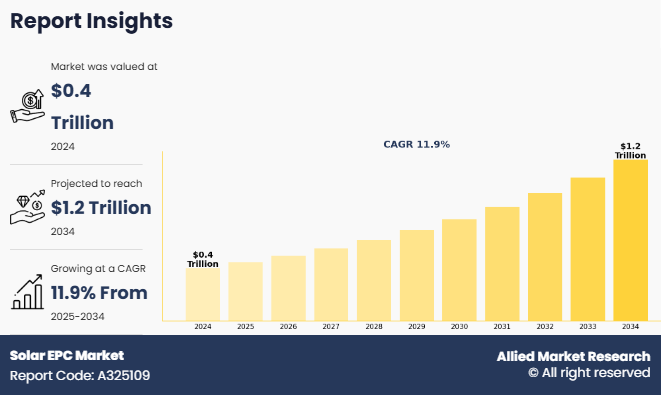
According to a new report published by Allied Market Research, the solar EPC market size was valued at $0.4 trillion in 2024 and is projected to reach $1.2 trillion by 2034, growing at a CAGR of 11.9% from 2025 to 2034. The rapid expansion of renewable energy adoption, supportive government policies, and technological advancements are key factors driving the growth of the solar EPC market globally.
Solar EPC (Engineering, Procurement, and Construction) is a turnkey service model in which a single contractor manages the complete lifecycle of a solar project. From system design and equipment sourcing to installation and commissioning, solar EPC contractors ensure seamless project execution. This integrated approach reduces risks, improves accountability, and accelerates project timelines across residential, commercial, and utility-scale applications.
Download PDF Brochure: https://www.alliedmarketresearch.com/request-sample/A325109
Growing Importance of the Solar EPC Market
The solar EPC market plays a vital role in expanding solar power infrastructure worldwide. EPC contractors are responsible for engineering system layouts, procuring components such as solar panels, inverters, and mounting structures, and executing construction and grid integration. Many solar EPC companies also provide post-installation maintenance and performance monitoring services, ensuring long-term operational efficiency.
As governments intensify efforts to reduce carbon emissions and meet renewable energy targets, the solar EPC market is becoming increasingly important. Solar energy offers a stable and sustainable alternative to fossil fuels, particularly as conventional energy prices fluctuate.
Key Growth Drivers in the Solar EPC Market
Several major factors are fueling growth in the solar EPC market:
1. Government Incentives and Policies
Government initiatives such as tax credits, feed-in tariffs, renewable portfolio standards, and power purchase agreements (PPAs) have significantly improved project viability. For example, investment tax credits and subsidies reduce upfront costs, encouraging businesses and households to adopt solar systems. These favorable policies have strengthened demand for solar EPC services worldwide.
2. Rising Fossil Fuel Costs
Volatile fossil fuel prices are prompting consumers and industries to seek cost-effective and stable energy alternatives. Solar power provides long-term price predictability, making the solar EPC market an attractive option for investors.
3. Energy Security and Independence
Countries striving for energy independence are investing heavily in domestic renewable energy generation. Solar installations, supported by solar EPC contractors, are critical to building resilient and decentralized energy systems.
4. Technological Advancements
Continuous improvements in solar panel efficiency, energy storage systems, and smart grid integration are enhancing project feasibility. The integration of artificial intelligence (AI) and the Internet of Things (IoT) in solar project monitoring has improved operational performance and reduced maintenance costs, further boosting the solar EPC market.
Market Challenges and Restraints
Despite strong growth prospects, the solar EPC market faces certain challenges. High upfront installation costs remain a significant barrier for small businesses and residential consumers. Although solar technology costs have declined, initial capital investment can still be substantial.
Fluctuations in raw material prices, especially silicon and copper, can impact procurement budgets and delay project timelines. In addition, regulatory complexities at local, state, and national levels create uncertainty for investors and EPC contractors. Inconsistent policy frameworks and approval processes can slow down project execution in some regions.
Emerging Opportunities in the Solar EPC Market
Emerging economies in Asia, Latin America, and Africa present lucrative opportunities for the solar EPC market. These regions have high solar irradiance levels and rapidly growing energy demands. International investments and supportive government programs are fostering solar infrastructure development.
The increasing adoption of distributed solar systems and rooftop installations also presents growth potential. Small and medium-sized solar projects are gaining popularity, creating opportunities for EPC contractors to expand their service portfolios.
Furthermore, advancements in energy storage technology are enhancing the reliability of solar systems, allowing better grid integration and peak load management. These developments are expected to create additional growth avenues for the solar EPC market during the forecast period.
Market Segmentation Analysis
The solar EPC market is segmented based on technology, installation type, size, end-use, and region.
By Technology
The market is divided into photovoltaic (PV) solar and concentrated solar power (CSP). The photovoltaic segment accounted for 81.2% of the solar EPC market share in 2024 and is projected to grow at a CAGR of 12.0% during the forecast period. The widespread adoption of PV technology due to its cost-effectiveness and scalability is driving this dominance.
By Installation Type
Based on installation type, the market is classified into rooftop, ground-mounted, and floating systems. The rooftop segment accounted for the highest revenue share in 2024 and is expected to grow at a CAGR of 12.1%. Rooftop installations are increasingly popular among residential and commercial users seeking energy independence and lower electricity bills.
By Size
The solar EPC market is categorized into small (up to 1 MW), medium (1–10 MW), and large (more than 10 MW) projects. The small segment is projected to grow at the highest CAGR of 12.2%, driven by distributed energy adoption and decentralized power generation initiatives.
By End-Use
The market is segmented into residential, commercial & industrial (C&I), and utility-scale applications. The commercial and industrial segment accounted for the highest revenue share in 2024 and is projected to grow at a CAGR of 12.1%. Businesses are increasingly adopting solar systems to reduce operational costs and achieve sustainability goals.
Regional Insights
Region-wise, the solar EPC market is analyzed across North America, Europe, Asia-Pacific, and LAMEA.
Asia-Pacific dominated the global solar EPC market in 2024, accounting for 41.4% of the total market share. The region is projected to grow at the highest CAGR of 12.3% during the forecast period. Rapid industrialization, supportive policies, and large-scale solar deployment projects in countries such as China and India are driving regional growth.
North America and Europe also hold significant shares due to strong regulatory support and increased investment in renewable energy infrastructure.
Get a Customized Research Report: https://www.alliedmarketresearch.com/request-for-customization/A325109
Competitive Landscape
The solar EPC market features intense competition among leading players striving to strengthen their global presence. Key companies operating in the industry include Jinko Solar Holding Co. Ltd., JA Solar Holdings Co. Ltd., Hanwha Solutions, First Solar, Inc., Trina Solar Limited, Larsen & Toubro, Canadian Solar, Yingli Green Energy Holding Company Limited, SolarEdge Technologies, Inc., and SunPower Corporation.
These companies are focusing on technological innovation, strategic partnerships, and geographic expansion to enhance their market share in the solar EPC market.
Future Outlook
The solar EPC market is set to witness substantial growth through 2034, supported by favorable government policies, falling technology costs, and rising environmental awareness. As the global energy transition accelerates, solar EPC contractors will play a crucial role in delivering efficient, cost-effective, and sustainable solar infrastructure.
With expanding applications across residential, commercial, and utility sectors, the solar EPC market is poised to remain a cornerstone of the renewable energy industry in the coming decade.
Other Trending Reports:-
Concentrated Solar Power Market
About Us
Allied Market Research (AMR) is a full-service market research and business-consulting wing of Allied Analytics LLP based in Portland, Oregon. Allied Market Research provides global enterprises as well as medium and small businesses with unmatched quality of “Market Research Reports” and “Business Intelligence Solutions.” AMR has a targeted view to provide business insights and consulting to assist its clients to make strategic business decisions and achieve sustainable growth in their respective market domain.
Pawan Kumar, the CEO of Allied Market Research, is leading the organization toward providing high-quality data and insights. We are in professional corporate relations with various companies and this helps us in digging out market data that helps us generate accurate research data tables and confirms utmost accuracy in our market forecasting. Each and every data presented in the reports published by us is extracted through primary interviews with top officials from leading companies of domain concerned. Our secondary data procurement methodology includes deep online and offline research and discussion with knowledgeable professionals and analysts in the industry.




