

According to a new report published by Allied Market Research, titled, “Smart Airport Market” was valued at $7.1 billion in 2022, and is estimated to reach $24.3 billion by 2032, growing at a CAGR of 13% from 2023 to 2032.
Maintaining airport safety and security is critical. Airports face a constantly changing situation of security challenges, including potential terrorist actions, smuggling, and other criminal activities. These concerns need airports to remain vigilant and adapt their security procedures on a regular basis to protect the safety of passengers, their luggage, and airport infrastructure. It is critical to adapt to new technologies and evolving security requirements to maintain a safe and secure environment for all travelers. These threats encompass a range of concerns, from terrorism and smuggling to various forms of illegal activities. Staying vigilant and employing advanced security measures are essential aspects of airport operations. As airports invest in these smart security solutions, it creates opportunities for businesses that provide these technologies. Also, travelers may feel safer and more confident when they use smart airports, which is a win-win for both passengers and airport operators.
Download Sample Report: https://www.alliedmarketresearch.com/request-sample/A07144
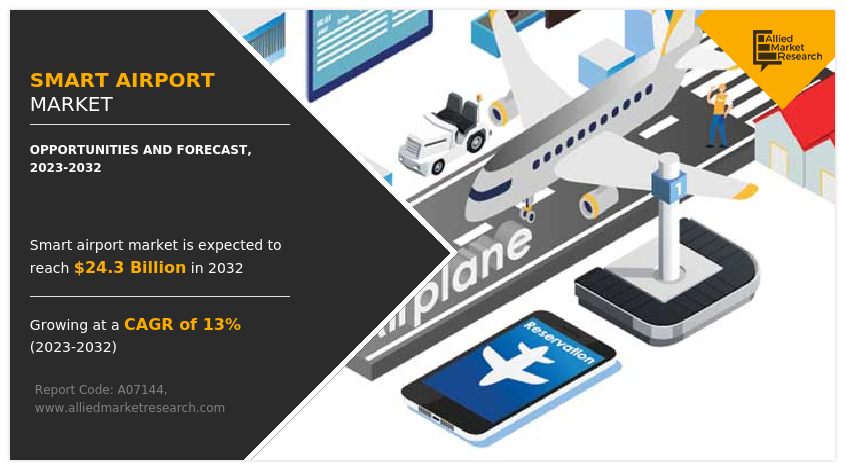
The smart airport market has been segmented based on application, airport size, type, and region. By application, the market is segmented into landside, airside, and terminal side. By airport size, the market is divided into small, medium, and large. By type, the market is segmented into airport 2.0, airport 3.0, and airport 4.0. Region wise, the market is analyzed across North America, Europe, Asia-Pacific, and LAMEA.
Optimization of runway utilization and scheduling, using modern technology and data analytics to reduce delays, increase safety, and improve overall operational efficiency, is a significant advancement in airside operations. Airports are progressively employing advanced gate allocation systems to shorten aircraft turnaround times, resulting in enhanced flight schedules and better resource allocation. Moreover, automation and robotics are becoming more prevalent in airside activities, streamlining aircraft servicing, maintenance, and cargo handling on the apron, enhancing efficiency and safety.
In addition, one prominent development in terminal side operations is adoption of biometric technologies, such as facial recognition and fingerprint scanning, for passenger identity verification at various points within the terminal, streamlining security checks and enhancing passenger convenience.
Buy This Research Report: https://www.alliedmarketresearch.com/smart-airport-market/purchase-options
There is a growing trend in terminal side operations to provide passengers with advanced self-service options, such as self-check-in kiosks, mobile check-in, and automated baggage drop-off solutions, which significantly streamline passenger processing and reduce waiting times. For instance, in August 2023, Kempegowda International Airport Bengaluru (BLR Airport) launched international operations from Terminal 2 (T2). T2 is well-equipped to efficiently manage increased passenger traffic, offering a modern infrastructure, advanced technology, and passenger-friendly amenities to ensure a comfortable and seamless travel experience. The terminal is equipped with spacious check-in counters and self-baggage drop facilities for a swift and hassle-free check-in process. Therefore, increased adoption of smart technologies in various applications such as baggage handling, security checkpoints and shopping lead to growth of this segment.
Moreover, the continuous growth in air travel rates is a significant growth factor for landside operations, as airports need to provide efficient solutions to handle the increasing number of passengers and reduce congestion and delays in and around the airport. Airport operators expand their landside area for better space management. For instance, in October 2021, Los Angeles International Airport (LAX) officially inaugurated its new economy parking facility, representing a substantial investment of $294 million. This facility is a pivotal element of LAX’s broader $5.5 billion Landside Access Modernization Program (LAMP). LAX is expected to become a concentrated center for ground transportation services in the future. It includes cutting-edge smart parking technology to improve the parking experience, such as pre-booking choices, user-friendly wayfinding, and electric vehicle charging stations.
For Purchase Enquiry: https://www.alliedmarketresearch.com/purchase-enquiry/A07144
Furthermore, construction of new airports was announced in Africa to accommodate the increased air passenger traffic. For instance, in May 2023, a major airlines group in Ethiopia announced a Request for Proposals (RFP) in 2024 for a substantial $4 billion airport project. This project will be executed in three phases. The first phase, set for completion by 2028, will comprise two terminals. This initiative offers significant opportunities for companies across various sectors, including project design and management, heavy machinery supply, passenger rail, aviation ground equipment, baggage handling and cargo/passenger security systems, and various additional air passenger services, such as franchise and retail.
Key Players in Smart Airport Market
Key players covered in the global smart airport market report include Siemens AG, Wipro, Honeywell International Inc., Cisco Systems Inc., Huawei Technologies Co., Ltd., Thales, IBM Corporation, Smart Airport Systems (SAS), SITA, and T-Systems International GmbH.




