
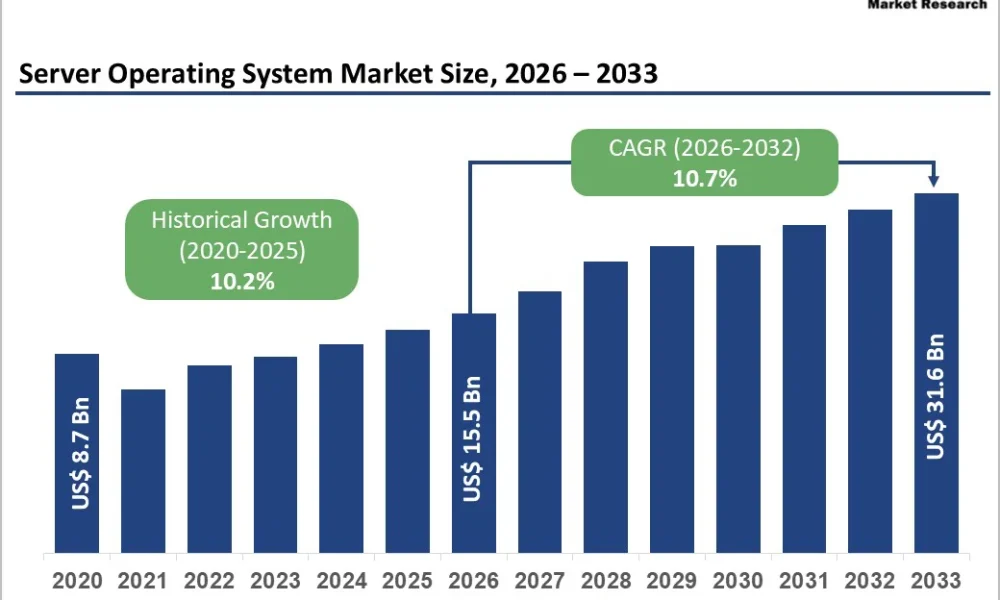
The global Server Operating System (Server OS) Market is entering a sustained expansion phase as enterprises modernize IT infrastructure to support cloud-native applications, AI workloads, virtualization, and edge computing. The market is expected to be valued at US$ 15.5 billion in 2026 and is projected to reach US$ 31.6 billion by 2033, reflecting steady double-digit momentum over the forecast period.
Rapid cloud migration, increasing virtualization adoption, multi-cloud deployment strategies, and rising cybersecurity requirements are fundamentally reshaping server architectures. Server operating systems now serve as the foundation for digital transformation—enabling workload orchestration, virtualization management, containerization, security enforcement, and hybrid cloud interoperability.
Market Dynamics
Cloud and Hybrid IT Adoption Accelerate Server OS Demand
The widespread adoption of cloud computing is the primary catalyst for growth in the server operating system market. Enterprises increasingly deploy workloads across hybrid and multi-cloud environments to achieve scalability, redundancy, and cost efficiency.
Server OS platforms must now support:
- Cloud-native application deployment
- Container orchestration
- Microservices architectures
- API-driven integration
- Hybrid workload portability
Solutions such as Windows Server and Red Hat Enterprise Linux are widely deployed due to their compatibility with virtualization platforms, enterprise applications, and hybrid cloud services.
The integration between Microsoft Azure and Windows Server environments further strengthens enterprise adoption by enabling seamless hybrid cloud management.
Virtualization and VM Growth Transform Infrastructure
Virtualization remains central to modern server infrastructure. The Virtual Machines (VMs) segment accounts for over 60% of server OS-related revenue and continues to expand rapidly.
Hypervisor technologies such as VMware vSphere and Microsoft Hyper-V allow multiple virtual instances to run on a single physical server, improving resource utilization and reducing hardware costs.
Benefits driving virtualization growth include:
- Improved server consolidation
- Enhanced disaster recovery
- Simplified testing and deployment
- Reduced capital expenditure
As enterprises modernize legacy systems and transition toward containerized workloads, server OS platforms must support both VM and container orchestration environments simultaneously.
AI, ML, and Edge Computing Reshape Server Architectures
The rise of artificial intelligence and machine learning workloads requires server operating systems capable of handling high-performance computing, GPU acceleration, and distributed edge deployments.
Server OS platforms now integrate:
- Advanced memory management
- Container runtime optimization
- Real-time workload orchestration
- AI inference support
In edge computing environments—such as smart factories, connected healthcare systems, and autonomous IoT networks—lightweight and scalable server OS variants are increasingly in demand.
The shift toward decentralized processing models is opening new opportunities for server OS vendors to design optimized, low-latency operating environments tailored for edge deployments.
Market Restraints
Cybersecurity Complexity and Compliance Pressures
As cyber threats grow more sophisticated, server OS platforms must continuously evolve to provide:
- Zero-trust architecture compatibility
- Advanced encryption
- Secure boot mechanisms
- Automated patch management
Regulatory frameworks such as data localization laws and sector-specific compliance mandates increase operational complexity. Organizations must balance performance optimization with stringent security standards.
Frequent security updates and vulnerability patching may also create temporary service disruptions, adding to operational burdens.
Licensing Costs and Open-Source Competition
Commercial server operating systems often involve subscription licensing, maintenance agreements, and support costs. For cost-sensitive enterprises, open-source alternatives such as Ubuntu Server present attractive options.
Open-source ecosystems offer flexibility and lower upfront costs, intensifying competitive pressure on proprietary vendors. However, enterprises often favor paid solutions for enhanced enterprise-grade support and compliance guarantees.
Elevate your business strategy with comprehensive market data. Request a sample report now: https://www.persistencemarketresearch.com/samples/34674
Key Growth Opportunities
Edge Computing Expansion
Edge computing represents one of the most promising growth areas for server OS providers. As data generation shifts closer to devices and endpoints, lightweight operating systems capable of running on micro data centers and industrial gateways become critical.
Applications include:
- Smart manufacturing
- Autonomous vehicles
- Remote healthcare monitoring
- Retail analytics
Server OS vendors that develop compact, energy-efficient, and secure edge-ready systems stand to capture significant market share.
AI-Optimized Server Platforms
AI integration offers substantial upside. Server operating systems increasingly embed AI-driven management tools for:
- Predictive maintenance
- Intelligent workload balancing
- Anomaly detection
- Automated resource scaling
Major vendors such as Microsoft Corporation and IBM Corporation are embedding AI capabilities into server environments to enhance automation and reduce administrative overhead.
Category-Wise Insights
Operating System Analysis: Windows Leads
Windows OS holds over 58% global market share in the server operating system category. Windows Server remains dominant due to:
- Strong enterprise ecosystem
- Compatibility with legacy enterprise applications
- Integrated security frameworks
- Hybrid cloud capabilities
Its deep integration with Microsoft enterprise tools and Azure cloud services reinforces widespread adoption across large organizations.
Linux-Based Server OS Gaining Momentum
Linux-based operating systems—including Red Hat Enterprise Linux and Ubuntu Server—continue gaining traction, particularly in cloud-native and containerized environments.
Linux offers:
- Open-source flexibility
- High stability and performance
- Container ecosystem compatibility (Docker, Kubernetes)
- Lower licensing costs
Cloud service providers frequently deploy Linux-based server OS platforms for scalable and microservices-driven applications.
Virtualization Segment: Virtual Machines Lead
The VM segment remains the dominant virtualization model. Enterprise reliance on virtualized infrastructure continues to grow, particularly in hybrid cloud data centers.
Virtualization improves:
- Resource allocation
- Scalability
- Security isolation
- Operational resilience
As organizations increasingly adopt containerized orchestration alongside VMs, server OS platforms must support dual environments seamlessly.
Regional Insights
North America: Market Leader
North America accounts for nearly 38% of global server OS revenue. Advanced IT infrastructure, strong enterprise cloud migration, and the presence of major technology providers drive dominance.
The region hosts industry leaders such as:
- Microsoft Corporation
- VMware, Inc.
- Red Hat, Inc.
Strong data center density and early adoption of AI workloads reinforce continued regional leadership.
Europe: Compliance-Driven Modernization
European enterprises prioritize data sovereignty and regulatory compliance, accelerating server OS modernization.
Strong adoption of hybrid cloud and enterprise virtualization supports steady regional growth.
Asia Pacific: Fastest-Growing Region
Asia Pacific is the fastest-growing market, driven by:
- Aggressive data center expansion
- Rapid AI adoption
- Government-backed digital transformation initiatives
- Growing startup ecosystems
Countries such as China, India, Japan, and Singapore are investing heavily in hyperscale data centers and cloud infrastructure, increasing demand for robust and scalable server operating systems.
Competitive Landscape
The server operating system market is moderately consolidated, with established vendors controlling significant market share.
Key companies include:
- Microsoft Corporation
- IBM Corporation
- Oracle Corporation
- Hewlett Packard Enterprise
- VMware, Inc.
- Red Hat, Inc.
Competition centers on:
- Cloud integration capabilities
- Virtualization performance
- Security enhancements
- AI-powered automation
- Licensing flexibility
Vendors are expanding hybrid cloud compatibility and embedding intelligent automation tools to differentiate offerings.
Future Outlook
The next phase of growth in the server operating system market will be defined by:
- AI-native infrastructure management
- Edge-first operating environments
- Zero-trust security architecture
- Container-VM convergence
- Sustainability-focused energy optimization
As enterprises increasingly deploy distributed computing models, server operating systems will become more lightweight, automated, and AI-integrated.
Conclusion
The global Server Operating System Market is poised for substantial growth, projected to double to US$ 31.6 billion by 2033. Cloud computing, virtualization, AI workloads, and edge computing are reshaping enterprise infrastructure requirements.
Windows Server continues to lead globally, while Linux-based platforms gain momentum in cloud-native environments. North America dominates, but Asia Pacific’s rapid digital expansion positions it as the fastest-growing region.
Server operating systems are no longer merely backend infrastructure—they are strategic enablers of digital transformation, powering the next generation of intelligent, scalable, and secure enterprise computing environments.
Related Reports:




