
Definition
Semiconductor wafer mounting systems are specialized equipment used in semiconductor fabrication for precisely mounting wafers onto frames using tapes or films following grinding operations. This step is essential to prevent wafer contamination, ensure structural integrity, and maintain the quality of subsequent processing, including dicing, packaging, and testing.
Wafer mounting systems vary by automation level and production scale:
- Fully automatic wafer mounting machines – suitable for high-volume semiconductor fabs, offering high throughput and minimal human intervention.
- Semi-automatic wafer mounting machines – suitable for medium-scale production, combining manual handling with automated processes.
- Manual wafer mounting machines – ideal for low-volume production or R&D, providing flexibility but lower throughput.
These systems are integral to modern semiconductor manufacturing, especially as the industry transitions to larger wafer sizes (12-inch) and advanced nodes (sub-5nm technologies). They are also critical in advanced packaging technologies like 3D IC packaging, chip-on-wafer, and wafer-on-wafer integration, where precision alignment and contamination control are crucial. Leading manufacturers, such as Nitto Denko and DISCO Corporation, continue to innovate, improving throughput, automation, and contamination control to meet next-generation semiconductor fabrication needs.
Recent Developments
The semiconductor wafer mounting systems market is experiencing rapid innovation driven by the increasing complexity of advanced packaging technologies like 3D stacking and fan-out wafer-level packaging. A key trend is the development of fully automated systems that incorporate AI and machine vision to achieve unprecedented levels of precision and alignment accuracy. These systems are crucial for handling ultra-thin and larger-diameter wafers, which are more susceptible to warping and breaking. Furthermore, manufacturers are focusing on integrating advanced process control algorithms and predictive maintenance to improve yields and minimize costly downtime. There is also a notable trend toward developing integrated systems that combine mounting with other backend processes like temporary bonding and debonding.
Major Distribution
The distribution of semiconductor wafer mounting systems is primarily conducted through a direct, business-to-business (B2B) model. Leading equipment manufacturers, many of which are based in Japan, sell directly to major semiconductor foundries, integrated device manufacturers (IDMs), and outsourced semiconductor assembly and test (OSAT) companies. This is because these systems are highly specialized, often requiring direct technical support, customization, and long-term service agreements. In some cases, specialized distributors may also be utilized to reach smaller-scale manufacturers or research institutions, but the core of the market is built on close, direct relationships between the equipment suppliers and the world’s largest chipmakers. This ensures a secure and efficient supply chain for this critical part of the semiconductor manufacturing process.
Market Size
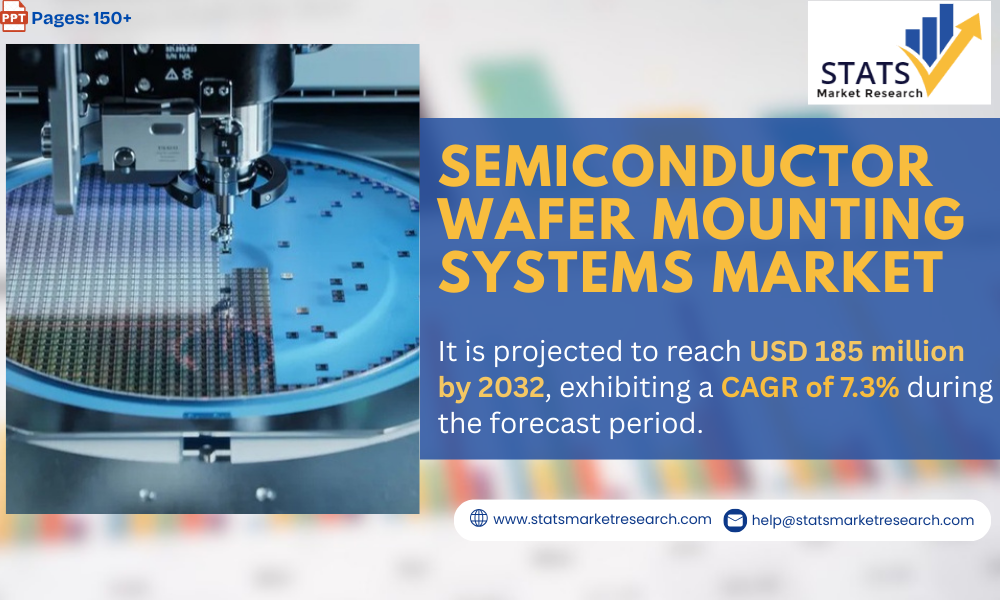
Global semiconductor wafer mounting systems market was valued at USD 114 million in 2024 and is projected to grow to USD 185 million by 2032, registering a CAGR of 7.3%.
Key Statistics & Trends:
- Global semiconductor revenue is projected to reach USD 611 billion in 2024, up 16% year-over-year, driving demand for wafer mounting equipment.
- The shift toward 12-inch wafer production accounts for 65% of new installations, creating equipment upgrade cycles.
- The industry is emphasizing yield optimization, which increases demand for precise mounting solutions.
- Investments in advanced logic, memory chips, and 3D IC packaging are boosting equipment adoption.
Market Outlook:
The wafer mounting systems market is expected to grow steadily due to expanding semiconductor fab capacities worldwide. Demand is particularly high in regions with large-scale semiconductor manufacturing, such as Japan, South Korea, China, and Taiwan. Automation and AI integration into mounting systems is expected to further accelerate market growth by improving throughput and reducing wafer damage during handling.
Download FREE Sample of this Report @ https://www.statsmarketresearch.com/download-free-sample/8058786/global-semiconductor-wafer-mounting-systems-forecast-market
Market Dynamics (Drivers, Restraints, Opportunities, and Challenges)
Market Drivers
- Exponential Growth in Semiconductor Manufacturing
- Expansion of semiconductor fabs worldwide is increasing demand for high-precision wafer mounting equipment.
- Major semiconductor foundries are investing $100+ billion globally since 2022 in next-generation facilities.
- Transition to Larger Wafer Sizes
- Shift from 8-inch to 12-inch wafers drives replacement and upgrade of mounting systems.
- Systems must handle larger wafers with nanometer-level alignment accuracy, critical for yield improvement.
- Advanced Packaging Demands
- Emerging 3D IC, chip-on-wafer, and wafer-on-wafer applications require precise thermal and mechanical stability.
Market Restraints
- High Capital Costs
- Fully automated systems can cost $500,000–$2 million per unit, limiting adoption for smaller fabs.
- Total cost of ownership, including maintenance and utilities, can add 15–20% annually.
- Technical Challenges
- Advanced nodes (3nm, 2nm) involve ultra-thin wafers prone to warping and breakage.
- Adhesion and clean removal of mounting tapes require precise process control, challenging at smaller geometries.
- Infrastructure & Skilled Labor Requirements
- Requires cleanroom upgrades and trained operators.
- Installation complexity and operator skill shortages create bottlenecks.
Market Opportunities
- Advanced Packaging Technologies
- Rapid growth of heterogeneous integration, WLP, and TSV processes drives demand for hybrid mounting systems.
- Equipment capable of temporary bonding and debonding enables efficient 3D IC production.
- Automation & AI Integration
- Machine vision and adaptive process control can improve yield by up to 15%.
- Modular mounting platforms allow flexibility for wafer sizes and processes, reducing the need for new equipment investment.
Market Challenges
- Supply Chain Vulnerabilities
- Precision linear guides, servo motors, and sensors face 6–9 month lead times, impacting production.
- Geopolitical issues affect rare earth materials for motion control systems.
- Technical Expertise Shortage
- 40% of manufacturers report difficulty finding skilled engineers for advanced equipment.
- Regulatory Compliance Pressures
- Stringent regulations on adhesives and mounting tapes increase development costs and require requalification.
Regional Analysis
- Japan: Dominates technology leadership, with companies like Nitto Denko, LINTEC, DISCO Corporation driving innovations in automation and ultra-thin wafer handling.
- South Korea: Focused on memory chip production; companies like Technovision and Dynatech supply advanced wafer mounting solutions.
- China: Rapid expansion in semiconductor fabs; players like Heyan Technology and Jiangsu JCXJ offer cost-competitive alternatives.
- Taiwan & Singapore: Driven by semiconductor foundries (TSMC, UMC) expanding capacity, increasing demand for automated mounting systems.
- North America & Europe: Emerging applications in automotive ICs, AI, and HPC drive adoption of advanced mounting technologies.
Get the Complete Report & TOC @ https://www.statsmarketresearch.com/global-semiconductor-wafer-mounting-systems-forecast-market-8058786
Competitor Analysis (in brief)
The market is highly concentrated, dominated by Japanese players, holding nearly 65% market share. Key observations:
- Nitto Denko & LINTEC: Vertical integration of tapes and machinery, strong global footprint.
- DISCO Corporation: Strategic collaborations and 12-inch wafer specialization.
- Takatori Corporation: Focused on ultra-thin wafer handling and advanced packaging.
- Chinese companies: Offer cost-effective solutions, though precision lags behind Japanese & U.S. competitors.
Global Semiconductor Wafer Mounting Systems Market: Segmentation Analysis
This report provides a deep insight into the global Semiconductor Wafer Mounting Systems Market, covering all its essential aspects. This ranges from a macro overview of the market to micro details of the market size, competitive landscape, development trend, niche market, key market drivers and challenges, SWOT analysis, value chain analysis, etc.
The analysis helps the reader to shape the competition within the industries and strategies for the competitive environment to enhance the potential profit. Furthermore, it provides a simple framework for evaluating and assessing the position of the business organization. The report structure also focuses on the competitive landscape of the Global Semiconductor Wafer Mounting Systems Market. This report introduces in detail the market share, market performance, product situation, operation situation, etc., of the main players, which helps the readers in the industry to identify the main competitors and deeply understand the competition pattern of the market.
In a word, this report is a must-read for industry players, investors, researchers, consultants, business strategists, and all those who have any kind of stake or are planning to foray into the Semiconductor Wafer Mounting Systems Market in any manner.
Market Segmentation (by Application)
- 12 Inch Wafer
- 6 & 8 Inch Wafer
- Standard Purity
- High Purity
Market Segmentation (by Type)
- Fully Automatic Wafer Mounting Machine
- High-Speed Models
- Standard Models
- Semi-Automatic Wafer Mounting Machine
- Manual Wafer Mounting Machine
- Basic Models
- Precision Models
Key Company
- Nitto Denko (Japan)
- LINTEC Corporation (Japan)
- Takatori Corporation (Japan)
- DISCO Corporation (Japan)
- Teikoku Taping System (Japan)
- NPMT (NDS) (Japan)
- Technovision (South Korea)
- Dynatech Co., Ltd (South Korea)
- Advanced Dicing Technologies (Israel)
- Heyan Technology (China)
Geographic Segmentation
- Japan
- South Korea
- China
- Taiwan
- Singapore
- North America
- Europe
FAQ Section
- What is the current market size of the Semiconductor Wafer Mounting Systems Market?
The market was valued at USD 114 million in 2024 and is projected to reach USD 185 million by 2032. - Which are the key companies operating in the Semiconductor Wafer Mounting Systems Market?
Key players include Nitto Denko, LINTEC, Takatori, DISCO Corporation, Teikoku Taping System, NPMT, Technovision, Dynatech, Advanced Dicing Technologies, and Heyan Technology. - What are the key growth drivers in the Semiconductor Wafer Mounting Systems Market?
Drivers include expanding semiconductor manufacturing capacity, transition to 12-inch wafers, and growth in advanced packaging applications. - Which regions dominate the Semiconductor Wafer Mounting Systems Market?
Japan dominates technology and market share, followed by South Korea and China. Taiwan and Singapore are also growing due to semiconductor fab expansions. - What are the emerging trends in the Semiconductor Wafer Mounting Systems Market?
Emerging trends include automation, AI integration, machine vision-based process control, modular mounting platforms, and solutions for 3D IC packaging..
About Us
☎️ International: +1 (332) 2424 294
📄 Website: www.statsmarketresearch.com
Join us on LinkedIn:- https://www.linkedin.com/company/statsmarketresearch




