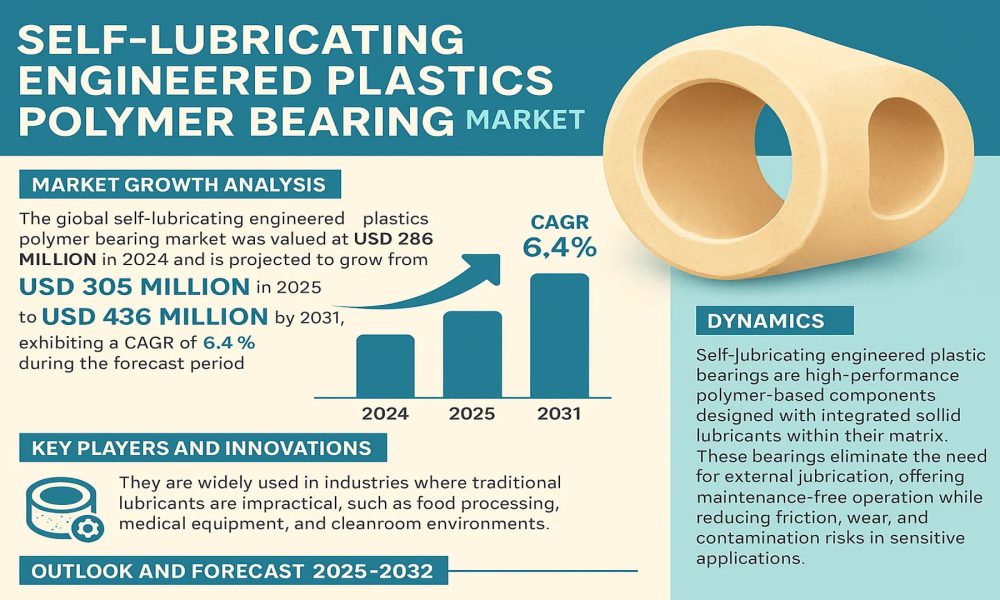
Self-lubricating Engineered Plastics Polymer Bearing Market was valued at USD 286 million in 2024 and is projected to grow from USD 305 million in 2025 to USD 436 million by 2031, exhibiting a CAGR of 6.4% during the forecast period.
Self-lubricating engineered plastic bearings are high-performance polymer-based components designed with integrated solid lubricants within their matrix. These bearings eliminate the need for external lubrication, offering maintenance-free operation while reducing friction, wear, and contamination risks in sensitive applications. They are widely used in industries where traditional lubricants are impractical, such as food processing, medical equipment, and cleanroom environments.
The market growth is driven by increasing demand from the automotive and industrial machinery sectors, where these bearings provide corrosion resistance and weight reduction benefits. Furthermore, stringent environmental regulations regarding lubricant usage and rising automation in manufacturing processes are accelerating adoption. Key players like IGUS, SKF, and GGB are expanding their product portfolios through technological advancements, with recent developments focusing on hybrid bearings combining polymer matrices with reinforced fibers for enhanced load capacity.
Claim Your Free Sample Report- https://www.intelmarketresearch.com/download-free-sample/4790/self-lubricating-engineered-plastics-polymer-bearing-market
MARKET DYNAMICS
MARKET DRIVERS
Growing Demand from Automotive and Industrial Sectors to Drive Market Expansion
The automotive industry’s shift toward lightweight components and reduced maintenance requirements is significantly boosting adoption of self-lubricating polymer bearings. These bearings offer considerable weight reduction compared to traditional metal bearings, with an average weight savings of 40-60%, while delivering comparable performance. The industrial machinery sector, which accounts for approximately 35% of global bearing demand, increasingly prefers polymer bearings for their corrosion resistance and ability to operate in harsh environments without lubrication. Major automotive OEMs are now specifying polymer bearings in electric vehicle drivetrains and suspension systems to eliminate lubrication-related contamination risks.
Advancements in Polymer Technology Accelerating Market Growth
Recent developments in high-performance polymers like PEEK, PTFE composites, and polyimides have substantially improved the load-bearing capacity and thermal stability of polymer bearings. These advanced materials now withstand continuous operating temperatures exceeding 250°C while maintaining low coefficients of friction. The introduction of nanostructured polymer composites has enhanced wear resistance by up to 300% compared to first-generation materials. Market leaders are investing heavily in R&D, with some companies allocating over 8% of annual revenue to develop next-generation polymer bearing solutions. Such innovations are expanding application possibilities into previously inaccessible high-load and high-temperature industrial environments.
Strict Environmental Regulations Favoring Adoption of Maintenance-Free Bearings
Global environmental regulations restricting the use of petroleum-based lubricants are creating strong demand for self-lubricating alternatives. The European Union’s Machinery Directive 2006/42/EC and similar regulations worldwide are driving manufacturers to eliminate oil and grease from machinery components. Polymer bearings eliminate lubricant leakage risks, reducing environmental contamination while lowering total cost of ownership by 15-25% through eliminated maintenance requirements. Industries facing strict cleanliness requirements, such as food processing and pharmaceuticals, are transitioning to polymer bearings at an accelerated pace to comply with regulatory standards and improve operational hygiene.
MARKET OPPORTUNITIES
Expansion in Renewable Energy Sector Creating New Growth Frontiers
The rapid growth of wind and solar energy installations presents substantial opportunities for polymer bearing manufacturers. Wind turbine applications particularly benefit from maintenance-free bearing solutions that withstand harsh environmental conditions. The global wind energy market, projected to install over 100 GW of new capacity annually through 2030, represents a major addressable market for advanced polymer bearings. Solar tracking systems also increasingly utilize polymer bearings for their corrosion resistance in outdoor environments, with the solar tracker market expected to grow at 15% CAGR over the next decade.
Emerging Economies Offering Untapped Growth Potential
Industrialization in developing nations creates significant growth potential as manufacturers modernize equipment with advanced bearing technologies. Markets in Southeast Asia and Africa are experiencing compound annual growth rates of 8-12% for industrial machinery, outpacing mature markets. Local manufacturing initiatives like India’s ‘Make in India’ program are driving demand for high-performance components, while economic development is enabling greater investment in maintenance-reducing technologies. These regions currently represent less than 20% of global polymer bearing consumption but are expected to account for over 35% of market growth through 2030.
Developing Customized Solutions for Niche Applications
Specialized applications in medical equipment, semiconductor manufacturing, and marine environments offer premium opportunities for tailored polymer bearing solutions. The medical device sector requires biocompatible bearings with ultra-clean operation, while semiconductor manufacturing demands components that won’t generate particulate contamination. These high-value niche applications command significant price premiums, with some customized medical-grade polymer bearings achieving 300-400% margins compared to standard industrial bearings. Manufacturers investing in application-specific R&D can capture these lucrative specialized market segments while diversifying their revenue streams.
Segment Analysis:
By Type
Plastic Rolling Bearings Segment Holds Major Share Driven by High Durability and Load Capacity
The market is segmented based on type into:
- Plastic Rolling Bearings
- Plastic Sliding Bearings
By Application
Industrial Machinery Segment Leads Owing to Demand for Maintenance-Free Solutions in Harsh Environments
The market is segmented based on application into:
- Auto Industry
- Industrial Machinery
- Construction Machinery
- Others
By Material
PTFE-Based Bearings Dominate Due to Superior Chemical Resistance and Low Friction Properties
The market is segmented based on material into:
- PTFE (Polytetrafluoroethylene)
- PEEK (Polyether Ether Ketone)
- Polyimide
- Others
By End-User
Manufacturing Sector Shows Strong Adoption Due to Automation Trends
The market is segmented based on end-user into:
- Manufacturing
- Aerospace
- Energy
- Food Processing
- Others
List of Key Self-Lubricating Polymer Bearing Manufacturers
- IGUS (Germany)
- GGB (GGB Bearing Technology) (U.S.)
- SKF (Sweden)
- Oiles Corporation (Japan)
- Tristar Plastics Corp. (U.S.)
- BNL Ltd. (UK)
- KMS Bearings (U.S.)
- CiXi JinLin Bearings (China)
- Altra Industrial Motion Corp (U.S.)
SELF-LUBRICATING ENGINEERED PLASTICS POLYMER BEARING MARKET TRENDS
Maintenance-Free Operation to Drive Adoption Across Industries
The demand for self-lubricating engineered plastics polymer bearings continues to surge, driven by their ability to operate without external lubrication across extreme conditions. These bearings demonstrate superior performance in environments where traditional metal bearings fail whether in high-corrosion settings, dusty atmospheres, or ultra-low temperatures. Current market data indicates that over 60% of new industrial machinery installations now incorporate polymer bearings for at least one critical motion component. As manufacturers prioritize reducing equipment downtime, the maintenance-free nature of these solutions positions them as essential for industries ranging from food processing to aerospace, where contamination risks from lubricants must be eliminated.
Other Trends
Material Innovations Enhancing Load Capacity
Recent breakthroughs in composite polymer formulations have dramatically expanded the load-bearing capabilities of these components. Leading manufacturers now offer bearings capable of withstanding static loads exceeding 250 MPa while maintaining a coefficient of friction below 0.15 performance metrics that rival many metal alternatives. The integration of advanced filler materials like carbon fiber and PTFE has enabled these improvements, with newer products demonstrating 30-40% longer service life compared to conventional offerings. This technological leap is particularly impactful in the renewable energy sector, where polymer bearings are increasingly specified for wind turbine blade pitch systems and solar tracker mechanisms.
Growing Preference in Electric Vehicle Manufacturing
The automotive industry’s rapid transition toward electrification is creating substantial opportunities for self-lubricating polymer bearings. EV manufacturers particularly value their lightweight properties with bearings weighing up to 80% less than steel equivalents helping to maximize battery range. Applications in suspension components, battery cooling systems, and electric motor mounts are witnessing double-digit annual growth as automakers seek to eliminate liquid lubricants that could contaminate sensitive electronics. Furthermore, these bearings demonstrate exceptional performance in handling the high-frequency vibrations unique to electric drivetrains, making them indispensable for next-generation vehicle architectures.
Claim Your Free Sample Report- https://www.intelmarketresearch.com/download-free-sample/4790/self-lubricating-engineered-plastics-polymer-bearing-market
Recent Developments in the Self-lubricating Engineered Plastics Polymer Bearing Market
- Introduction of High-Performance Bearings
Leading manufacturers have recently launched self-lubricating polymer bearings with enhanced load-bearing capacity and thermal stability. These new products aim to reduce maintenance costs and increase operational efficiency in industries such as automotive, aerospace, and industrial machinery. - Focus on Eco-Friendly Materials
Several companies are innovating with environmentally friendly polymers that minimize friction and wear without using hazardous lubricants. This development aligns with global sustainability trends and regulatory requirements for reducing industrial waste. - Expansion in Automotive and Aerospace Applications
With the growing demand for lightweight and durable components, self-lubricating polymer bearings are increasingly used in electric vehicles (EVs) and aircraft systems. Recent product launches focus on high-temperature resistance and reduced vibration, catering to these high-performance applications. - Strategic Partnerships and Collaborations
Market players are entering collaborations to enhance R&D capabilities, accelerate product innovation, and expand geographic reach. For example, partnerships between polymer manufacturers and bearing specialists are enabling the development of hybrid bearings that combine metals and polymers for superior performance. - Technological Advancements
Innovations in polymer composites, such as reinforced PTFE and PEEK-based bearings, are improving wear resistance, load capacity, and friction properties. Additive manufacturing (3D printing) is also being adopted for rapid prototyping and customized solutions in niche industrial applications.
About Intel Market Research
Intel Market Research delivers actionable insights in technology and infrastructure markets. Our data-driven analysis leverages:
- Real-time infrastructure monitoring
- Techno-economic feasibility studies
Competitive intelligence across 100+ countries
Trusted by Fortune 500 firms, we empower strategic decisions with precision.
International: +1(332) 2424 294 | Asia: +91 9169164321
Website: https://www.intelmarketresearch.com
Follow us on LinkedIn: https://www.linkedin.com/company/intel-market-research




