
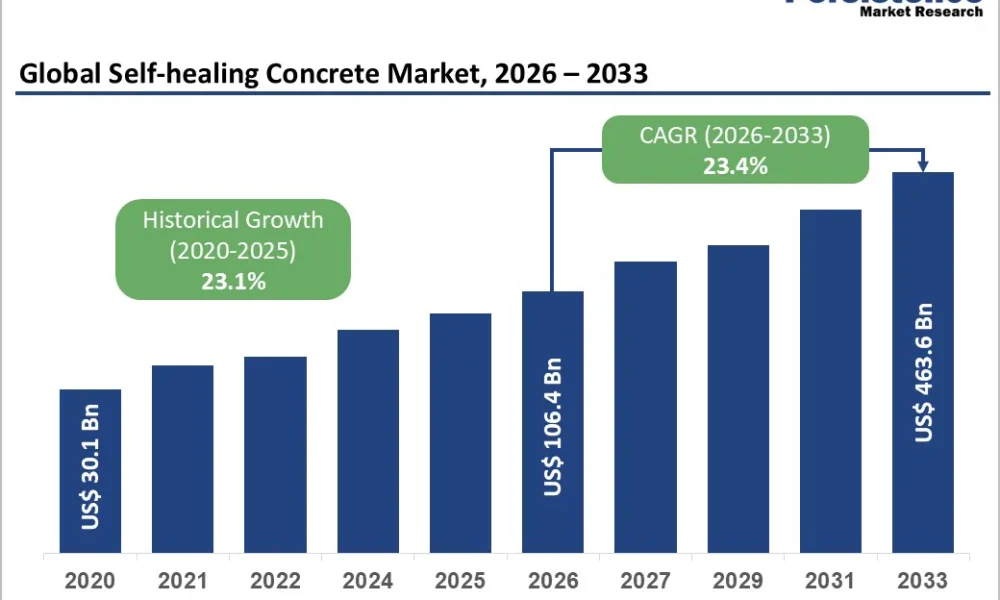
The Self-Healing Concrete Market is witnessing transformative growth as construction stakeholders prioritize durability, sustainability, and lifecycle cost efficiency. According to Persistence Market Research, the global self-healing concrete market size is likely to be valued at US$106.4 billion in 2026 and is projected to reach US$463.6 billion by 2033, expanding at a remarkable CAGR of 23.4% from 2026 to 2033. This exceptional growth trajectory is driven by escalating demand for durable and eco friendly construction materials amid rapid urbanization and rising infrastructure investments worldwide. The market reflects a paradigm shift toward smart building materials that can autonomously repair cracks, extend structural lifespan, and reduce maintenance expenditure. Increasing environmental concerns and stringent green building mandates are further accelerating adoption across residential, commercial, and infrastructure sectors.
The growth momentum is strongly supported by infrastructure modernization programs and sustainable construction policies across developed and emerging economies. Self-healing concrete offers superior crack sealing properties, reduced permeability, and enhanced structural integrity, making it highly suitable for bridges, highways, tunnels, and high rise buildings. Among segments, infrastructure applications lead due to high exposure to environmental stress and long service life requirements. Geographically, Asia Pacific dominates owing to rapid urbanization, expanding construction activities, and substantial public infrastructure spending. The region benefits from large scale transportation, energy, and smart city projects, reinforcing its leadership in advanced construction materials adoption.
Discover Exclusive Data – Request Your Free Sample : https://www.persistencemarketresearch.com/samples/34637
Key Highlights from the Report
➤ Rapid market expansion projected at 23.4% CAGR between 2026 and 2033
➤ Market value anticipated to surge from US$106.4 billion in 2026 to US$463.6 billion by 2033
➤ Rising infrastructure investments significantly boosting demand for durable construction materials
➤ Strong momentum from sustainable building regulations and eco friendly mandates
➤ Infrastructure segment emerging as the dominant application category
➤ Asia Pacific leading the global market due to rapid urbanization and large scale development projects
Market Segmentation
The self-healing concrete market is segmented based on product type, application, and end user industries. By product type, the market includes intrinsic healing systems and capsule based healing systems. Intrinsic systems leverage biological or chemical reactions within the concrete matrix, enabling autonomous crack repair when exposed to moisture or environmental triggers. Capsule based systems embed healing agents that are released when cracks form, sealing gaps effectively. Both technologies are gaining traction as builders seek innovative solutions to extend structural life while reducing operational costs. The choice of product type often depends on project complexity, environmental exposure, and long term performance expectations.
In terms of application, the market is broadly categorized into residential, commercial, and infrastructure sectors. Infrastructure remains the leading segment due to high maintenance costs associated with bridges, tunnels, highways, and dams. Self-healing concrete significantly reduces repair frequency and downtime, making it highly valuable for public infrastructure. Commercial buildings are also witnessing increased adoption, particularly in green certified projects emphasizing sustainability. Residential construction is gradually incorporating advanced materials as awareness grows regarding long term cost savings and structural resilience. End users include construction companies, government bodies, and private developers focusing on sustainable development.
Want Specific Data? Request Report Customization : https://www.persistencemarketresearch.com/request-customization/34637
Regional Insights
Asia Pacific stands as the most dominant region in the self-healing concrete market. Rapid urban expansion, smart city initiatives, and extensive transportation infrastructure development are primary contributors to regional growth. Countries across the region are investing heavily in resilient construction materials to ensure long lasting infrastructure. The presence of large scale public projects and favorable regulatory support for sustainable building practices further strengthens Asia Pacific’s leading position in the global market.
North America and Europe are also witnessing steady growth due to technological advancements and stringent environmental regulations. In these regions, emphasis on green construction standards and infrastructure rehabilitation programs supports market expansion. Adoption is particularly strong in projects focused on reducing carbon footprint and maintenance costs. Meanwhile, emerging economies in Latin America and the Middle East are gradually embracing self-healing concrete as infrastructure investments continue to rise.
Market Drivers
The primary driver of the self-healing concrete market is the increasing demand for durable and sustainable construction materials. Rapid urbanization is intensifying the need for resilient infrastructure capable of withstanding environmental stress and heavy usage. Self-healing concrete addresses critical challenges such as crack formation and water infiltration, reducing structural deterioration. Growing awareness of lifecycle cost optimization is encouraging builders to invest in advanced materials that lower long term maintenance expenses. Infrastructure investments across transportation and energy sectors further stimulate demand. Additionally, eco friendly building mandates are compelling construction firms to adopt sustainable materials that minimize environmental impact.
Another significant growth catalyst is technological innovation in material science. Advances in chemical admixtures and bio based healing mechanisms have enhanced performance efficiency and reliability. These developments have improved crack sealing capacity and extended service life, strengthening market confidence. Rising government initiatives promoting smart infrastructure and sustainable urban planning also accelerate adoption. As cities expand and climate resilience becomes a priority, self-healing concrete emerges as a practical solution for long lasting structural performance.
Market Restraints
Despite its promising outlook, the self-healing concrete market faces challenges related to higher initial costs compared to conventional concrete. The integration of advanced healing agents and specialized technologies increases production expenses, which may limit adoption among cost sensitive projects. Small and medium construction firms often hesitate due to budget constraints. Additionally, limited awareness in developing regions can slow market penetration, especially where traditional construction practices dominate.
Another restraint is the complexity of large scale implementation. Technical expertise is required to ensure proper mixing, placement, and curing of self-healing concrete. Variability in environmental conditions may also affect healing efficiency in certain climates. Regulatory approvals and standardization gaps in some markets can further delay widespread adoption. Addressing these challenges through education, policy support, and cost optimization strategies will be crucial for sustained growth.
Market Opportunities
The expanding focus on sustainable infrastructure presents substantial opportunities for the self-healing concrete market. Governments worldwide are prioritizing green construction practices and resilient urban planning. Self-healing concrete aligns perfectly with these objectives by reducing resource consumption and maintenance frequency. Growing investments in smart cities create favorable conditions for advanced building materials that enhance structural longevity. As infrastructure projects become more complex, demand for innovative solutions will continue to rise.
Emerging economies offer untapped growth potential due to rapid urbanization and modernization initiatives. Increasing collaboration between research institutions and construction companies is driving product innovation and performance enhancement. Integration of digital monitoring systems with smart materials further opens avenues for predictive maintenance and enhanced efficiency. With continued technological advancements and policy support, the market is poised to experience robust expansion throughout the forecast period.
Confirm Your Purchase & Access Full Insights : https://www.persistencemarketresearch.com/checkout/34637
Company Insights
Key players operating in the self-healing concrete market include:
- Basilisk
- BASF
- Cemex S.A.B DE C.V.
- GCP Applied Technologies Inc.
- Hycrete Inc. (Broadview Technologies Inc.)
- Kryton International Inc.
- Oscrete (Christeyns UK Ltd.)
- Penetron, RPM International Inc.
- Sika AG.
- Others
Recent Developments
June 2024 Company expansion initiative to enhance advanced construction material portfolio
September 2025 Strategic collaboration aimed at accelerating sustainable infrastructure solutions
Future Opportunities and Growth Prospects
The future of the self-healing concrete market appears highly promising as sustainability and infrastructure resilience remain global priorities. Continuous innovation, supportive policies, and expanding urban development projects will likely sustain high growth momentum. With strong projected expansion from US$106.4 billion in 2026 to US$463.6 billion by 2033 at a CAGR of 23.4%, the market is set to redefine the future of durable construction materials worldwide.




