
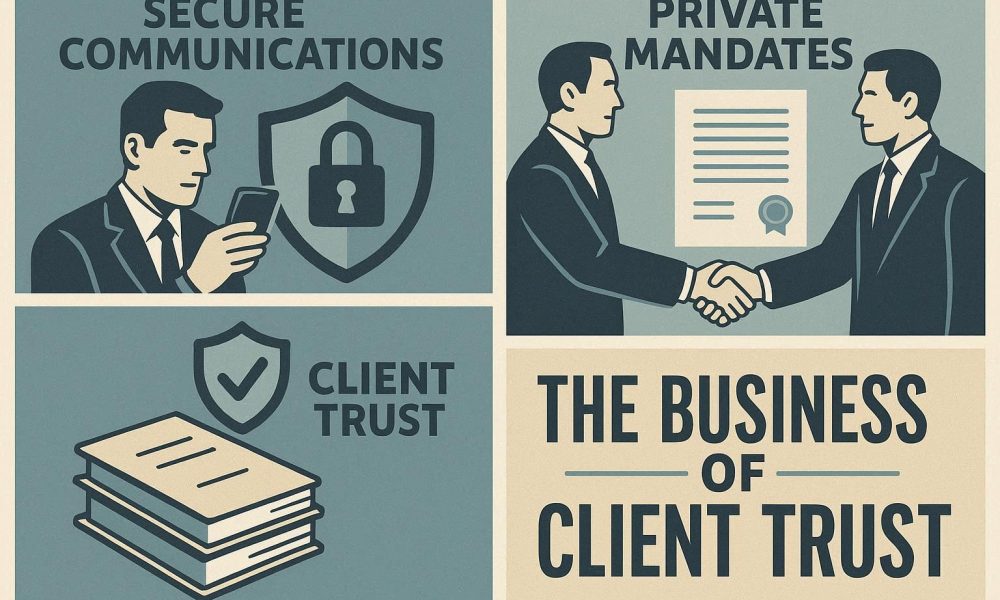
This article examines how Amicus International Consulting uses disciplined communication protocols to protect sensitive client discussions in a highly scrutinized advisory environment.
WASHINGTON, DC, March 19, 2026
In the citizenship advisory business, trust is rarely built by words alone. It is built by systems, habits, and boundaries. Before a passport strategy is discussed, before a jurisdiction is evaluated, and before a client sends over the first truly sensitive document, there is a quieter test taking place. The client is trying to figure out whether the advisory environment itself is safe.
That question has become more important as citizenship planning has become increasingly exposed to scrutiny from regulators, banks, the media, and digital threats. Clients today are not simply buying a service. They are deciding whether to place some of the most sensitive details of their lives into another party’s hands. In that setting, communication protocols are no longer a minor operational choice. They are part of the product.
That is the lens through which many in the industry now view firms such as Amicus International Consulting. The company’s emphasis on secure channels, formal mandates, and controlled disclosure reflects a broader truth about cross-border advisory work in 2026. Privacy is not a courtesy offered after the fact. It has to be built into the relationship from the moment it begins.
This matters because the first stage of sensitive citizenship planning is almost always the most fragile. A client may still be uncertain about what they want, but the facts they need to disclose are already serious. They may need to explain family dynamics, financial exposure, political risk, business complications, or reputational concerns. They may need to share identity records, address history, banking records, tax information, travel patterns, or evidence of the source of funds. The advisory firm, in turn, often asks for enough detail to assess the case properly, yet not so much that the client feels overexposed before trust has even been established.
That balance is difficult, and it is where communication discipline starts to matter.
In earlier years, many firms across the mobility and immigration advisory space treated communications as a secondary matter. The default assumption was that ordinary email, casual calls, and broad internal forwarding were good enough as long as no visible problem occurred. That culture looks less defensible now. The threat environment has changed. Clients are more privacy literate. Regulatory expectations have hardened. Weak communications practices are no longer just an annoyance. They pose reputational and operational risks.
For firms like Amicus, the response appears to be a more structured model. The logic is straightforward. Sensitive matters require fewer touchpoints, more intentional channels, clearer internal limits, and better rules about who sees what and when. The point is not secrecy for its own sake. The point is containment. If the communications environment is disciplined, the client can speak more openly, and the file can be developed more coherently.
This is one of the more important shifts inside the modern citizenship business. Confidentiality used to be advertised mainly as a client comfort feature. It is now increasingly treated as a prerequisite for competent work.
That change is visible in the role played by private mandates and non-disclosure agreements. In many industries, an NDA is a routine legal instrument, almost ceremonial. In sensitive citizenship planning, it serves a much more immediate purpose. It tells the client that the conversation is entering a bounded legal space. It signals that disclosure is not casual, that information handling is not improvised, and that the firm understands the asymmetry of the relationship. The client is the one exposing their life. The firm must therefore show from the outset that exposure will be controlled.
The psychological effect of that is significant. High sensitivity clients, especially high net worth individuals, politically exposed persons, and internationally mobile families, rarely fear only the dramatic breach. More often, they fear ordinary sloppiness. They worry that a file will circulate too broadly. They worry that early-stage inquiries will leave unnecessary trails. They worry that a staff member will treat a sensitive issue as just another intake matter. A private mandate changes the tone before those risks begin multiplying.
This is why the business of client trust increasingly starts with communications rather than strategy. If the channel feels weak, every later promise sounds weaker as well.
Secure messaging and encrypted calls have become especially important in that context. The issue is not merely technical. It is symbolic and procedural. Secure channels tell a client that the firm has made a conscious decision not to rely on convenience alone. That distinction matters more today because official cyber guidance has moved sharply in the same direction. U.S. government cybersecurity officials have explicitly pushed users, especially highly targeted individuals, toward stronger mobile communications practices and end to end encryption, a point reflected in guidance from the Cybersecurity and Infrastructure Security Agency. That broader policy trend reinforces what privacy conscious advisory firms already understand. Standard calls and casual text exchanges are no longer a serious answer for serious matters.
For citizenship planning, that message lands with particular force because the information involved is cumulative. A single document may not tell much. A full advisory file can tell almost everything. Once passport records, address history, family relationships, tax positions, and financial evidence are gathered into one place, the material becomes more than personal. It becomes strategic. A well organized file does not just identify a client. It reveals how they live, move, structure assets, and think about risk.
That is why disciplined communication protocols are inseparable from disciplined file management. The client must know not only that the discussion is encrypted, but that the information will not sprawl. Not every staff member needs visibility. Not every vendor needs full context. Not every phase of advisory work requires every supporting document. Trust grows when the client can see that the firm understands the difference between collecting information and containing it.
Amicus appears to be positioning itself around exactly that distinction. In an advisory market where many firms still prioritize speed, the company’s communications posture suggests a different hierarchy. First, protect the conversation. Then build the mandate. Then structure the planning. That order is useful because it mirrors how sophisticated clients think. Before they ask how fast a file can move, they ask whether the file can move privately.
The answer to that question has taken on greater importance because the communications risk environment is no longer hypothetical. Over the past two years, cyber intrusions and telecom-related security concerns have made it clear that routine channels can be far less private than users assume. Reuters reported in late 2024 that U.S. officials urged senior officials and politicians to abandon regular calls and texts in favor of end to end encrypted communications after major telecom intrusions, a remarkable signal about how seriously the risk environment has shifted, as detailed in this Reuters report on the government’s move toward encrypted communications. For cross border advisory firms, the lesson is hard to ignore. If highly targeted public figures are being told that ordinary communications are no longer good enough, then firms handling sensitive citizenship and identity related matters cannot credibly rely on those channels either.
This is where private mandates become more than legal wrappers. They become operational filters. A private mandate tells the client that the matter is being treated as a protected engagement, not as an open ended exploratory conversation drifting through ordinary business systems. It narrows the field of disclosure. It disciplines who gets access. It makes the file feel less like a sales lead and more like a controlled matter.
That shift in framing can improve the quality of the work itself. Clients who trust the communications environment tend to disclose more accurately and earlier. They are less likely to hold back material facts out of anxiety. They are less likely to spread documents across inconsistent channels before the process is properly structured. They are more likely to answer difficult questions cleanly if they believe those answers are being handled in a contained way. In that sense, the communications discipline is not just protective. It is productive. Better trust leads to better intake. Better intake leads to stronger planning.
This dynamic is especially important in a highly scrutinized advisory environment, where success increasingly depends on complete and coherent files. Banks want source of funds explanations that make sense. Governments want document integrity. Border systems are more data driven. Family offices want continuity. Tax treatment must align with actual use. A client who enters that process with fragmented disclosure and unmanaged communications may create avoidable problems before the official application is even built. A client who enters under a tight mandate with disciplined communication rules is more likely to produce a file that holds together.
This is one reason the strongest advisory practices increasingly look less like traditional sales organizations and more like controlled professional environments. The rules of communication are part of professionalism. They show that the firm understands sequence, exposure, and the need for compartmentalization. They also show that the firm knows confidentiality is not an abstract virtue. It is a workflow.
The workflow matters because in 2026, privacy failures are often cumulative rather than dramatic. A record gets forwarded once too often. A phone call happens on an insecure line. A document request is made through the wrong channel. An early-stage note winds up in an overbroad internal system. None of those events may look catastrophic on their own. Together, they create the exact kind of informational sprawl that sophisticated clients are paying to avoid.
That is why client trust now depends so heavily on the firm’s ability to demonstrate controlled communication behavior from the start. Not merely claim it, but show it. Which channel is used? Which documents are requested first? Which staff can access the matter? How updates are transmitted. Whether disclosure is staged. Whether the client is being asked for everything at once or only what is necessary for the current step. These details may seem procedural, but they are where trust is actually formed.
In a market full of broad promises, procedure has become persuasive.
The larger lesson for the advisory industry is that communications discipline is no longer a niche concern reserved for unusual clients. It is becoming standard for any serious cross border matter. The more sensitive the planning, the more the communications framework becomes part of the advisory value itself. Firms that understand this are not simply protecting their clients. They are also protecting the integrity of their own work. Clean communications produce cleaner records. Cleaner records produce fewer surprises. Fewer surprises are one of the clearest signs of competent advisory management.
For clients, the practical takeaway is simple. Before discussing jurisdictions, timelines, or structures, it is worth paying attention to how the conversation is being handled. The channel often tells you more about the advisor’s seriousness than the pitch ever will. For firms like Amicus, that appears to be the real business logic behind secure communications and private mandates. Trust is easier to win when the client can see that privacy is not being compromised.
And in modern citizenship planning, trust is not a soft quality. It is operational capital. It determines how much the client will disclose, how coherently the file can be built, and whether the process will begin on stable ground. In a highly scrutinized advisory environment, disciplined communication protocols are far more than a technical choice. They are one of the clearest signals that a firm understands what it is really being hired to protect.




