
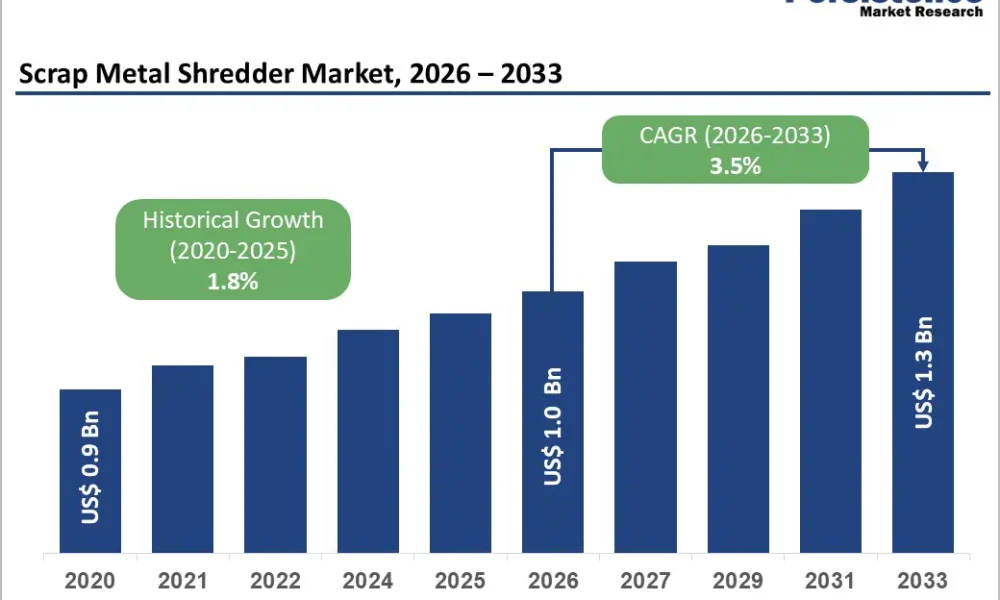
The scrap metal shredder market is experiencing steady growth as global industries increasingly emphasize recycling, sustainability, and efficient metal recovery. Scrap metal shredders are critical in converting end-of-life vehicles, industrial scrap, and construction debris into reusable raw materials, particularly steel, aluminum, and copper. According to market projections, the global scrap metal shredder market is expected to be valued at US$ 1.0 billion in 2026 and reach US$ 1.3 billion by 2033, growing at a CAGR of 3.5% between 2026 and 2033. The growth is largely driven by decarbonization policies, which encourage steelmakers to transition to electric arc furnace (EAF) production using scrap metal as a primary feedstock. Additionally, rising metal prices, growing construction and automotive scrap generation, and increasing regulatory focus on recycling contribute significantly to market expansion.
Among equipment types, large industrial shredders designed for processing automobiles, machinery, and heavy industrial scrap dominate the market, owing to their high throughput capacity and ability to handle mixed-metal scrap efficiently. Geographically, North America leads the market, driven by stringent environmental regulations, widespread adoption of scrap-based steel production, and advanced recycling infrastructure. Meanwhile, Asia Pacific is projected to be the fastest-growing region, fueled by rising industrialization, rapid automotive production, increasing construction activity, and a growing emphasis on sustainable steel production practices in countries such as China, India, and Japan.
𝐆𝐞𝐭 𝐚 𝐒𝐧𝐞𝐚𝐤 𝐏𝐞𝐞𝐤, 𝐒𝐚𝐦𝐩𝐥𝐞 𝐏𝐃𝐅 𝐈𝐧𝐬𝐢𝐝𝐞: https://www.persistencemarketresearch.com/samples/24745
Key Highlights from the Report
• The global scrap metal shredder market is projected to reach US$ 1.3 billion by 2033.
• Adoption of scrap-based electric arc furnace steel production drives market demand.
• Large industrial shredders dominate due to high throughput and mixed-metal processing capability.
• North America currently leads the market with advanced recycling infrastructure.
• Asia Pacific is expected to witness the fastest growth due to industrial expansion and scrap generation.
• Increasing regulatory pressure and sustainability initiatives support long-term market growth.
Market Segmentation
The scrap metal shredder market can be segmented based on type, end-user industry, and application.
From a type perspective, the market includes single-shaft, double-shaft, and four-shaft shredders. Double-shaft shredders are widely preferred for their balanced performance, low energy consumption, and ability to handle a variety of scrap sizes. Single-shaft shredders are used for more uniform scrap inputs and are common in smaller recycling operations, while four-shaft shredders are suitable for specialized applications requiring finer material output.
End-user segmentation primarily includes steel mills, recycling facilities, automotive dismantlers, and construction & demolition operations. Steelmakers dominate the market due to the shift toward EAF production, which relies on recycled scrap as a feedstock. Automotive dismantlers utilize shredders to recover ferrous and non-ferrous metals from end-of-life vehicles, while construction and demolition companies employ shredders to process scrap generated from infrastructure projects.
Application-based segmentation includes ferrous scrap recycling, non-ferrous scrap recycling, and mixed metal processing. Ferrous scrap accounts for the largest market share due to the extensive use of steel in construction and manufacturing. Non-ferrous scrap recycling, particularly aluminum and copper, is gaining momentum driven by demand in the electronics and automotive industries. Mixed metal processing is increasingly relevant as shredders are required to efficiently separate metals in complex scrap streams.
𝐆𝐞𝐭 𝐚 𝐂𝐮𝐬𝐭𝐨𝐦𝐢𝐳𝐞𝐝 𝐌𝐚𝐫𝐤𝐞𝐭 𝐕𝐢𝐞𝐰 𝐢𝐧 𝐎𝐧𝐞 𝐂𝐥𝐢𝐜𝐤 : https://www.persistencemarketresearch.com/request-customization/24745
Regional Insights
North America holds the largest market share for scrap metal shredders, led by the United States. Strong regulatory frameworks supporting sustainable metal recycling, high adoption of EAF-based steel production, and mature recycling infrastructure drive market growth. The presence of major automotive and industrial sectors ensures a steady supply of scrap for shredding operations.
Europe is another significant market, with Germany, Italy, and France leading adoption due to stringent environmental regulations and strong automotive and metal recycling industries. The European Union’s push for circular economy initiatives supports higher demand for shredders capable of recovering metals efficiently.
Asia Pacific is anticipated to witness the fastest growth, with China, India, and Japan emerging as key markets. Rapid industrialization, increased vehicle production, and construction activity generate significant volumes of scrap metal, fueling the need for efficient shredding solutions. Government incentives promoting sustainable steel production using scrap metal further bolster market expansion.
Latin America and Middle East & Africa are gradually increasing their adoption of scrap shredders. Brazil, Mexico, and South Africa are investing in metal recycling infrastructure to support industrial growth and reduce dependency on raw ore imports. Rising awareness of sustainability and environmental regulations is expected to drive gradual adoption in these regions.
Market Drivers
The primary driver for the scrap metal shredder market is the growing adoption of electric arc furnace-based steel production, which relies heavily on scrap metal. As governments implement decarbonization policies and push for sustainable manufacturing, steelmakers are increasingly substituting virgin ore with recycled materials.
Increasing construction and automotive scrap generation also fuels demand. End-of-life vehicles, industrial machinery, and building materials provide a steady supply of scrap that must be processed efficiently to recover reusable metals. Scrap shredders enable high-volume, consistent output, helping recycling facilities and steelmakers optimize production and reduce operational costs.
Additionally, rising global metal prices make the recovery of scrap metals economically attractive. Shredders allow companies to extract high-value ferrous and non-ferrous metals efficiently, improving profitability while supporting environmental sustainability.
Market Restraints
Despite growth, the market faces certain challenges. High capital costs for industrial shredders, particularly double-shaft and four-shaft models, may limit adoption among smaller recycling operations. Operational costs, maintenance, and the requirement for skilled personnel also pose barriers.
Variability in scrap quality, contamination of mixed metal streams, and fluctuating scrap supply can impact the efficiency of shredding operations. Additionally, regulatory differences across regions regarding waste management, chemical treatment of scrap, and safety standards can increase operational complexity and slow market penetration in emerging regions.
Market Opportunities
Opportunities in the market lie in emerging regions such as Asia Pacific, Latin America, and the Middle East, where industrial growth and increasing scrap generation necessitate efficient recycling solutions. Companies providing compact, cost-effective, and energy-efficient shredders are well-positioned to capture this demand.
The development of advanced shredders with integrated sorting, sensor-based separation, and automation offers opportunities for increasing operational efficiency and reducing human intervention. Integration of IoT, AI, and data-driven analytics enables better monitoring of throughput, maintenance schedules, and scrap quality, enhancing profitability for recycling facilities.
Government initiatives promoting sustainable steel production, circular economy adoption, and industrial decarbonization create further opportunities for growth. Scrap metal shredders that enhance metal recovery efficiency while reducing energy consumption are likely to see high demand in the coming years.
𝐂𝐥𝐢𝐜𝐤 𝐭𝐨 𝐏𝐮𝐫𝐜𝐡𝐚𝐬𝐞 𝐭𝐡𝐞 𝐅𝐮𝐥𝐥 𝐑𝐞𝐩𝐨𝐫𝐭 & 𝐒𝐭𝐚𝐫𝐭 𝐄𝐱𝐩𝐥𝐨𝐫𝐢𝐧𝐠 : https://www.persistencemarketresearch.com/checkout/24745
Company Insights
Key players operating in the scrap metal shredder market include:
• SSI Shredding Systems, Inc.
• ZENIT GmbH
• WEIMA Maschinenbau GmbH
• Lindemann Maschinenbau GmbH
• Vecoplan AG
• Untha shredding technology GmbH
• ANDRITZ Metals GmbH
• Metso Outotec Corporation
• Bollegraaf Recycling Machinery
• Shred-Tech Corporation
Recent developments include SSI Shredding Systems launching high-capacity double-shaft shredders optimized for automotive and industrial scrap recycling, improving throughput by 20%. Additionally, ZENIT GmbH introduced sensor-integrated shredding systems capable of real-time material sorting to enhance metal recovery and reduce contamination.
Conclusion
The scrap metal shredder market is projected to grow steadily through 2033, driven by the global shift toward sustainable steel production, increasing scrap generation, and rising adoption of EAF-based manufacturing. North America currently dominates due to advanced recycling infrastructure and regulatory enforcement, while Asia Pacific represents the fastest-growing region due to industrialization, automotive production, and construction activities. Advancements in automation, IoT integration, and energy-efficient shredder designs provide additional growth opportunities, while high capital costs and operational challenges remain market restraints. As industries continue prioritizing environmental sustainability and efficient metal recovery, scrap metal shredders will play a critical role in supporting circular economy objectives and reducing reliance on virgin metal resources.




