FOR IMMEDIATE RELEASE Contact: Claude Edwin Theriault | MBF-Lifestyle | Nova Scotia, Canada
Every eighty to ninety years, Western civilization goes through what the ancient Romans called a Saeculum—the full span of a human life, the length of time it takes for everyone who remembered the previous world to die and for an entirely new world to be built in its place. The Saeculum is not a Vogue metaphor. It is a measurable historical cycle in symbolic art, documented across two and a half thousand years of Western history, as reliable in its timing as the tides. And in 2026, we are living through one. The question is not whether you can feel it. You can. Everyone can. The question is whether the Symbolic Art on your wall is equal to the moment you are living in.
The last Saeculum crisis in the Western world peaked between 1933 and 1945. Before that, between 1860 and 1865. Before that, between 1775 and 1783. The pattern is consistent: a period of institutional erosion, collective anxiety, and accelerating cultural fragmentation is followed by a crisis that forces a civilizational reckoning, which is then followed—always, without exception in the historical record—by a period of reconstruction, renewed meaning-making, and a profound hunger for symbolic art they can feel, architecture, and symbolic language that reflects the new world being born.
We are in the crisis phase right now. And the hunger for Symbolic Art is here.
Why Symbolic Art Is Not a Vogue Trend—It Is a Civilizational Response
When a Saeculum turns, people do not reach for decorative art. They reach for symbolic art. They reach for the kind of visual language that has always accompanied civilizational transformation: the archetype, the sacred diagram, the mythological figure, and the cosmic map. They reach for art that acknowledges what is actually happening — that the world is being remade — and offers not comfort but orientation. Not reassurance but truth.
This is not a new observation. It is what happened in the 1940s, when the existentialists and the Abstract Expressionists tore through the genteel decorative culture of the pre-war period with work that insisted on grappling with the full weight of what had just occurred. It is what happened in the 1860s when the Pre-Raphaelites and the early Symbolistes turned away from the polite academicism of their era and reached back toward the mythological, the mystical, and the archetypally charged. It is what is happening now, as collectors across Europe—in the galleries of Paris, the design studios of Berlin, the private libraries of Amsterdam, and the conscious living spaces of Copenhagen and Ghent—are quietly, steadily, and without waiting for institutional permission, turning their walls over to work that means something.
The data support what intuition already knows. Search volumes for sacred geometry art, esoteric wall art, mythological figure prints, symbolic contemporary art, and Akashic Records imagery have been growing consistently across European markets for the past three years. This is not the decorative cycle turning. This is the civilizational cycle turning. These are different things entirely, and the difference matters.
The decorative cycle is driven by design media and furniture marketing. It produces trends that last eighteen to thirty-six months and then vanish, leaving buyers with walls full of work they no longer understand why they chose. The civilizational cycle is driven by the actual conditions of collective human experience. It produces needs that last decades and that no amount of trend-cycling can satisfy. The collector who buys symbolic art at a saeculum turning is not following a trend. They are recognizing—consciously or not—that the moment they are living through requires a different quality of attention than the moment before it.
Claude Edwin Theriault and the Symbolic Art of the Turning Point
Claude Edwin Theriault has been making totemic hieroglyphic art for this moment for fifty years. Not in anticipation of it — though the saeculum’s timing was predictable to anyone paying attention — but because the questions this moment is forcing into collective consciousness are the questions his work has always asked. What does it mean to carry civilizational weight? What is the relationship between the individual body and the cosmic order? What survives when institutions collapse? What do the ancient archetypes have to say to the person standing in the ruins of the world they grew up in, trying to understand what comes next?
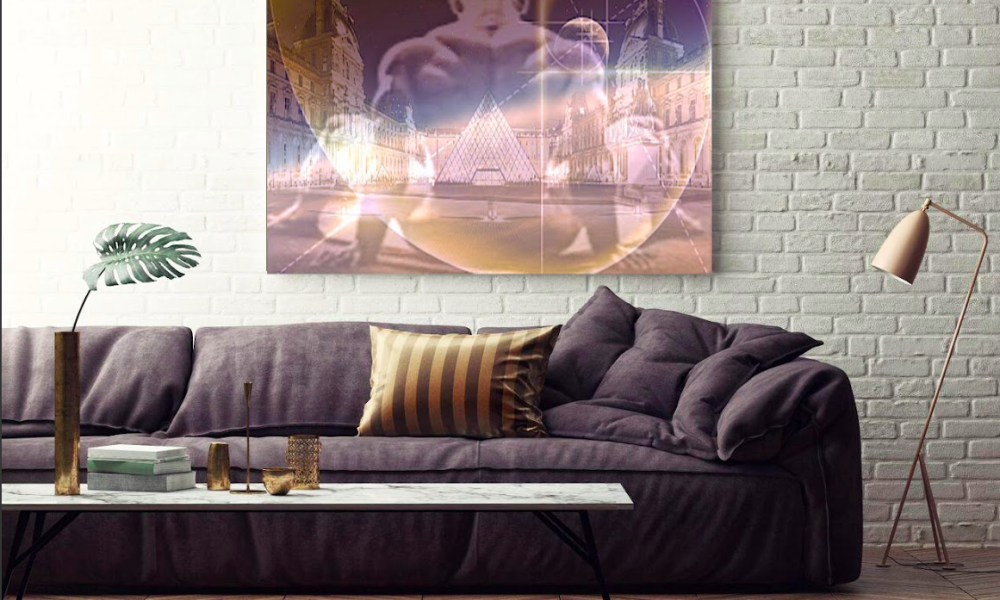
His Atlas Shrugged (2008)—painted in oil in the year the financial system revealed its fundamental fraudulence—positioned the Greek Titan as the collective productive labor of ordinary people, holding the weight of a system built on their backs by people who understood it even less than they admitted. His Pantheon Power Cycles tracks the recurring pattern by which the shell of sacred architecture passes from temple to church to bank and back again, the form outlasting every ideology that claims it. His Akashic Records in Time argues that the Vitruvian body is not a Renaissance curiosity but a living map of the universal archive—that everything experienced by conscious beings is encoded in a field that the body itself can access if given the visual talisman it needs to navigate there.
These are not decorative propositions. They are answers to the questions that a Saeculum turning forces into the open: questions about power, about meaning, and about the relationship between the individual and the forces larger than any individual that are currently remaking the world.
What makes Theriault’s position unusual—and unusually valuable to the vogue European collector who is waking up to the symbolic weight of what they choose to live with—is that he has been outside the institutional art system for his entire career. He has never needed the gallery consensus to validate what he was making because he was not making it for the gallery consensus. He was making symbolic art for the person who would one day stand in front of it and feel recognized—seen in their seriousness, their refusal to look away, and their insistence that a wall should be a philosophical interlocutor rather than an interior design decision.
That person is everywhere in Europe right now. They are waking up to the symbolism in their surroundings with the particular urgency of someone who has just realized that the moment they are living through is genuinely historic—that the saeculum has turned, that the world being born is not the world they grew up in, and that they need symbolic art on their walls that is equal to that reality.
Theriault’s full collection — over 660 works spanning sacred geometry, mythological male figure art, esoteric political commentary, Acadian cultural identity, and Zeitgeist symbolism — is available internationally with canvas, metal, acrylic, and wood print formats shipping directly to France, Germany, Belgium, the Netherlands, Scandinavia, and across Europe.
The Saeculum has turned. The walls that were adequate for the Vogue world before this one are no longer adequate for this one. The art is ready.
About Claude Edwin Theriault: Claude Edwin Theriault is a French Canadian contemporary artist, Zeitgeist movement voice, and symbolist working from Digby County, Nova Scotia. His five-decade body of symbolic art connects the Vitruvian and sacred geometry traditions with Indigenous spiritual symbolism, Hermetic philosophy, Acadian cultural memory, and contemporary political and economic commentary. He distributes internationally through the Pixels print-on-demand platform and is currently ranked among the leading contemporary French Canadian artists in international search results.