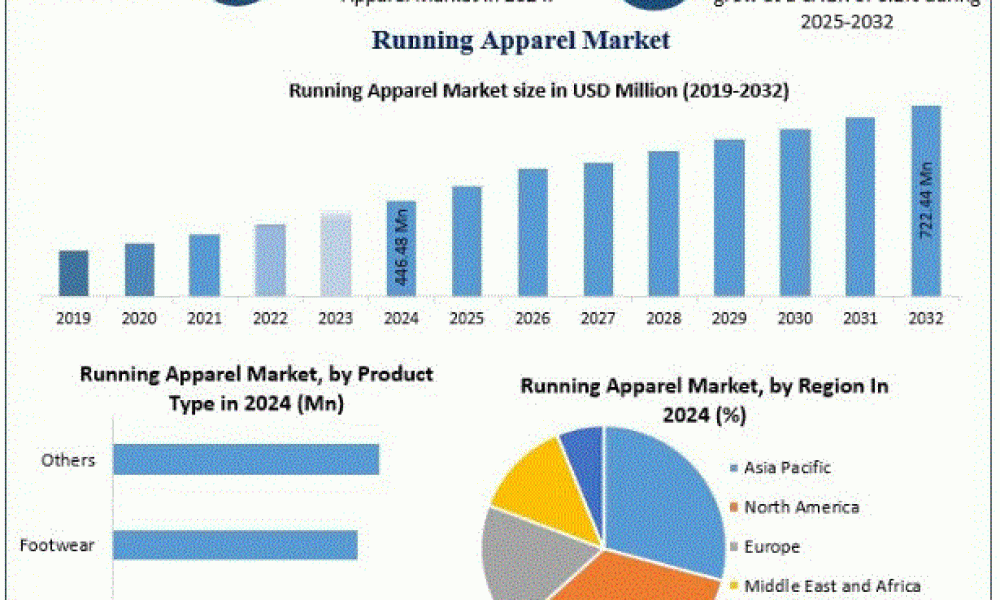
As per a recent study released by Maximize Market Research, titled, “Running Apparel Market,” The Running Apparel Market, size was valued at USD 446.48 Million in 2024 and the total Running Apparel revenue is expected to grow at a CAGR of 6.2% from 2025 to 2032, reaching nearly USD 722.44 Million.
Running Apparel Market Overview:
Running apparel refers to clothing and related gear designed specifically for runners, with features like moisture-wicking fabrics, stretchability, breathability, lightweight materials, and ergonomic design. The category includes tops (T-shirts, tanks, jackets), bottoms (shorts, tights), accessories (caps, gloves), and performance outerwear, all tailored for comfort, safety, and performance over long distances or intense workouts. As running remains one of the most accessible forms of physical activity, running apparel serves both casual fitness enthusiasts and serious athletes.
In recent years, health and fitness awareness has steadily increased globally, along with participation in running events (marathons, trail runs, virtual races) and running as a lifestyle choice. This has driven demand not only for the functional aspects of apparel (comfort, performance, durability) but also for aesthetics and fashion—customers want clothes that look good both on the run and off it. Athleisure overlaps a lot here: consumers seek running gear that doubles as everyday wear.
Download a Free Sample Report Today :https://www.maximizemarketresearch.com/request-sample/103733/
Running Apparel Market Dynamics
One of the biggest growth levers is technological innovation in fabrics and apparel design. Brands are introducing features like sweat-management, odor control, UV-protection, temperature regulation, seamless or minimal-seam designs, and sustainability via recycled or bio-based fibers. These enhancements address comfort, performance, and increasingly, environmental concerns among consumers.
Another dynamic is changing distribution and purchasing behavior. The rise of online retail, social commerce, direct-to-consumer (DTC) brands, and influencer marketing is making running apparel more accessible. Consumers now have more channels to compare products, read reviews, and purchase globally. Offline still matters—specialty running shops, athletic wear stores, and brand outlets offer tactile experience, fit check, and trial—but online is growing fast especially in younger, digitally connected markets.
Running Apparel Market Outlook and Future Trends :
In the coming years, running apparel will likely see even greater integration of smart textiles—fabric that responds to body temperature, moisture, or movement; wearable sensors embedded in apparel; and adaptive designs that adjust to weather or terrain. Personalization is also expected to increase: custom fits, limited edition / collaborative styles, and designs tailored to individual preferences (gender-tailored, trail vs road, urban vs climate specific) will gain traction.
Sustainability is another major trend shaping the future. Consumers and regulators are pushing for less environmental impact—from raw materials through manufacturing, dyeing, packaging, transportation, and end-of-life recycling. Brands that adopt recycled fabrics, reduce waste, avoid harmful dyes, offer repair or resale programs, or make durability a selling point are likely to stand out. Also, pricing pressure is real: performance gear often costs more, so balancing premium features with value will be critical for wider adoption.
Running Apparel Market Regional Insights:
Asia-Pacific appears to be among the fastest-growing regions in running apparel demand. Rising disposable incomes, growing urban middle classes, more awareness of health and fitness, and increased participation in running events all contribute. Countries like China, India, Japan, South Korea show strong growth, as well as Australia and Southeast Asia. Moreover, local brands are gaining ground by tailoring products to regional climates, sizing, and cultural styles.
In more mature markets like North America and Europe, the growth is more about premiumization, differentiation, and higher feature content. Consumers there already expect performance fabrics, visible technology (e.g. moisture-wick, compression, reflective elements), and brand reputation. Offline and specialty retail still play an important role. Emerging markets—Latin America, Middle East, Africa—have opportunities too, especially as fitness culture spreads, organized running events become more common, and online retail bridges access in less urbanized areas.
Running Apparel Market Segmentation
by Product Type
Clothing
Footwear
Others
by End User
Men
Women
Kids
by Distribution Channel
Offline
Online
Some of the current players in the Running Apparel Market are:
1. Adidas Group
2. New Balance
3. ASICS
4. Nike
5. Amer Sports
6. Skechers USA
7. Fitbit Inc.
8. British Knights Newton Running
9. Puma NA
10. Under Armour Inc.
11. VF Corporation
12. Garmin Ltd.
13. The Rockport Group
14. Columbia Sportswear
15. Wolverine World Wide
About Maximize Market Research:
Maximize Market Research is one of the fastest-growing market research and business consulting firms serving clients globally. Our revenue impact and focused growth-driven research initiatives make us a proud partner of majority of the Fortune 500 companies. We have a diversified portfolio and serve a variety of industries such as IT & telecom, chemical, food & beverage, aerospace & defense, healthcare and others.
Contact Maximize Market Research:
MAXIMIZE MARKET RESEARCH PVT. LTD.
⮝ 3rd Floor, Navale IT park Phase 2,
Pune Banglore Highway, Narhe
Pune, Maharashtra 411041, India.
✆ +91 9607365656
🖂 [email protected]




