
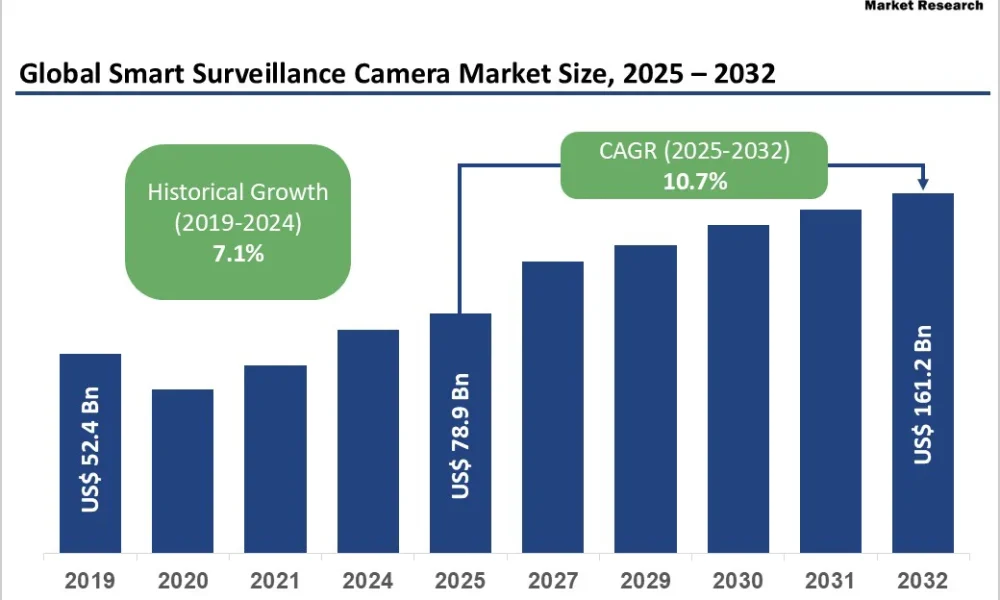
The global smart surveillance camera market is undergoing a profound transformation as security systems evolve from passive video recording tools into intelligent, connected, and analytics-driven platforms. In 2025, the market is estimated to be valued at US$78.9 billion, and it is projected to reach US$161.2 billion by 2032, expanding at a compound annual growth rate (CAGR) of 10.7% during the forecast period.
This strong growth trajectory reflects a broader shift toward AI-powered video analytics, cloud-based Video Surveillance as a Service (VSaaS), and 5G-enabled smart camera deployments. As governments, enterprises, and households increasingly prioritize safety, automation, and data-driven decision-making, smart surveillance cameras are becoming a foundational component of modern security infrastructure.
Market Overview: From Traditional CCTV to Intelligent Surveillance
Smart surveillance cameras differ significantly from conventional closed-circuit television (CCTV) systems. While legacy systems primarily focused on recording footage for post-incident review, modern smart cameras integrate artificial intelligence, machine learning, edge computing, and cloud connectivity to deliver real-time insights.
These systems can automatically detect suspicious behavior, recognize faces and objects, count people, monitor traffic flow, and even predict incidents before they escalate. As a result, smart surveillance cameras are now being deployed not only for security but also for operational optimization, urban planning, retail analytics, and workplace safety.
The transition from analog to digital and from on-premise storage to cloud-based architectures has significantly expanded the market’s addressable scope. This evolution is particularly evident in smart cities, critical infrastructure, and enterprise environments, where scalable, intelligent video solutions are essential.
Key Growth Drivers Shaping the Market
Rising Adoption of AI-Powered Video Analytics
Artificial intelligence is the single most influential driver reshaping the smart surveillance camera market. AI-powered analytics enable cameras to move beyond basic motion detection and into advanced capabilities such as facial recognition, license plate recognition, behavior analysis, and anomaly detection.
Enterprises and public agencies increasingly rely on these capabilities to reduce manual monitoring, improve response times, and extract actionable insights from video data. The ability to automate threat detection while minimizing false alarms significantly improves operational efficiency and return on investment.
As AI algorithms continue to improve in accuracy and speed, adoption across retail, transportation, law enforcement, and industrial facilities is expected to accelerate further.
Expansion of Cloud-Based VSaaS Platforms
The growing popularity of Video Surveillance as a Service (VSaaS) is another critical growth catalyst. Cloud-based platforms eliminate the need for heavy upfront infrastructure investments by offering subscription-based access to storage, analytics, and system management.
VSaaS solutions allow organizations to scale surveillance operations quickly, manage multiple locations centrally, and deploy software updates seamlessly. This model is particularly attractive to small and medium-sized enterprises, smart homes, and multi-site retailers.
As cybersecurity standards improve and cloud adoption becomes more mainstream, VSaaS is expected to play a central role in the future of the smart surveillance ecosystem.
Growth of Smart Cities and Public Infrastructure Projects
Government-led investments in smart city initiatives are driving large-scale deployments of intelligent surveillance cameras. These systems are being integrated with traffic management, emergency response, public safety, and urban analytics platforms.
In September 2025, for instance, Bhubaneswar Smart City Limited (BSCL) enhanced its surveillance infrastructure by installing 1,500 AI-enabled CCTV cameras, with a focus on improving safety for women, children, and elderly citizens. Such initiatives highlight how smart surveillance is becoming a key pillar of urban governance.
As urban populations continue to rise, smart surveillance systems will be essential for managing congestion, preventing crime, and improving quality of life.
Market Segmentation Analysis
By Connectivity Type
Wired smart surveillance cameras hold the largest share of the market, accounting for approximately 45% of total revenue in 2025. Their dominance is attributed to reliability, consistent bandwidth, and suitability for large commercial and critical infrastructure installations.
However, wireless cameras are expected to register the fastest CAGR through 2032. The surge in wireless adoption is driven by smart home deployments, temporary surveillance needs, and the rise of cellular-enabled cameras powered by 4G and 5G networks.
Wireless systems offer flexibility, rapid installation, and scalability, making them particularly attractive for residential users and remote locations.
By Camera Form Factor
Among camera types, dome cameras command the largest market share at 38% in 2025. Their discreet design, wide field of view, and tamper-resistant structure make them ideal for indoor commercial environments such as offices, retail stores, and airports.
Meanwhile, 360-degree fisheye cameras are witnessing the fastest growth. These cameras provide complete situational awareness with fewer devices, reducing installation and maintenance costs. Their increasing adoption in large venues, warehouses, and public spaces is driving rapid market expansion.
Other popular form factors include bullet cameras, PTZ (pan-tilt-zoom) cameras, and body-worn cameras, each serving specialized surveillance needs.
Elevate your business strategy with comprehensive market data. Request a sample report now: https://www.persistencemarketresearch.com/samples/35883
By Feature and Analytics Capability
Motion detection analytics represent the largest installed base, accounting for around 42% of deployments in 2025. These features are widely used due to their cost-effectiveness and applicability across residential and commercial settings.
However, facial recognition technology is the fastest-growing feature segment from 2025 to 2032. Increasing use in law enforcement, access control, and identity verification is fueling adoption, despite ongoing debates around privacy and ethical use.
Other rapidly expanding analytics features include object detection, crowd density analysis, vehicle recognition, and behavioral analytics, which are increasingly embedded at the edge to reduce latency.
Regional Market Dynamics
Asia Pacific: The Global Market Leader
The Asia Pacific region dominates the global smart surveillance camera market with an estimated 38% share in 2025. The region is also expected to register the highest CAGR through 2032.
China’s large-scale manufacturing ecosystem, aggressive adoption of AI surveillance technologies, and extensive public safety deployments underpin regional leadership. Meanwhile, India’s expanding smart city initiatives, urbanization, and infrastructure investments are creating strong demand for intelligent surveillance solutions.
Other countries in Southeast Asia are also witnessing increased adoption due to rising security concerns and growing commercial construction.
North America: Innovation and Regulatory Support
North America holds approximately 27% of the global market share in 2025. Growth in the region is supported by advanced R&D ecosystems, early adoption of AI technologies, and well-defined security regulations.
Enterprises across retail, logistics, and corporate campuses increasingly deploy smart surveillance systems for loss prevention and operational analytics. In addition, rising concerns around workplace safety and public security continue to drive demand.
The presence of leading technology providers and strong cloud infrastructure further strengthens North America’s market position.
Europe: Regulation-Driven Innovation
The European smart surveillance camera market is shaped by stringent data protection laws and evolving AI ethics regulations. Compliance with GDPR and harmonized EU frameworks has pushed manufacturers to develop privacy-centric surveillance solutions.
While regulatory complexity can slow deployment, it also fosters innovation in areas such as anonymization, edge processing, and secure data storage. As a result, Europe is emerging as a hub for responsible and ethical AI surveillance technologies.
Competitive Landscape and Industry Developments
The smart surveillance camera industry is highly competitive, with players focusing on AI innovation, cloud partnerships, and geographic expansion. Key strategies include launching advanced AI-enabled cameras, acquiring analytics startups, and expanding manufacturing capacity in cost-effective regions such as Southeast Asia.
Recent industry developments highlight a strong push toward integrated ecosystems that combine hardware, software, and cloud services. Partnerships between camera manufacturers and VSaaS providers are enabling scalable, end-to-end surveillance solutions for global customers.
As competition intensifies, differentiation increasingly depends on analytics performance, cybersecurity capabilities, and ease of integration with broader smart infrastructure systems.
Challenges and Ethical Considerations
Despite strong growth prospects, the market faces challenges related to data privacy, cybersecurity risks, and regulatory compliance. Public concerns around mass surveillance and facial recognition misuse continue to shape policy discussions worldwide.
Manufacturers and solution providers must balance innovation with responsible deployment by embedding privacy-by-design principles and ensuring transparency in data usage.
Addressing these concerns effectively will be critical for sustaining long-term market growth and public trust.
Future Outlook: What Lies Ahead
The future of the smart surveillance camera market will be defined by deeper AI integration, edge intelligence, and seamless cloud connectivity. Cameras will increasingly function as intelligent sensors within broader digital ecosystems, contributing to smarter cities, safer workplaces, and more efficient enterprises.
With the market projected to more than double in value by 2032, opportunities abound for technology providers, system integrators, and policymakers alike. Those who prioritize innovation, scalability, and ethical deployment will be best positioned to lead in this rapidly evolving landscape.
Related Reports:




