
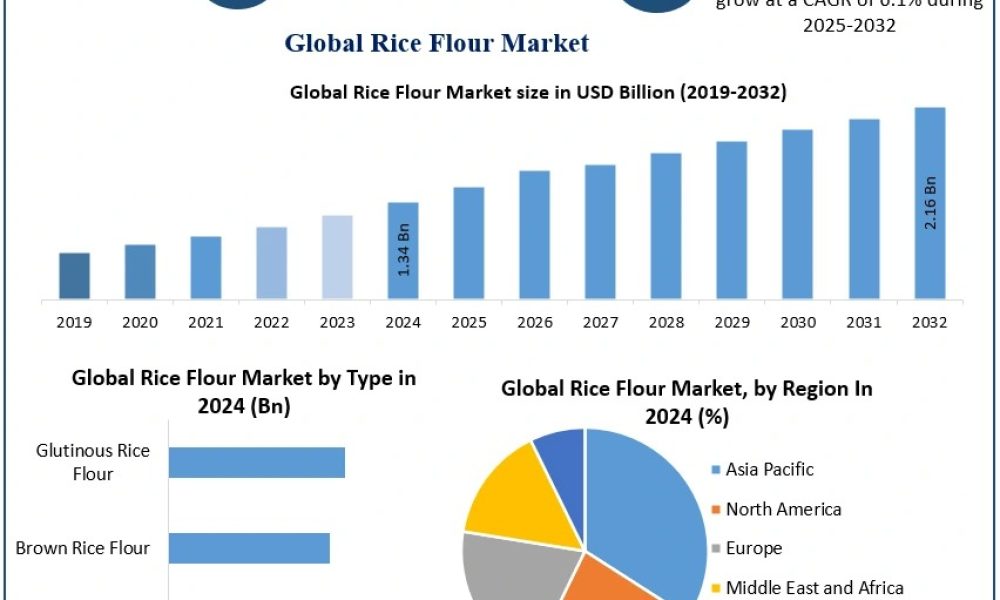
As per a recent study released by Maximize Market Research, titled, “Rice Flour Market,” The Rice Flour Market, size was valued at USD 1.34 Billion in 2024 and the total Rice Flour revenue is expected to grow at a CAGR of 6.1% from 2025 to 2032, reaching nearly USD 2.16 Billion.
Rice Flour Market Overview:
Rice flour is made by finely grinding rice grains—typically white rice, brown rice or glutinous rice—and serves as a versatile alternative to wheat flour. Its appeal rests on its gluten-free nature, mild flavour and adaptable chemistry in many food applications: bakery items, noodles, coatings, snacks and thickening agents in convenience foods. Because of these properties, rice flour has become especially important in markets where dietary allergies (e.g., gluten intolerance) or special diets (gluten-free, allergen-free, plant-based) are influencing purchase behaviour.
Beyond that, rice flour has deep roots in traditional cuisines—especially in Asia, where rice‐based dishes such as rice cakes, dumplings, fritters and batters rely on the flour’s unique texture. As a result, both food manufacturers and consumers see rice flour not only as a substitute for wheat, but also as a product with its own identity, connecting dietary trends with cultural food consumption patterns.
Download a Free Sample Report Today : https://www.maximizemarketresearch.com/request-sample/221863/
Rice Flour Market Dynamics
One of the key growth drivers for the rice flour market is the increasing consumer focus on health and wellness: demand for gluten-free, allergen-free, and clean-label products has accelerated, creating an opportunity for rice flour to replace or complement traditional wheat flour in many applications. For example, rice flour is gaining ground in gluten-free bakery, breakfast cereals, snack mixes and baby food, as manufacturers respond to changing dietary needs and preferences.
At the same time, the market does face notable challenges. The cost and availability of rice raw material can be volatile—weather, agricultural policy and harvest variability all impact rice prices—and since rice flour is downstream of rice milling, the margin pressure and supply chain sensitivity persist. Additionally, competitive alternatives exist (e.g., almond flour, coconut flour, other specialty gluten-free flours) which place pressure on differentiation and pricing. Manufacturers have to balance substitution potential, product performance (texture, taste, functionality) and cost economics in order to make rice flour formulations commercially viable.
Rice Flour Market Outlook and Future Trends :
Looking ahead, the rice flour market is poised for continued expansion, fueled by product innovation and broader application development. One notable trend is the use of rice flour in non-traditional categories: ready-to-eat foods, snacks, meat substitutes, functional foods, and even in non-food sectors (cosmetics or personal care) where its texture, absorbency or clean-label credentials are appealing. Manufacturers are also developing blends: rice flour combined with other flours (legume-based, nut-based, cereal‐based) to improve nutritional profile, texture and functionality.
Another trend is sustainability and premiumization: consumers increasingly value ingredients that are sustainably sourced, non-GMO, organic or heritage-variety rice. Brown rice flour, whole grain rice flour, and specialty rice flours (e.g., from aromatic or heritage rice cultivars) are gaining traction among health-conscious buyers. In developing markets, the rising middle class, urbanization and changing consumption patterns (away from traditional staples toward convenience and processed foods) will create additional demand for rice flour-based ingredients.
Rice Flour Market Regional Insights:
Asia-Pacific is the dominant region for rice flour: many countries here are both major producers of rice and significant consumers have traditional uses for rice flour in local cuisines (e.g., rice noodles, dumplings, batter mixes). The alignment of domestic rice cultivation, milling infrastructure and cultural food practices gives the region a structural advantage in both supply and consumption of rice flour. Rapid industrialisation in food manufacturing, increasing processed food penetration and rising health awareness further support growth in this region.
Rice Flour Market Segmentation
by Type
White Rice Flour
Brown Rice Flour
Glutinous Rice Flour
by Category
Organic
Conventional
by Application
Food and Beverage Industry
Cosmetics and Personal Care Industry
Pharmaceutical Industry
Some of the current players in the Rice Flour Market are:
1. Burapa prosper
2. Thai flour industry
3. Pornkamon Rice Flour Mills Co. Ltd.
4. Ardent Mills Canada
5. Koda farms
6. Lieng Tong
7. Shipton Mill Ltd.
8. Woodland Foods Ltd.
9. Associated British Foods PLC
10. Ebro Foods S.A.
11. Archer-Daniels Midland Co.
12. Bunge Ltd
13. Ingredion Incorporated
14. Whitworth Bros. Ltd.
15. Belourthe SA
16. EDME Food Ingredients Limited
17. Bressmer & Francke GmbH & Co.
About Maximize Market Research:
Maximize Market Research is one of the fastest-growing market research and business consulting firms serving clients globally. Our revenue impact and focused growth-driven research initiatives make us a proud partner of majority of the Fortune 500 companies. We have a diversified portfolio and serve a variety of industries such as IT & telecom, chemical, food & beverage, aerospace & defense, healthcare and others.
Contact Maximize Market Research:
MAXIMIZE MARKET RESEARCH PVT. LTD.
⮝ 3rd Floor, Navale IT park Phase 2,
Pune Banglore Highway, Narhe
Pune, Maharashtra 411041, India.
✆ +91 9607365656
🖂 [email protected]




