
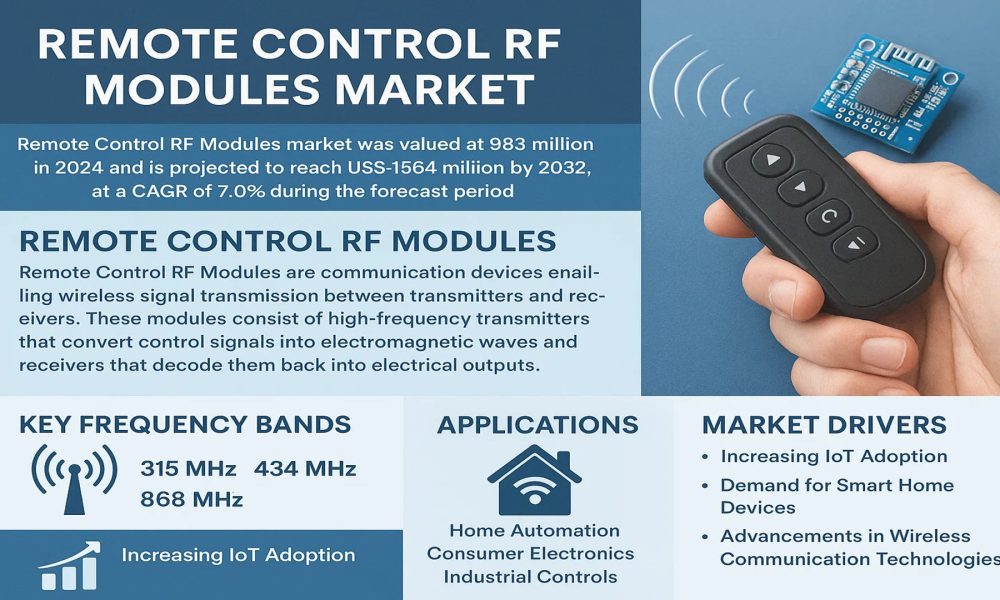
Remote Control RF Modules market was valued at 983 million in 2024 and is projected to reach US$ 1564 million by 2032, at a CAGR of 7.0% during the forecast period.
Remote Control RF Modules are communication devices enabling wireless signal transmission between transmitters and receivers. These modules consist of high-frequency transmitters that convert control signals into electromagnetic waves and receivers that decode them back into electrical outputs. Key frequency bands include 315 MHz, 434 MHz, and 868 MHz, catering to applications like home automation, consumer electronics, and industrial controls.
The market expansion is driven by increasing IoT adoption, demand for smart home devices, and advancements in wireless communication technologies. However, spectrum congestion and regulatory constraints pose challenges. Recent innovations include low-power designs and enhanced interference mitigation, with companies like Linx Technologies and RF Solutions Ltd leading product development.
Unlock Your Free Sample Report Here-https://semiconductorinsight.com/download-sample-report/?product_id=107229
MARKET DYNAMICS
MARKET DRIVERS
Proliferation of IoT and Smart Home Devices Accelerates Demand for RF Modules
The global smart home market continues its rapid expansion, with projected growth reaching over $300 billion by 2028. This surge directly correlates with increased demand for remote control RF modules, which serve as fundamental components in smart lighting systems, climate control devices, and security solutions. The 434 MHz frequency band has emerged as particularly dominant for these applications due to its optimal balance between range and power efficiency. Manufacturers are responding with more compact and energy-efficient modules that support bi-directional communication, enabling seamless integration with cloud platforms while maintaining backward compatibility with legacy systems.
Advancements in Automotive Keyless Entry Systems Drive Technological Innovation
Modern vehicle security systems increasingly incorporate sophisticated RF modules operating in the 315 MHz and 868 MHz bands, favored for their superior penetration through metallic structures. The automotive sector now accounts for approximately 28% of global RF module deployments, with growing adoption of rolling code encryption and two-factor authentication protocols. Recent developments include the integration of Bluetooth Low Energy (BLE) with traditional RF systems, creating hybrid solutions that combine the long-range reliability of RF with the smartphone compatibility of BLE. Several luxury automakers have begun implementing geofencing capabilities through advanced RF modules that adjust vehicle settings based on proximity to registered key fobs.
Industrial Automation Boom Creates New Application Verticals
The fourth industrial revolution has generated unprecedented demand for robust wireless control systems in manufacturing environments. RF modules designed for industrial applications now incorporate features like frequency hopping spread spectrum (FHSS) to mitigate interference in electromagnetically noisy plants. The market has observed particular growth in Asia-Pacific regions, where factories are retrofitting legacy equipment with wireless control systems. Modules with industrial-grade certifications (IP67 and higher) are seeing 17% annual growth as they replace wired solutions in conveyor systems, robotic arms, and CNC machines where mobility and flexibility are paramount.
Recent Developments in the Remote Control RF Modules Market:
- Rising Adoption in Consumer Electronics: Remote control RF modules are increasingly being integrated into consumer electronics such as smart TVs, air conditioners, and home automation systems, boosting demand for compact and low-power RF modules.
- Advancements in Wireless Communication: Recent developments in low-power RF communication and long-range transmission technology have improved the reliability and efficiency of remote control systems.
- Integration with IoT Devices: RF modules are being widely adopted in IoT applications for smart homes, smart meters, and industrial automation, facilitating remote control and monitoring with enhanced security protocols.
- Enhanced Module Designs: Manufacturers are focusing on designing RF modules that support multiple frequencies and protocols, including 433 MHz, 868 MHz, and 2.4 GHz bands, to improve compatibility across various devices.
- Collaborations and Strategic Partnerships: Leading companies in the RF module space are collaborating with IoT and home automation solution providers to offer integrated solutions, expanding their market reach.
- Focus on Energy-Efficient Modules: With increasing concerns about energy consumption, recent developments have emphasized low-power RF modules that extend battery life in remote control devices.
- Expansion in Industrial Applications: RF modules are seeing increased adoption in industrial remote control systems, including robotics, automated machinery, and warehouse management systems, driving market growth.
- Emerging Markets: Growth in developing regions, such as Asia-Pacific and Latin America, is creating new opportunities due to rising demand for wireless communication systems in both consumer and industrial segments.
MARKET OPPORTUNITIES
Medical Device Connectivity Opens New Frontiers for Low-Power RF
The healthcare sector presents substantial growth potential as hospitals transition to wireless patient monitoring systems. RF modules operating in medical ISM bands enable real-time vitals tracking without restricting patient mobility. Recent FCC rule changes have expanded available spectrum for medical body area networks (MBANs), catalyzing development of modules with ultra-low power consumption below 1mW. Several academic medical centers are piloting RF-based asset tracking systems that reduce equipment search times by over 60%, demonstrating the technology’s potential beyond traditional control applications.
Energy Harvesting Modules Enable Truly Wireless Solutions
Breakthroughs in piezoelectric and RF energy harvesting are eliminating the need for battery replacements in remote control applications. Prototype modules can now sustain operation through kinetic energy from button presses combined with ambient RF scavenging. This innovation proves particularly valuable for industrial sensors and building automation systems where maintenance access is limited. Early adopters report 80% reductions in total cost of ownership compared to conventional battery-powered units, suggesting strong market potential as the technology matures.
Emerging Markets Present Untapped Potential for Cost-Optimized Solutions
Developing economies are demonstrating increased appetite for affordable RF control systems in agricultural automation and utility metering. Modules optimized for price sensitivity rather than maximum feature sets are gaining traction, particularly in regions prioritizing basic functionality over advanced specifications. Manufacturers adapting products for harsh environmental conditions (high temperature, dust resistance) have achieved 30% higher adoption rates in these markets compared to standard offerings.
List of Key Remote Control RF Modules Companies Profiled
- Linx Technologies (U.S.)
- RF Solutions Ltd (U.K.)
- Radiometrix (U.K.)
- Digi-Key (U.S.)
- DreamLNK (China)
- Rely Industrial Co., Ltd (Taiwan)
- Amstronics Control Systems Private Limited (India)
- Nanjing Xiading Electronic Technology Co., Ltd (China)
- Circuit Specialists (U.S.)
Unlock Your Free Sample Report Here-https://semiconductorinsight.com/download-sample-report/?product_id=107229
Segment Analysis:
By Type
315 MHz Segment Dominates Due to Its Wide Adoption in Consumer Electronics
The market is segmented based on frequency types into:
- 315 MHz
- 434 MHz
- 868 MHz
- Others (including 915 MHz, 2.4 GHz)
By Application
Television Segment Leads the Market Owing to High Demand for Smart TV Controls
The market is segmented based on application areas into:
- Television
- Sound System
- Illumination
- Home Environment Control
- Others (including industrial automation, automotive)
By Technology
RF Transceiver Modules Gain Traction Due to Two-Way Communication Capabilities
The market is segmented based on technology into:
- RF Transmitter Modules
- RF Receiver Modules
- RF Transceiver Modules
By Range
Short-Range Modules Hold Significant Share for Indoor Applications
The market is segmented based on operational range into:
- Short Range (up to 100 meters)
- Medium Range (100-500 meters)
- Long Range (above 500 meters)
Other Topic-Silicon Carbide (SiC) Shell and Tube Heat Exchanger Market
CONTACT US:
City vista, 203A, Fountain Road, Ashoka Nagar, Kharadi, Pune, Maharashtra 411014
[+91 8087992013]




