
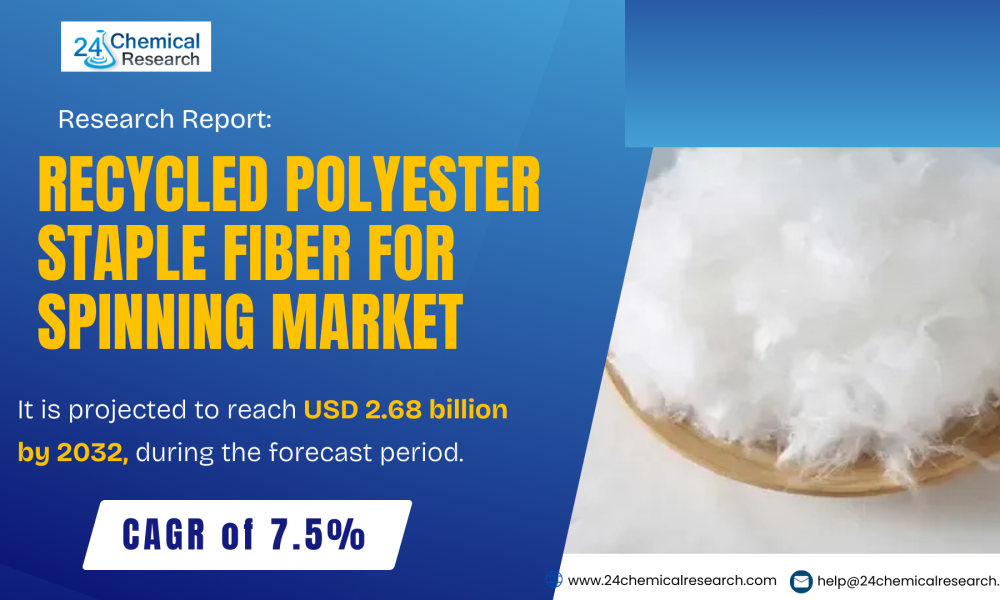
Global Recycled Polyester Staple Fiber for Spinning Market is experiencing robust growth, valued at USD 1,236 million in 2023 and projected to reach USD 1,682.03 million by 2032, expanding at a CAGR of 4.50%. This upward trajectory reflects the textile industry’s accelerating shift toward sustainable materials, driven by both regulatory pressures and evolving consumer preferences.
Recycled polyester staple fiber transforms post-consumer PET waste into versatile textile-grade fibers, offering manufacturers an eco-conscious alternative without compromising performance. Major brands increasingly adopt this solution to meet ambitious sustainability targets, particularly in apparel and home furnishings. The technology has advanced significantly, now matching virgin polyester in quality while reducing energy consumption by 30-50% in production.
Download FREE Sample Report: https://www.24chemicalresearch.com/download-sample/286750/global-recycled-polyester-staple-fiber-for-spinning-forecast-market-2025-2032-426
Recent News & Developments
- Supply agreements & expansion
- Swedish recycler Syre (backed by H&M) has struck partnerships with U.S. retailers Gap and Target to supply recycled polyester. They aim to produce over 3 million metric tons of recycled polyester by 2032, using used garments as feedstock.
- Fashion brand Ganni inked a four‑year offtake deal with Ambercycle (a US startup) to use Cycora, a recycled‑polyester material derived from post‑consumer textile waste, committing part of their polyester use to it.
- Regulatory / sustainability pressure increasing
- More brands are under pressure via consumer demand, regulations, or ESG (environment, social, governance) goals to incorporate recycled content. For example, retailers want traceability in supply chains and are signing longer‑term contracts with recyclers to ensure supply and visibility. (From multiple sources summarizing recent agreements)
- Increased capacity expansions: recyclers are investing in new facilities, e.g. for converting PET bottles or textile waste into high‑quality feedstock for spinning.
- Technological improvements
- Advances in sorting, cleaning, and chemical recycling are helping produce recycled polyester with higher purity, less contamination, and more consistent properties. This helps make RPSF more competitive with virgin polyester for demanding spinning applications.
- Efforts to enable recycling of mixed‑fiber textile waste (not just PET bottles) are being scaled up. For example, Ambercycle’s Cycora is derived from post‑consumer textile waste; separation technologies are improving.
- Demand dynamics
- Growing demand from both apparel/fashion and non‑apparel sectors (home textiles, automotive, upholstery, etc.) for sustainable fibers.
- Brands are increasingly using certifications (e.g. GRS – Global Recycled Standard) to assure recycled content and traceability. This is more than greenwashing: it’s a requirement for many buyers now.
Market Overview & Regional Analysis
Asia-Pacific commands 58% of global production capacity, with China alone recycling over 7 million metric tons of PET annually. The region’s dominance stems from established textile hubs in India, Vietnam, and Indonesia integrating recycled fibers into export-oriented manufacturing. However, collection infrastructure varies significantly, creating supply chain complexities.
Europe showcases the most mature regulatory landscape, with the EU Circular Economy Action Plan mandating 25% recycled content in PET products by 2025. North America follows closely, where brand-led initiatives like Patagonia’s 100% recycled polyester lines drive adoption. Emerging markets in Latin America and Africa present untapped potential but require substantial investment in waste management systems.
Key Market Drivers and Opportunities
Three disruptive forces are reshaping the industry: First, extended producer responsibility (EPR) laws in 34 countries now hold brands accountable for product lifecycles. Second, technology breakthroughs in chemical recycling enable fiber-to-fiber regeneration without quality loss. Third, fast-fashion giants like H&M and Zara have pledged to double recycled polyester usage by 2026.
Emerging applications in technical textiles (automotive interiors, geotextiles) and non-wovens (hygiene products, filtration) present lucrative growth avenues. The automotive sector alone is projected to increase recycled fiber consumption by 12% annually through 2030, driven by lightweighting requirements and OEM sustainability mandates.
Challenges & Restraints
Feedstock volatility remains the Achilles’ heel – fluctuating PET bottle collection rates create pricing instability. Contamination issues in post-consumer waste often force manufacturers to blend virgin materials, undermining sustainability claims. Furthermore, recent anti-dumping duties on Chinese recycled fibers (up to 25% in the US) disrupt global trade flows.
Quality perceptions persist as a barrier in premium segments, where brands hesitate to substitute high-tenacity virgin fibers. The industry also faces a credibility crisis due to widespread greenwashing, with only 14% of “recycled” claims being fully verifiable according to Textile Exchange audits.
Market Segmentation by Type
- Mechanically Recycled Fiber
- Chemically Recycled Fiber
Download FREE Sample Report: https://www.24chemicalresearch.com/download-sample/286750/global-recycled-polyester-staple-fiber-for-spinning-forecast-market-2025-2032-426
Market Segmentation by Application
- Apparel (Sportswear, Outerwear)
- Home Textiles (Bedding, Upholstery)
- Industrial Textiles
- Personal Protective Equipment
- Automotive Interiors
Competitive Landscape
Innovation leaders are redefining industry standards:
- Unifi (REPREVE® fibers) achieved 40% energy reduction through proprietary waterless dyeing
- Martex Fiber launched traceable PCR fibers with blockchain verification
- Aquafil’s ECONYL® regenerates nylon waste into premium fibers
- Asian producers like Jiangyin Chemical Fiber dominate commodity segments through vertical integration
Report Scope
This 325-page analysis provides granular insights across:
- Capacity expansions at 78 recycling facilities worldwide
- Comparative analysis of mechanical vs chemical recycling economics
- Impact of EU Green Claims Directive on fiber labeling
- Patent analysis of 140 innovations in fiber modification
The report equips strategic planners with:
- Plant-by-plant production data through 2032
- Break-even analysis for recycling investments
- Regulatory change impact assessments
- Supplier benchmarking across 18 parameters
Get Full Report Here: https://www.24chemicalresearch.com/reports/286750/global-recycled-polyester-staple-fiber-for-spinning-forecast-market-2025-2032-426
Emerging Technologies
Depolymerization breakthroughs are overcoming traditional limitations – Eastman’s molecular recycling achieves 93% yield rates for textile waste. Biomimetic fiber engineering enhances moisture management without chemical treatments. Digital twins now optimize recycling plant operations, reducing yield losses by 18-22%.
Investment Trends
Private equity poured $2.3 billion into fiber recycling ventures in 2023 alone. Notable deals include Carlyle’s $700 million stake in Verdeco and Breakthrough Energy Ventures backing Circ’s chemical recycling platform. Infrastructure funds are financing regional collection hubs to secure feedstock – a critical bottleneck.
Future Outlook
By 2027, recycled fibers will capture 28% of the polyester staple market, propelled by:
- Textile-to-textile recycling mandates in California and France
- ISO 14090 certification requirements for circular content
- Carbon pricing mechanisms valuing recycled fiber’s 75% lower footprint
About 24chemicalresearch
Founded in 2015, 24chemicalresearch has rapidly established itself as a leader in chemical market intelligence, serving clients including over 30 Fortune 500 companies. We provide data-driven insights through rigorous research methodologies, addressing key industry factors such as government policy, emerging technologies, and competitive landscapes.
- Plant-level capacity tracking
- Real-time price monitoring
- Techno-economic feasibility studies
With a dedicated team of researchers possessing over a decade of experience, we focus on delivering actionable, timely, and high-quality reports to help clients achieve their strategic goals. Our mission is to be the most trusted resource for market insights in the chemical and materials industries.
International: +1(332) 2424 294 | Asia: +91 9169162030
Website: https://www.24chemicalresearch.com/




