
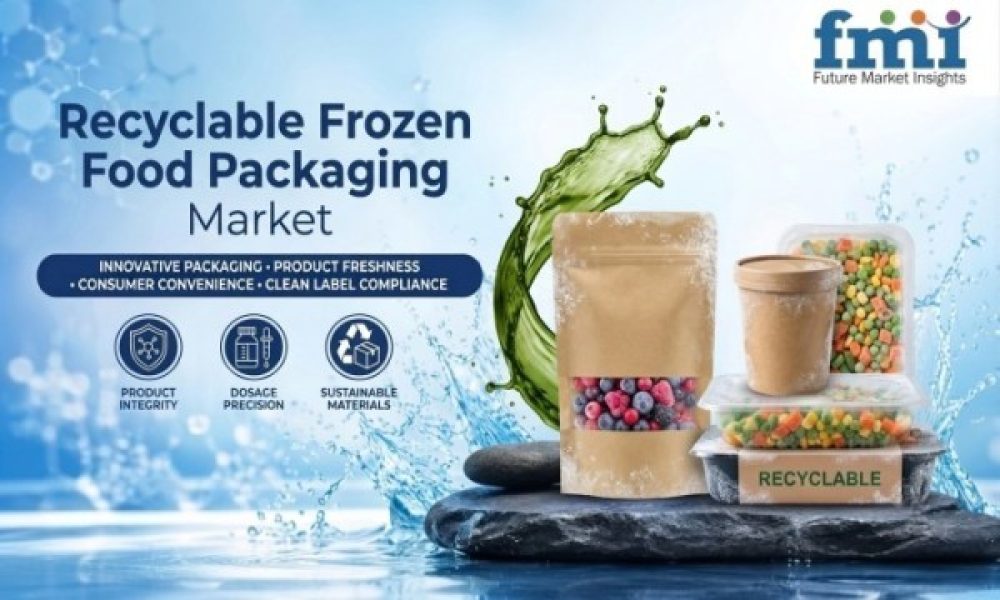
The global Recyclable Frozen Food Packaging Market is projected to grow from USD 1,647.8 million in 2026 to USD 3,241.5 million by 2036, registering a 7.0% CAGR during the forecast period, according to Future Market Insights (FMI). Growth is being shaped by stricter recyclability requirements, increasing scrutiny of packaging recovery routes, and the need to maintain freezer performance and production efficiency.
The European Commission brought the Packaging and Packaging Waste Regulation into force in February 2025, making recyclability an increasingly relevant packaging specification for European frozen-food processors. Companies evaluating replacement structures must balance recycling requirements with barrier protection, seal integrity, freezer durability, and high-speed filling performance.
Get detailed market forecasts, competitive benchmarking, and pricing trends:
https://www.futuremarketinsights.com/reports/sample/rep-gb-34704
Recyclability Becomes Part of Frozen-Food Packaging Qualification
Packaging decisions are moving beyond basic product protection. Frozen-food processors increasingly need evidence that new structures can perform through cold storage and commercial production while also supporting an appropriate recovery route.
This is creating a more detailed qualification process for packaging suppliers and food manufacturers. Structures that offer recyclable characteristics still need to demonstrate reliable performance under cold-chain conditions. The report identifies qualification cycles as a key restraint because seals and barriers must remain effective at low temperatures without reducing packing-line efficiency.
Local recovery infrastructure also affects adoption. Brazil is forecast to expand at a 7.4% CAGR through 2036, compared with 5.6% in Japan. Differences in collection coverage can influence how fiber-based and plastic packaging formats are assessed during commercial qualification.
Dispersion-Coated Cartons Lead Product Type
Among product types, dispersion-coated cartons are estimated to account for 32.0% of the market in 2026. Their combination of carton stiffness and a thin barrier layer supports frozen-food applications where grease and moisture protection are required.
Dispersion coating is also projected to lead the barrier technology segment, with a 40.0% share in 2026. The technology provides targeted barrier protection while retaining a fiber-led structure that can support established paper recovery routes.
Virgin paperboard is expected to hold 36.0% of material demand in 2026, supported by predictable fiber strength and consistent converting performance. These characteristics remain relevant for processors running repeated commercial volumes on high-speed equipment.
Direct OEM supply is forecast to lead the sales channel category with a 52.0% share in 2026. Direct relationships can help packaging suppliers and processors coordinate filling-line trials, machine settings, artwork changes, and recurring production requirements.
Regulatory and Technical Requirements Create New Opportunities
Regulation is one of the key forces changing material selection. Regulation (EU) 2025/40 includes a 10% recycled-content requirement by 2030 for specified contact-sensitive non-PET plastic packaging. This encourages processors to evaluate mono-material and fiber-based alternatives against both technical requirements and recovery pathways.
At the same time, cold-chain qualification remains a practical barrier. Packaging must maintain seals and barriers under low-temperature conditions while operating at commercial filling speeds. This increases the value of suppliers that can provide application testing, recyclability documentation, and structures compatible with existing production equipment.
The report identifies line-ready recyclable structures as an opportunity for packaging companies. Formats that can move through established equipment with limited changes may shorten implementation cycles and reduce disruption during conversion.
Regional Growth Remains Uneven
Brazil leads the profiled countries with a 7.4% CAGR, followed by the United Kingdom at 6.9%, Germany at 6.8%, the United States at 6.4%, and Japan at 5.6%.
The differences reflect variations in packaging regulation, collection infrastructure, technical qualification, and market conditions. In the United States, for example, differing state requirements can complicate the development of one packaging specification across national processor networks. In Japan, collection coverage varies between packaging categories, requiring disposal evidence to be considered alongside freezer performance.
Analyst Perspective
“Frozen-food processors should compare recovery evidence with freezer durability and line behavior before approving a new structure. Commercial advantage favors companies that shorten trials and document recycling acceptance without forcing costly equipment changes.”
Nandini Roy Choudhury, Principal Consultant, Future Market Insights
Competitive Landscape
The competitive landscape includes fiber-board, carton, and recyclable flexible packaging platforms. Notable companies profiled include Stora Enso Oyj, Graphic Packaging, Smurfit Westrock, Billerud, Mondi, Huhtamaki, ProAmpac, and Coveris.
Recent developments include Mondi’s expanded food-packaging portfolio for deep-freeze applications, Huhtamaki’s recyclable and compostable ice cream cups, and ProAmpac’s USA patents covering R-2000 and R-2050 mono-material laminated technologies for frozen foods and other applications.
Report Scope
The FMI study covers product type, material, barrier technology, application, end use, sales channel, and region. The analysis spans North America, Latin America, Europe, East Asia, South Asia and Pacific, and the Middle East and Africa. The forecast period covers 2026 to 2036 and uses primary and secondary research with market triangulation.
Full Report: https://www.futuremarketinsights.com/reports/recyclable-frozen-food-packaging-market
FMI Custom Research: Strategic Intelligence for Confident Decision-Making
In today’s rapidly evolving business environment, leadership teams need more than market data—they need clear, actionable intelligence tailored to their strategic objectives. FMI’s Custom Research solutions are designed around the specific business questions organizations need answered, enabling executives to evaluate growth opportunities, validate investments, assess competitive dynamics, and reduce uncertainty before making critical decisions. By combining deep industry expertise, primary research, and proprietary market intelligence, FMI delivers insights that help organizations move from assumptions to evidence-based strategies with greater speed and confidence.
Business Impact
FMI helps organizations transform market complexity into strategic clarity, enabling leadership teams to identify growth opportunities faster, optimize resource allocation, strengthen competitive positioning, and make high-stakes business decisions with confidence.
To explore how FMI Custom Research can support your strategic priorities, please connect with our team at – [email protected]
About Future Market Insights (FMI)
Future Market Insights, Inc. (FMI) is an ESOMAR-certified, ISO 9001:2015 market research and consulting organization, trusted by Fortune 500 clients and global enterprises. With operations in the U.S., UK, India, and Dubai, FMI provides data-backed insights and strategic intelligence across 30+ industries and 1200 markets worldwide.



