
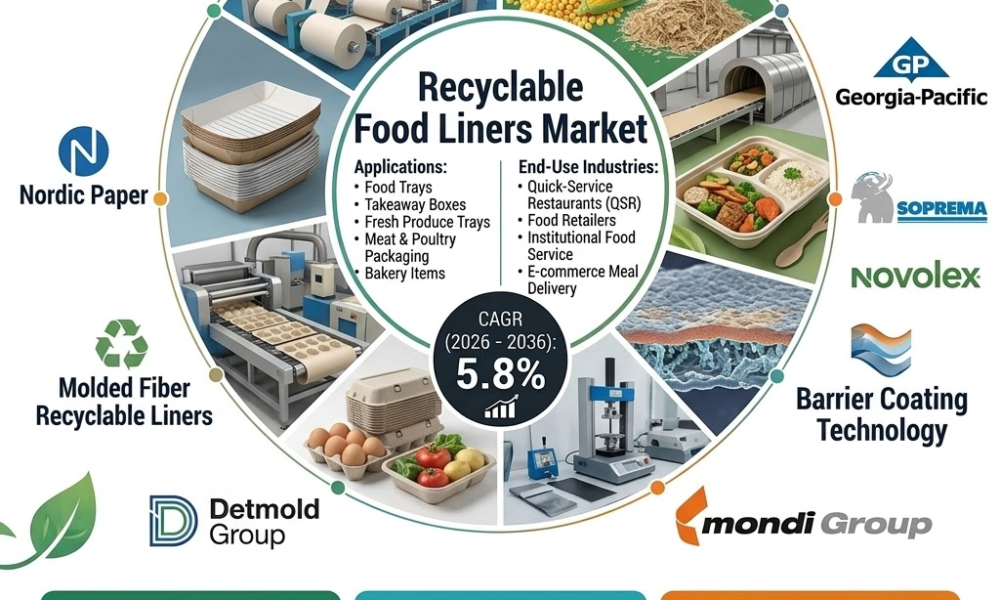
Recyclable Food Liners Market – The global recyclable food liners market is projected to grow from USD 1.2 billion in 2026 to USD 2.1 billion by 2036, registering a 5.8% CAGR during the forecast period, according to Fact.MR. The market reached USD 1.1 billion in 2025 as foodservice operators revised barrier specifications and increased attention to food-contact performance and recovery routes.
The market is expected to create an absolute opportunity of USD 0.9 billion by 2036. Demand is being shaped by the need for grease and moisture control while maintaining established food packaging formats and supporting recycling requirements.
Get detailed market forecasts, competitive benchmarking, and pricing trends https://www.factmr.com/connectus/sample?flag=S&rep_id=15825
Foodservice remains a key demand center
Restaurant chains require liners that control grease without changing established cartons, serving baskets, and takeout formats. Food processors also require liners that can withstand filling and holding when used with oily or moist foods.
Converters are evaluating sheets for print quality, cutting, folding, and high-speed packing operations. At the same time, retail and procurement teams are placing greater emphasis on documented recovery routes as packaging disposal claims face closer scrutiny.
Foodservice is forecast to account for 56.0% of the market in 2026, making it the leading end-use segment. Quick-service restaurants are expected to represent 38.0%, supported by repeated serving and takeout routines.
Recyclable greaseproof paper leads material demand
Recyclable greaseproof paper is projected to account for 40.0% share in 2026. Its position is supported by low weight, flexible converting, and grease-control requirements across foodservice formats.
Box-carton liners are expected to hold 34.0% share of the product type segment in 2026. These liners separate food-contact protection from the structural carton, allowing foodservice operators to manage barrier requirements without redesigning the complete package.
Grease-resistant designs are anticipated to capture 44.0% share by barrier treatment in 2026. Visible oil staining and leakage risks continue to influence liner specifications, particularly across foodservice applications.
Direct-OEM programs are projected to account for 43.0% share of sales channels. Controlled specifications, long-term supply agreements, and requirements for consistent sizing and food-contact compliance support this channel.
Regulatory and recovery considerations influence specifications
PFAS-free barrier reformulation is one factor supporting adoption across food-contact applications. The supplied report notes that the February 2024 U.S. phase-out changed greaseproof specifications and increased the importance of documented chemistry before restaurant trials.
In January 2025, the FDA ended 35 PFAS food-contact notifications affecting paper packaging during the compliance transition.
Packaging recyclability rules are also influencing product development. The report identifies Regulation (EU) 2025/40 as a factor favoring liner structures that fit recognized paper streams while maintaining foodservice performance.
However, recovery remains uneven. Collection programs can treat coated and food-soiled paper differently across restaurant locations and municipal systems. Food and coating residue can also affect recovered-fiber quality.
Regional markets show varied growth patterns
India is projected to record an 8.2% CAGR, supported by formal reporting and wider use of paper packaging materials. China is estimated to post a 7.4% CAGR, driven by catering scale and takeout containers.
Brazil is anticipated to register a 6.3% CAGR, while the United Kingdom is forecast to expand at 6.1% CAGR. Germany is expected to advance at 5.5% CAGR, supported by established paper recovery and structured packaging compliance.
The market also continues to see development in barrier materials. In March 2026, UPM and Paramelt introduced a recyclable food-packaging concept using barrier paper and a bio-based heat-seal coating.
Industry priorities extend beyond recyclability claims
The report highlights the need to test liners under actual menu temperatures and holding periods before national restaurant approval. Food processors are advised to compare barrier weight and migration records before approving grades for high-output lines.
Converters also need to document repulpability and print performance across collection systems with different coated-paper rules. For liner suppliers, the ability to run grease barriers on existing equipment while maintaining a credible recovery route remains an important qualification factor.
Principal Consultant at Fact.MR, Shambhu Nath Jha, states: “Recyclable liner demand depends on proven barrier performance and practical recovery routes. Adoption is expected to favor formats that protect greasy foods without disrupting existing restaurant equipment.”
Competitive landscape
The competitive environment includes integrated converters, specialty paper producers, and fiber packaging platforms. Key companies profiled in the market include Huhtamaki, Novolex, Detmold Group, Mondi Group, Stora Enso, Nordic Paper, and Georgia-Pacific.
Huhtamaki and Detmold Group provide direct foodservice conversion coverage, while Mondi Group and Stora Enso strengthen fiber barrier material capabilities. The report also identifies competition between Huhtamaki and Novolex with Detmold Group across finished formats and direct restaurant service.
Report scope
The Fact.MR study covers recyclable food liners used inside food packaging to control grease or moisture while retaining a recycling route. The analysis covers material, product type, barrier treatment, application, end use, sales channel, and regional markets.
The study draws on 120+ sources, 35+ company portfolios, 25+ countries, and more than 20 industry interviews. Primary research includes manufacturers, technology developers, distributors, procurement teams, end users, and subject-matter experts.
To view related Reports
About (FACT MR)
Future Market Insights, operating as FACT MR, provides market intelligence and research covering industries, technologies, products, and evolving business sectors. Its research combines primary interviews, desk research, market sizing, forecasting, and data validation to support business and strategic decision-making.



