
The global Recyclable Bakery Wraps Market is projected to grow from USD 276.3 million in 2026 to USD 548.6 million by 2036, registering a 7.1% CAGR during the forecast period, according to Future Market Insights.
The market is gaining as bakery brands and packaging suppliers reassess paper structures used for direct food packaging. The commercial focus is shifting toward wraps that can provide grease and moisture protection while also offering credible recovery pathways.
Regulatory developments are an important part of this change. In January 2025, the FDA made 35 PFAS-related food-contact notifications ineffective for grease-proof paper coatings, increasing attention on alternative grease-resistant structures.
>> Get Detailed Market Forecasts, Competitive Benchmarking, and Pricing Trends: https://www.futuremarketinsights.com/reports/sample/rep-gb-34680
Uncoated Paper Wraps Lead Product Demand
Uncoated paper wraps are projected to account for 36.0% of product-type demand in 2026.
Their relatively simple fiber construction can reduce conversion complexity and make them suitable for bakery products that do not require intensive moisture control.
However, the absence of a complex barrier does not remove the need for qualification. Oily bakery products still require verified grease protection, particularly during routine retail packing and foodservice handling.
The commercial opportunity therefore depends on matching the paper construction to the product rather than applying one wrap specification across every bakery application.
Virgin Fiber Holds a 42.0% Material Share
Virgin fiber is expected to represent 42.0% of material demand in 2026.
Consistent pulp quality provides a controlled substrate for food-contact applications and can support repeatable coating, printing and sealing trials.
For bakery packaging, mechanical consistency is also important. Thin flexible paper needs to retain sufficient strength during filling, folding and closure while maintaining the required barrier performance.
Ahlstrom’s March 2025 launch of LamiBak Flex, based on 100% responsibly sourced wood pulp, illustrates the continued development of recyclable food-packaging papers with natural grease resistance.
Grease Barrier Remains the Core Functional Requirement
Grease barriers are projected to account for 38.0% of barrier demand in 2026.
Pastries and other prepared bakery products can release oil during display and service. A wrap therefore needs to limit oil migration without creating unnecessary complications for paper recovery.
This creates a technical trade-off.
More barrier can improve product protection, but excessive coatings may increase pulping rejects. Packaging engineers increasingly need to evaluate the complete converted wrap, rather than treating the paper substrate and barrier system as separate decisions.
Koehler Paper’s April 2026 introduction of NexPlus OGR, a PFAS-free grease-resistant paper solution, demonstrates the industry’s focus on combining grease resistance with recyclability.
Direct/OEM Supply Supports Qualification
Direct/OEM supply is projected to account for 38.0% of sales-channel demand in 2026.
Direct relationships can be valuable when bakery groups require custom dimensions, specific barrier performance or compatibility with installed wrapping equipment.
The advantage extends beyond procurement.
A direct technical relationship can coordinate print changes, line trials, material adjustments and recurring supply through a single commercial program.
This becomes especially relevant as bakery companies move from small sustainability trials toward standardized packaging specifications across multiple locations.
👉 Access the Complete Report in PDF Format: https://www.futuremarketinsights.com/reports/brochure/rep-gb-34680
Recyclability Must Be Proven at the Complete-Format Level
One of the market’s main challenges is that a paper wrap cannot be considered recyclable simply because its base material is paper.
Coatings, windows, adhesives and other components can influence pulping and screening performance.
Cepi published version 3 of its recyclability laboratory test method in March 2025, providing a method that simulates pulping and screening conditions used in conventional mills.
For bakery packaging teams, this reinforces the importance of testing the final converted structure.
The question is not only whether the paper can be recycled. It is whether the actual wrap configuration can enter the intended recovery route with acceptable performance.
Heat-Sealable Paper Creates a New Opportunity
Heat-sealable paper formats offer an opportunity to reduce conversion friction.
Seaman Paper launched heat-sealable curbside-recyclable paper packaging in September 2025 designed to work with most form-fill-seal and horizontal flow-wrapper equipment.
This is commercially important because bakery brands may be able to adopt paper formats without rebuilding installed machinery.
Line compatibility can therefore become an important factor in converting a sustainability objective into a practical packaging change.
Regional Growth
Brazil is projected to record the fastest CAGR among the profiled countries at 7.5%, followed by the United Kingdom at 7.0%, Germany at 6.9%, the USA at 6.5%, and Japan at 5.7%.
Brazil’s reverse-logistics environment is increasing the importance of recovery documentation for national bakery accounts.
In the UK, standardized workplace paper-collection requirements provide organized bakery and foodservice locations with clearer disposal routes.
Germany combines mature collection infrastructure with stricter requirements around evidence for coated paper formats.
The US market benefits from established paper recovery systems, although state-level labeling requirements can complicate uniform disposal claims.
Japan’s municipal collection systems make locally verified disposal guidance particularly important for bakery chains operating across different prefectures.
Competitive Landscape
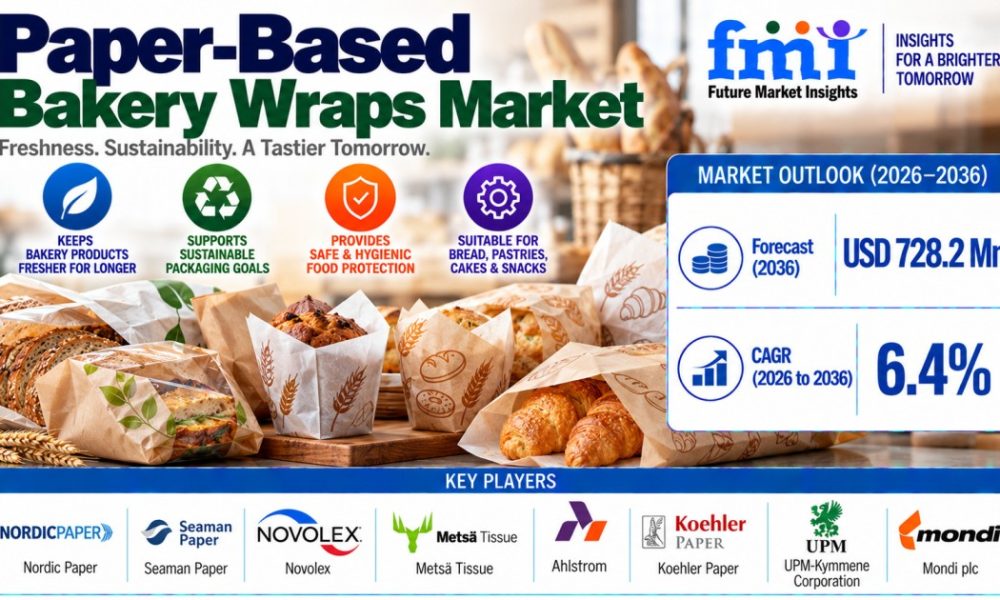
The competitive landscape includes Mondi, Sappi, Nordic Paper, Ahlstrom, Seaman Paper, Novolex, Metsä Group and Koehler Paper.
Competition spans functional barrier-paper platforms, greaseproof paper specialists and converted foodservice packaging.
Mondi and Sappi combine food-contact substrates with barrier and sealing capabilities. Nordic Paper and Metsä Group have strong positions in greaseproof paper. Ahlstrom and Koehler Paper bring specialty-material capabilities, while Seaman Paper and Novolex add converting and foodservice channel coverage.
Recent developments include Mondi’s August 2025 ramp-up of FunctionalBarrier Paper Ultimate production at Solec, Ahlstrom’s May 2025 inauguration of a new parchmentizer at Saint-Séverin, and Novolex’s April 2025 completion of its combination with Pactiv Evergreen.
Outlook
The Recyclable Bakery Wraps Market is moving toward paper structures that combine food-contact compliance, grease protection, machine compatibility and documented recovery performance.
For bakery brands, the strongest commercial proposition is not simply a paper wrap with a recyclable label. It is a format that performs consistently on the line, protects the food and provides credible disposal guidance across the locations where it is used.
Nandini Roy Chaudhary, Principal Consultant at Future Market Insights, states:
“Bakery groups should compare a recyclable wrap on sealing speed and grease holdout before treating paper content as a purchasing advantage.”
The market’s next stage will therefore be driven by complete-format qualification rather than material claims alone.
To explore how FMI Custom Research can support your strategic priorities, connect with our team at – [email protected]
About Future Market Insights (FMI)
Future Market Insights, Inc. is an ESOMAR-certified, ISO 9001:2015 market research and consulting organization trusted by Fortune 500 companies. With a global presence across the U.S., UK, India, and Dubai, FMI delivers data-driven insights across 30+ industries and 1200 markets worldwide.



