
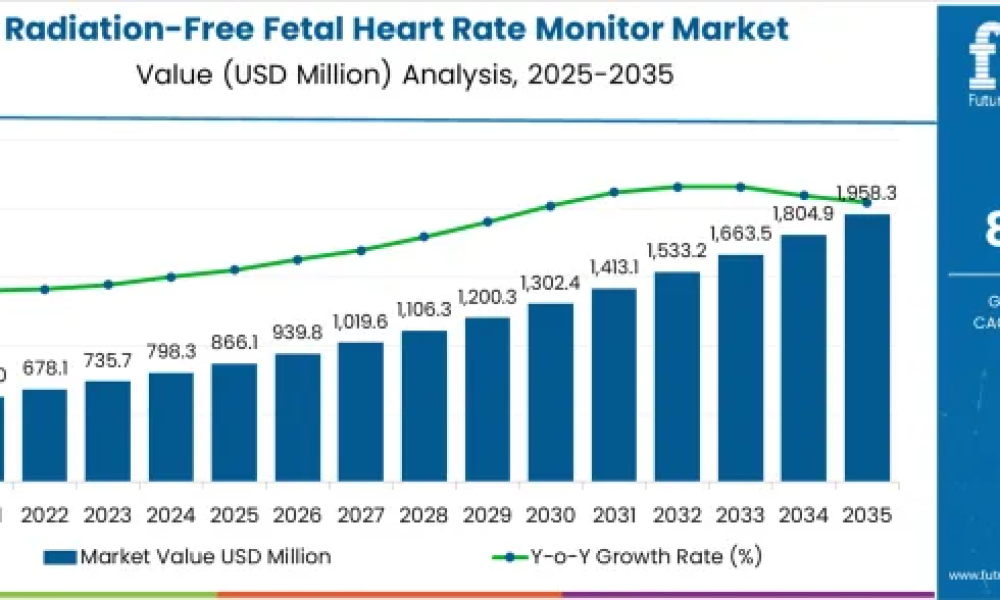
Future Market Insights (FMI), a leading provider of market intelligence and consulting services, today released its comprehensive report on the radiation-free fetal heart rate monitor market is emerging as a beacon of innovation in prenatal healthcare. According to the latest comprehensive analysis from Future Market Insights (FMI), the global market is valued at USD 866.1 million in 2025 and is projected to surge to USD 1,958.3 million by 2035, achieving a robust compound annual growth rate (CAGR) of 8.5%. This absolute growth of USD 1,092.2 million underscores a transformative shift toward non-invasive, risk-free monitoring solutions that prioritize accuracy without compromising safety.
The market’s trajectory reflects a broader industry commitment to preventive healthcare and technological advancement. As awareness of radiation exposure risks during pregnancy intensifies, healthcare providers and expectant parents are increasingly turning to radiation-free alternatives like Doppler ultrasound and photoelectric sensors. These devices offer real-time, precise fetal heart rate detection, eliminating the hazards associated with traditional methods. “This market isn’t just growing—it’s evolving to meet the demands of a health-conscious world,” said a leading industry analyst at FMI. “With birth rates climbing in developing regions and investments pouring into healthcare infrastructure, we’re witnessing a paradigm shift that empowers safer pregnancies globally.”
Driving Forces Behind the Boom
Several key drivers are fueling this expansion. Heightened public awareness of radiation’s potential dangers has spurred demand for non-invasive tools, particularly in premium healthcare segments where patient safety is paramount. Technological breakthroughs, such as advanced Doppler systems with digital signal processing for noise filtering and photoelectric sensors integrated with mobile apps, are enhancing usability and accessibility. Government initiatives worldwide are promoting maternal health, with expanded insurance coverage for prenatal services accelerating adoption.
In developing economies, rising birth rates and healthcare infrastructure investments are creating fertile ground for growth. For instance, preventive care emphasis and early detection of fetal complications are driving uptake in clinics and homes alike. However, challenges persist: high initial costs, technical training requirements, and regulatory hurdles could temper progress in resource-limited areas. Maintenance expenses and rural infrastructure gaps also pose barriers, yet industry leaders are countering these through innovative, cost-effective designs and strategic partnerships.
Market Segmentation: Doppler Leads the Charge
Breaking down the market by product type, Doppler fetal heart rate monitors dominate with a 60% share in 2025, thanks to their portability, early detection capabilities, and proven reliability in clinical settings. Photoelectric sensor monitors are gaining traction for home use, offering wearable, app-connected solutions that appeal to tech-savvy parents. Other non-invasive technologies round out the segment, catering to niche applications.
By end-user, clinics hold a commanding 65% market share, supporting routine prenatal check-ups with multi-patient functionality and seamless record-keeping. The home-use segment is expanding rapidly, driven by portable devices that enable self-monitoring and telemedicine integration. Additional users include wellness centers and research facilities, broadening the market’s reach.
Regionally, Asia-Pacific stands out for its high potential, with China leading at an 11.5% CAGR due to healthcare reforms and a burgeoning middle class. India follows closely at 10.6%, propelled by population growth and urban infrastructure in cities like Mumbai and Delhi. In Europe, Germany achieves a 9.8% CAGR through medical innovation and stringent quality standards. North America, particularly the United States at 8.1%, benefits from advanced infrastructure and insurance support, while Brazil (8.9%) and the United Kingdom (7.2%) highlight Latin American and European momentum. Japan, with a 6.4% CAGR, focuses on precision and demographic needs amid an aging population.
Emerging Trends and Opportunities
Industry trends are reshaping the landscape, with artificial intelligence (AI) integration enabling predictive analytics and automated risk assessments. Portable, smartphone-compatible devices are democratizing access, allowing real-time monitoring via wireless connectivity and cloud-based platforms. User-friendly designs are bridging clinical and home environments, while partnerships between manufacturers and providers are fostering telemedicine ecosystems.
Opportunities abound: Doppler monitors in clinics could unlock USD 400-420 million in markets like India and China, while photoelectric home devices target USD 280-300 million in Germany, the USA, and Japan. Portable solutions for emerging regions offer USD 200-220 million potential, and smart IoT/AI ecosystems add USD 120-140 million. Specialty applications round out with USD 70-80 million, emphasizing the market’s versatility.
Subscribe for Year-Round Insights → Stay ahead with quarterly and annual data updates: https://www.futuremarketinsights.com/reports/brochure/rep-gb-26807
Request for Discount: https://www.futuremarketinsights.com/reports/sample/rep-gb-26807
Competitive Edge: Leaders Paving the Way
The competitive arena features powerhouses like Philips, known for professional-grade solutions; Beurer, excelling in consumer-friendly devices; and Dräger, specializing in hospital integrations. Medtronic leads with AI-enabled platforms, while Nihon Kohden and Huntleigh Healthcare focus on precision prenatal tools. Emerging players such as Babyfun, CONTEC, Banglijian, Yuwell, Cofoe, and Cosonic Intelligent are innovating in cost-effective, niche areas. Strategies include heavy R&D investment in sensors and wireless tech, alongside expansions into diverse channels for broader penetration.
“This report highlights a market ripe for disruption,” noted the FMI analyst. “For industry leaders, it’s a call to action—invest in AI, portability, and partnerships to capture this 2.26x growth opportunity over the next decade.”
As the radiation-free fetal heart rate monitor market accelerates, it promises not only economic gains but also profound impacts on global maternal health. Stakeholders—from manufacturers to policymakers—are urged to align with these trends to ensure safer, more accessible prenatal care for generations to come.
About Future Market Insights (FMI)
Future Market Insights, Inc. (FMI) is an ESOMAR-certified, ISO 9001:2015 market research and consulting organization, trusted by Fortune 500 clients and global enterprises. With operations in the U.S., UK, India, and Dubai, FMI provides data-backed insights and strategic intelligence across 30+ industries and 1200 markets worldwide.
Why FMI: Decisions that Change Outcomes- https://www.futuremarketinsights.com/why-fmi
Contact Us:
Future Market Insights Inc.
Christiana Corporate, 200 Continental Drive,
Suite 401, Newark, Delaware – 19713, USA
T: +1-347-918-3531
Website: https://www.futuremarketinsights.com
LinkedIn| Twitter| Blogs | YouTube
Have a specific Requirements and Need Assistant on Report Pricing or Limited Budget please contact us – [email protected]



